Showing posts with label Flaubert. Show all posts

Monday, 30 March 2015

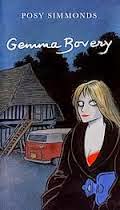
Gemma Bovery


I first learned of Gemma Bovery the book via the film. My friend Sim at Chapter 1 Take 1 featured the film trailer in September last year. Naturally, I was immediately smitten with the trailer. So funny, so fun. Soon I was discovering that the film was based on a 1999 graphic novel. Naturally I ordered it online immediately. The film is finally screening in Australia as part of the Alliance Française French Film Festival this year, not that I'll get to see it there, but I need to be prepared to see the film, so I grabbed an opportunity to read the book when I was in Newcastle for the Newcastle Writer's Festival last weekend.

I was drawn in by the very first sentence.

Gemma Bovery has been in the ground three weeks. 

Ok, you have my attention!


Our narrator is Raymond Joubert, a middle aged man who is now running the family bakery in a small town in Normandy. Raymond has full access to Gemma's diaries after her death, and he narrates from reading her diaries, and also his own observations of the events since the Bovery's moved to France. Set in both Normandy and London, the present and the near past Gemma Bovery is a fascinating modern riff on Flaubert's masterpiece Madame Bovary. I have read Madame Bovary but a number of years ago, so that while I remember broad brush strokes of action, I don't remember particular details. Joubert points out the parallels between the Bovery Bovary stories so that even those who weren't at all familiar with Madame Bovary would still find Gemma Bovery compelling.

And there are many parallels, so many affairs, so much heartache, accumulating debts and the gossiping nature of small town France. I've only read a handful of graphic novels but I do think that Gemma Bovery would be one of my favourites so far.

And it is laugh out loud funny at times.

I remarked her companion at once: an anglais, about 35, in breeding condition; an expensive linen jacket, his inside leg measurement much en valeur

It is written in an odd mix of English, French (sometimes translated, other times not) and Franglais. Posy Simmonds would appear to speak much better French than I do, she also has a great understanding of the French I think. I'm not sure how easy Gemma Bovery would be for someone with absolutely no French.
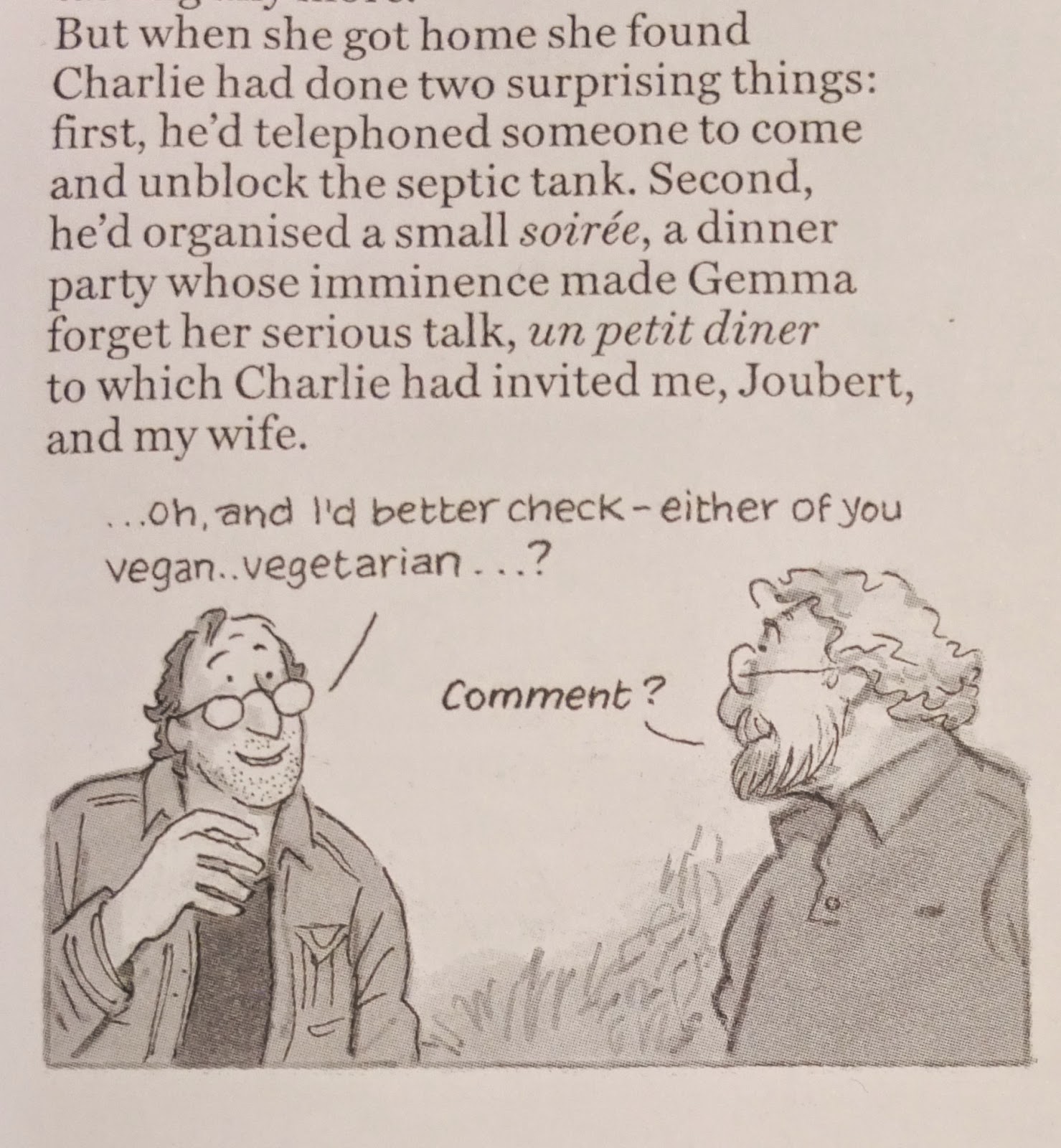

Gemma Bovery was apparently first published in The Guardian, which I find quite intriguing. Not that there is anything wrong with newspapers publishing cartoon strips, indeed they have quite a long tradition of exactly that. It's just that Gemma Bovery has what would be described in film or tv classifications nudity, sex scenes, language (I certainly learnt some new French words) and adult themes. I'm not sure it would get published in newspapers here. Perhaps it was in a somewhat different format then?

I found a rather intriguing youtube video of Posy Simmonds discussing Flaubert, and also the real life inspiration behind Gemma Bovery.


Posy also talks about the graphic novel format.

The pictures do all the work of description. They do everything, they do weather, they do landscape, they do details.

I'm really looking forward to seeing the movie.


Dreaming of France is a wonderful Monday meme
from Paulita at An Accidental Blog 

French Bingo 2015

Saturday, 12 November 2011

The Pedant in the Kitchen


I have a growing respect and admiration for Julian Barnes. We didn't get off to a good start because I read his England, England book first. And hated it so much I can't explain. The only reason I ever picked up another of his books was because I read and absolutely loved Gustave Flaubert's Madame Bovary. So I tentatively picked up Flaubert's Parrot. And loved it so much that I bought my own copy after I took the library copy back (I'd borrowed it expecting not to like it, and gave myself permission to stop reading it within the first few pages if I hated it- and I always make myself push on!) Anyway, I Absolutely Loved Flaubert's Parrot. And so I started to hope that perhaps England, England was an aberration.

Somewhere along the way I accumulated The Pedant in the Kitchen, and in an idle moment last night I picked it up. I've had a wonderful break in my scheduled reading over the past 10 days and have actually been able to pick up books on a whim! I've been very keen to read his recent Booker winner The Sense of an Ending, but have remained strong and not bought it yet.

The Pedant in the Kitchen appears to be a collection of 17 newspaper columns about Barnes' relative OCD nature  in the kitchen. He starts off telling us rather matter of factly that he is a late-onset cook. He didn't learn techniques and measurements at his mother's side as a young child. It was only as an adult, in his twenties that Julian was forced to try and prepare his own meals. With some initial disappointments of course. I think most of us go through that stage really. Wondering how your mother did very simple things, when it had just always appeared in a perfect form previously.

Julian isn't without ambition or hope in his cooking efforts though. He uses cookbooks, and relatively complicated ones at that and comes to take on some rather challenging dishes. Chocolate Nemesis from the first River Cafe Cookbook. A smoked haddock souffle from Margaret Costa's Four Seasons Cookery Book. Autumn Pudding (apparently much superior to Summer Pudding- with a mix of elderberries, blackberries and crab apples) from Susan Campbell's English Cookery New and Old. Jane Grigson's Salmon in Pastry with a Herb Sauce.

Julian wants things to be extremely precise whilst creating his haddock souffle. "Why should a cookbook be less precise than a manual of surgery?" He is an "anxious pedant" in the kitchen. Should that tablespoon of currants be heaped or rounded? In truth, I'm sure it matters not. I don't think Julian has ever truly heard, and certainly hasn't internalised the wisdom conveyed in the phrase "we're not building a piano".

I adhere to gas marks and cooking times. I trust instruments rather than myself. I doubt I shall ever test whether a chunk of meat is done by prodding it with my forefinger. The only liberty I take with a recipe is to increase the quantity of an ingredient of which I particularly approve. 
I think anxiety and lack of self confidence is the key here. You should never trust instruments more than your own judgement. In the kitchen, or in surgery as it turns out.

When not obsessed about minor details in the kitchen Julian takes us rather far and wide. The trial brought about by Oscar Wilde against the Marquess of Queensberry for criminal libel. Gustave Flaubert apparently not only admired camels in Egypt on his travels but he also ate some. However, his favourite delicacies were mandarins and oysters. And Mrs Beeton died at the unfortunately young age of 28, and so was not the dowager housekeeper we all imagine.

Julian has some interesting and useful thoughts on cookbooks, which I think I will leave for another post.


This post is linked to Weekend Cooking, a fabulous weekly meme at Beth Fish Reads.


Monday, 24 October 2011

The Art of Travel


Having just returned from Houston, it was a perfect time to stumble across this audio book on the shelf at the library. Travel does broaden the mind. Certainly Houston had surprised mine, and I was ready to contemplate travel more widely with de Botton. I've bought, but never read, Status Anxiety, although I might have watched the tv show. So I popped the CD into the player into the car. And steadied myself to be swept up in the joy of travel. How surprising to find that Alain starts with how disappointing travel is!

Few things are as exciting as the idea of travelling somewhere far from home. Somewhere with better weather, more interesting customs and more inspiring landscapes. So why are we so often dissatisfied with the reality of travel? Perhaps we should listen less to the guidebooks that tell us what to do when we get there, and learn to enjoy the journey. 

What? I'm sure glad I don't have to go on holidays with Alain. I already enjoy the journey Alain.

I'd expected The Art of Travel to be a journey of sorts, but I really wasn't expecting to be a journey to Gustauve Flaubert, William Wordsworth and Vincent Van Gogh, as much as it is a journey to Barbados and Amsterdam.

Much of Disc 2 was taken up with Flaubert, and I found it particularly fascinating. So much so that I listened to disc 2 twice. Flaubert wrote Madame Bovary of course, which was my introduction to French classic literature a couple of years ago. Astonishingly different to what was going on in England at the same time. How incredible to learn that if Flaubert had lived in my lifetime he would most likely have ended up committing a high school massacre as a teenager! His teenage self apparently wanted to blow the heads off the good citizens of Rouen as they passed by, and he had a particular enmity for the local Mayor.

Flaubert was very taken with the exoticism of Egypt, and I knew that he had famously travelled there. He was particularly taken with camels and spent quite some time trying to mimic their sounds! What a different experience travel must have been, to return home with just writings, drawings and the noises you could reproduce. I didn't realise that he was quite taken with examples of local colour such as donkeys shitting in cafes- which he apparently found quite appealing.

I learned more about Wordsworth than I ever had before. Not hard certainly as I don't think I knew anything except that he was a poet. He was born and worked in the Lake District of England, and he encouraged us to "see the many animals living alongside us whom we typically ignore, registering them only out of the corner of our eyes, having no appreciation for what they are up to and want".

We also journey to Provence with Van Gogh (in the news this week after speculation that he was murdered, excellent publicity for your new book) and to the lonely American highways, motels and petrol stations of Edward Hopper (who I had only learnt of from Shaun Tan back in May).

To me, Alain was telling us that all these famous thinkers and artists were telling us to notice the Detail of Travel, more than the Art. To see the colour as Van Gogh did, the birds as Wordsworth did, and the donkeys shitting in the corner of the cafe as Flaubert had.

How does Alain wrap up our rather esoteric travels? Alain makes his final journey in the last section accompanied by Xavier de Maistre in his fetching pink and blue cotton pyjamas. I'd not heard of Xavier before, but in 1794 he published a book called Voyage autour de ma Chambre (Voyage around My Bedroom), with the sequel Expedition Nocturne autour de ma Chambre (Night Voyage around My Bedroom). In his journey Xavier is apparently asking us to consider the detail of our daily lives, to shake off our habituation and the blinkers that blind us to the magnificence that is our own bed or chair. There is of course merit in noticing the joy of our everyday surroundings, and not being blind to the life that is already around us.
And yet de Maistre's work springs from a profound and suggestive insight: that the pleasure we derive from journeys is perhaps dependent more on the mindset with which we travel than non the destination we travel to. If only we could apply a travelling mindset to our own locales, we might find these places becoming no less interesting than the high mountain passes and butterfly-filled jungles of Humboldt's South America. 

Which is perhaps disingenuous to some extent. Some places are inherently more beautiful or captivating than others. There are reasons why Paris is the biggest tourist destination in Europe. The feeling of warm Parisian sun on your shoulder standing in Tuileries can not be recaptured whilst looking at your own loungechair, or filling your car with petrol at your local petrol station. I remember being shocked at the bored locals riding the metro. How can they be bored? Look depressed? In Paris?


And what of the audiobook itself? Again, as with Lance Armstrong's It's Not About the Bike, the reader struggles with the frequent references in other languages. Predominantly French, but he bumbles over a smattering of Spanish and German too. So much of The Art of Travel references paintings and visual splendour that I ended up borrowing the book version from the library too, needing to see the many illustrations that I knew this book would have.

It was certainly pleasant to listen to as I journeyed to and from work in the car each day. Although I must admit that his notion of man as "dust postponed" shook me up quite a bit. Just arriving in the car park to start another 10+ hours of work. And all you are is dust postponed. It's a discouraging start to the day. But when you think of the biblical dust to dust pronouncement, I guess that's what we are- dust postponed. Oh dear, I think I need to book another holiday.... and stop listening to philosophy in the car.

BTW Audiobooks are apparently a big craze now, with Hollywood jumping on board, but it's digital downloads that are cool, not people like me borrowing daggy old CDs to listen to in the car.

Friday, 21 May 2010

Flaubert's Parrot


I came to this book at the perfect time. I had just recently read and enjoyed Madame Bovary. Emma Bovary gave me my first introduction to 19th century French literature, and wow, Flaubert certainly wasn't anything like Jane Austen or The Brontes! I am now rather intrigued by Flaubert, son of a doctor, who clearly learnt a lot of contemporary medicine growing up at the Hotel- Dieu.

In Madame Bovary there's an amazing chapter describing the tenotomy that Charles Bovary performs on Hippolyte, the village stable hand who has been getting around perfectly well with his club foot. Sadly, Charles isn't much of a surgeon and the operation does not go well. The account of his further surgery is harrowing. In that chapter Flaubert makes mention of Ambroise Pare and Guillaume Dupuytren.

Flaubert's fascinating tale of Madame Bovary combined with the tantalising glimpses into the history of medicine made it almost compulsory for me to fall into the thrall of Flaubert. I'd heard of Flaubert's Parrot but never been particularly interested because I've read one Julian Barnes book before, the incredibly awful England, England which was somehow shortlisted for the Booker in 1998. So it was with some considerable trepidation that I borrowed this book from the library. Only to learn that it was based around the parrot that featured in A Simple Heart (Un Coeur Simple). So, I read that too before embarking on Flaubert's Parrot. Turns out I didn't really need to. Barnes' gives a two paragraph summary early on to explain why Flaubert needed to borrow a parrot from the Museum of Rouen to help in his writing of Un Coeur Simple.

Flaubert's Parrot has perhaps the most bizzare structure that I've ever come across in a novel. Indeed, it makes one wonder if this really is a novel. Barnes himself said that he wanted to mix of fact and fiction, elastic and capacious, and expected a small audience.

A great article from the Guardian.

Flaubert's Parrot makes us ponder why we should chase the writer? Because it's so damn interesting is my basic response I suppose. And Flaubert is a perfect case in point. I so wish that our upcoming trip to France could include Rouen. I would take Flaubert's Parrot with me to reread, and to walk the locations of the book, to gaze at the Hotel Dieu, to find the pictures of Flaubert. Last months Good Reading had a great article on the Flaubert trail in Rouen.

Writers are interesting in a way that actors for example can never be, IMHO. I can't understand why week after week newspapers are filled with articles about actors. When almost any other profession is more interesting in and of itself. And most of the magazines that fill the supermarkets one week and then landfills the next are choc full of articles about actors.

I think it was in this book that Braithwaite said that he was going to "save Virginia Woolf til he was dead". Sage advice, think I'll take that on board too. I fact I already have. Perhaps it should be one of my daily affirmations just in case I feel my resolve slipping.