Showing posts with label Victor Hugo. Show all posts

Friday, 28 December 2018

Les Misérables A Few Pages of History/ Quelques Pages d'histoire V4B1


Well this is a tough book to get through when you're trying to sprint to the end of the volume. A  Few Pages of History, yes. More like Five Chapters of History. Dense, intellectual history that I wish I knew enough to truly appreciate and understand. 


In (very fast) French
but with subtitles


The first five chapters of this book are a history lesson about the two years following the July Revolution of 1830. Much quieter than the well known French Revolution of 1789, the July revolution saw Louis-Philippe installed as King of the French. It seems Victor Hugo was quite the Louis-Philippe fan, even though he said that "the hour has not yet struck when history speaks in its venerable and impartial voice" to pass the "final verdict on this king". Yet he is "one of the best princes who ever sat  on a throne". "He was born a prince and believed that he had been elected king."

Louis-Philippe was a king of total transparency. While he reigned there was press freedom, parliamentary freedom, freedom of conscience and freedom of speech.
Louis-Philippe sounds a rather fascinating man. 
He was a bit of a builder, a bit of a gardener, a bit of a doctor. He bled a postilion who fell off his horse. Louis-Philippe went nowhere without his surgical knife, any more  than Henri III without his dagger. The royalists jeered at this ridiculous king, the first ever to shed blood as a cure. 
We now know of course that the last thing a horse rider needs after a fall, and presumably decent trauma is further blood loss, and we would do the exact opposite and transfuse them if required, but the 19th century was interesting times. 

There is just so much detail and knowledge jam packed into every sentence of this book. I have a particular fascination with Joan of Arc, and so I was most interested to read:

One of Louis-Philippe's daughters, Marie d'Orléans, won for her distinguished family's name a place among artists, as Charles d'Orléans had won for it a place among poets. She carved a statue of her soul and named it 'Joan of Arc'.
Fascinating! This statue still exists and is on display at Versailles. I've visited Versailles many times. I don't remember seeing this statue in particular, but will have to trawl through my photos sometime, as I always take a picture of any Joan statue that I see. I'd thought that I'd visited Versailles enough but perhaps I will need to return. It seems the original is marble and there are several bronze replicas about the place (New York, Orleans and Domrémy at least), and there is even a painting by Auguste Vinchon of Louis-Philippe visiting the statue that I now need to see. 


The royal family in front of the statue of Joan of Arc
Auguste Vinchon, 1848

Aaaah, If only I could get to Versailles before February 3 I could see the current exhibition Louis-Philippe and Versailles! Louis-Philippe turned Versailles into a museum, and now 32 rooms not normally open to the public will be open for this exhibition. (There is a magnificent 76 page Press Kit to download from that page for those of us stuck in the Southern Hemisphere, or otherwise not near Versailles)


This book is really quite philosophical as well. 

Some people have wanted wrongly to identify the bourgeoisie as a class. The bourgeoisie is simply the contented section of the people. The bourgeois is the man who now has time to sit down. A chair is not a caste. 
And I think gives us an insight into Victor Hugo's own vision of the future. 
Solve the two problems, encourage the rich and protect the poor, eliminate destitution, put an end to the unjust exploitation of the weak by the strong; curb the iniquitous envy, in the one who is making his way up, of the one who has arrived; set the wages for a job fairly and in the spirit of fellowship, foster the development of childhood with free compulsory education and make knowledge the foundation of manliness, develop minds while keeping hands busy; democratise property not by abolishing it but by making it universal, so that every citizen without exception may be a property owner, something easier to achieve than people think. In short, lean how to produce wealth and how to distribute it, and you will have both material greatness and moral greatness. And you will be worthy of calling yourself France. 
In chapter 6 Enjolras and His Lieutenants we once again get back to the narrative. Enjolras is assessing the strength of numbers.
How many are we?... Revolutionaries should always feel a sense of urgency, progress has no time to lose.
All quotes are from the 2013 Penguin Classics Deluxe Edition, translated by Christine Donougher. 

Thursday, 27 December 2018

Les Misérables V3 Marius


Oh dear. I've had such a bad reading (and blogging) year. I've been becalmed for months, and not just in Les Mis. I was so excited about the #LesMisReadalong at the start of the year. I really thought I could keep up with it. It seemed doable. Manageable. Even though I am notoriously bad at books over 500 pages I thought that tackling a chapter a day might help me get over the line on time. Well, nope.


I was stalled in May for a long time, and then managed to get caught up to August. Although sadly in the Real Life World it's December, and not August. It's not like I don't like Victor Hugo's writing- I really do. There is something quotable or profound on pretty much every page. I do still very much want to finish it, I don't want to DNF Les Mis. I'm always more optimistic about my reading capabilities than I will ever achieve in this life time (which goes much of the way to explaining my TBR) , so much so that it was only yesterday that I realised that I really wouldn't finish Les Mis in the allocated 2018 reading time. 


But last night I finished Volume 3, Marius, and now I'm going to make a last ditch effort and try to read V4 The Rue Plumet Idyll and The Rue St-Denis Epic before the end of the year. This is optimistic I know. Especially as I go back to work on Sunday, and have multiple social engagements to fit in too. 


Marius is of course very much the subject of his own volume. Despite qualifying as a lawyer Marius falls onto very hard times after his estrangement from his grandfather. 

Life became hard for Marius. Using his clothes and his watch for food was nothing. There was much worse he had to stomach. Terrible hardship, consisting of days without bread, nights without sleep, no candle in the evening, no fire in the hearth, weeks without work, a future without hope, a coat worn through at the elbows, an old hat that makes young girls laugh, a door found locked a night because the rent was not paid, the insolence of the doorman and the eating-house keeper, the sneering of neighbours, humiliations, dignity trampled underfoot, having to accept any kind of work, demoralisation, bitterness, despondency. 
We learn that "Marius was now a handsome young man of medium height, with thick jet-black hair, an intelligent high forehead, flared, sensuous nostrils, an air of sincerity and calm", and when he first sees a young girl sitting with an old man in the Luxembourg Gardens, she is "a slip of a thing of thirteen or fourteen years of age, so thin as to be almost ugly, awkward, unremarkable, but with some promise perhaps of having quite attractive eyes."

Having all my prior Les Mis knowledge based on the stage and movie versions I was quite surprised at this first description of teenage Cosette (not that Marius knows her name yet, and doesn't throughout this whole volume). Still, six months passes without Marius seeing the girl on the bench, and she has become quite changed when next he sees her. 

Only, when he came close, it was certainly the same man but it seemed too him it was no longer the same girl. The person he now saw was a tall and beautiful creature with all the loveliest of womanly curves at that very moment when they are still combined with all the most artless of childish graces. A fleeting and innocent moment that can only be conveyed by these three words: fifteen years old. 
Which almost sounds a bit creepy to the modern reader. Although Marius is a young man and he soon falls in love with Cosette merely by sight. I was delighted that there was some hanky dropping as in The Three Musketeers. 

Most of the rest of the volume is Marius trying to find Cosette again after having become too obvious and drawing her father's attention, and the rather dramatic events in the Gorbeau tenement when  Jondrette lures his benefactor into an ambush. There is much beauty in Hugo's prose about poverty and the misery of the 19th century French human condition. 

Cities, like forests, have their dens, and inside them lurks whatever they have that is most savage and fearsome. Only, in cities, what lurks there is ferocious, foul and small, that is to say, ugly. In forests, what lurks there is ferocious, wild and big, that is to say, beautiful. Den for den, that of the beasts, is preferable to that of man. Caves are better than slums. 
The contrast between rich and poor. 
"Villain! Yes, I know that's what you call us, you rich folk! Well, it's true my business went bust, I'm in hiding, I've no food, I've no money, I'm a villain! I've not eaten for three days, I'm a villain! Ah! you lot keep your feet warm, you have shoes made by Sakoski, you have padded overcoats like archbishophs, you live on the first floor in houses with caretaker, you eat truffles, you eat asparagus at forty francs a bunch in the month of January, and green peas, you gorge yourselves, and when you want to know whether it's cold you look in the newspaper to see what Engineer Chevallier's thermometer says. We're our won thermometers, we are! We don't need to go down to the embankment and look on the corner of the Tour de l'Horloge to find out how many degrees below zero it is. We feel the blood freezing in our veins and the ice reaching into our hearts, and we say: "There is no God!" And you come into our dens, yes, our dens, and call us villains!"
I was surprised at one of the villains of the Patron-Minette gang was called Montparnasse, and wondered if the famous left bank region was named after a fictitious criminal, or indeed a real criminal. Although I can't find anything out there to suggest that this is the case. Wikipedia suggests that Montparnasse has been part of Paris since the 17th century, obviously long predating Victor Hugo. 

Also fascinating to see a direct reference to the les misérables of our title:

They seemed very depraved, very corrupt, very debased- heinous, even - but rare are those who fall without sinking into vice. In any case, there is a point where the poor and the wicked become mixed up and lumped together in the one fateful word: les misérables- the wretched.


And now onward and upward to Volume 4...


All quotes are from the 2013 Penguin Classics Deluxe Edition, translated by Christine Donougher. 


Wednesday, 23 May 2018

Les Misérables The Gorbeau Tenement/La masure Gorbeau V2B4


Oh how have I got myself into such a sorry state of affairs? I've kind of stopped reading over the past month or two. Well I am reading, but just a little bit, one book every few weeks, and then I'm not blogging them. I'm not quite sure why, or how, this has happened, but it has. I guess I'm slumped. Which when I read at a snail's pace at the best of times is more than a little bit dispiriting. Especially as it relates to #LesMisReadalong. 

I thought I was behind when I got back from Cambodia in March, but that was just a minor disruption compared to now. I'm too scared to look at how far I'm behind at this stage. I just need to get back on the reading, and blogging, horse and get on with it. 

The Gorbeau Tenement is quite a short book. It's predominantly scene setting as Jean Valjean and Cosette arrive in Paris. They take up residence in a rundown tenement at one of the very edges of Paris. "Like birds of the wild, he had chosen the most deserted spot in which to build his nest."
It was an inhabited place where there was nobody, it was a deserted place where there was somebody. This was one of the city's boulevards, one of the streets of Paris, a greater wilderness at night than any forest, bleaker by day than any cemetery. 
But naturally there are flashes of Hugo's humour and insight along the way. 
The building as a whole is no more than a hundred years old. A hundred years is young for a church and old for a house. It is as though a man's house is, like himself, short-lived, and God's house shares his eternity. 
We do get some more insights into Jean Valjean, and his relationship with Cosette in Chapter 3 Happiness in Shared Misfortune. 
Jean Valjean had never loved anything. For twenty-five years he had been alone in the world. He had never been father, lover, husband, or friend. In prison he was ill-natured, sullen, celibate, ignorant and unsociable. 
And yet "he felt stirred to the roots of his being" when he rescued Cosette.
This was the second vision of whiteness he had experienced. The bishop had brought the dawn of virtue to his horizon. Cosette brought the dawn of love.  
Cosette of course benefits from her rescue and begins to change. She has become cold-hearted by the age of eight, and no wonder. 
She was so young when her mother left her, she could not remember her any more. Like all children, resembling the tendrils of the vine that cling to everything, she had tried to love. It had done her no good. Everyone had rejected her, the Thénardiers, their children, other children. She loved the dog, which died. 
But I was most surprised when I came upon this sentence:
At times he imagined with a kind of gladness that she would be ugly. 
I initially read that as saying that Jean Valjean saw Cosette as ugly, but now I think that's wrong. He's hoping that Cosette would not grow up to be a beauty, to protect her and keep her with him.

Thursday, 29 March 2018

Victor Hugo Introduction


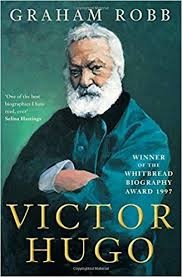
I've had a few Graham Robb books in the TBR for some time. Chunksters like Parisians and The Discovery of France. I knew that he'd written a chunky biography of Victor Hugo, and while I was somewhat interested because of my Francophile nature I was never brave enough to pick it up. Well, my participation in the year long #LesMisReadalong this year has changed all that. You may have noticed that I'm really loving it. A few weeks ago I found myself ordering a copy of Victor Hugo, and tonight I picked it up. 

I'm really not much of a reader of chunky books. I'm such a slow reader that they take me months and I find it endlessly frustrating, and I lose interest long before I'm anywhere near finished. But once you're taking on a 1416 page Les Mis then a 682 page biography of its author can seem like a relative doddle. It helps that Graham Robb already displays such a light touch.
The present biography was intended primarily to provide its author with an excuse to spend four years reading the works of Victor Hugo. 
I think I'm going to enjoy this. Tonight I read just the seven page Introduction. Already there is so much there. So much food for thought.  So much worthy of quoting starting with the very first sentence. 
Wherever one looks in the nineteenth century- there is Victor Hugo....
While I'm no expert on the nineteenth century certainly wherever I go- there is Victor Hugo. Naturally I've visited Musée Victor Hugo in Paris (see my blog post) which really helped me start to understand what a phenomenon he really was. I've visited his final resting place at the Pantheon (several times), and somewhat randomly found the Maison de Victor Hugo in Vianden, Luxembourg in 2010. There was even a link to my recent trip to Cambodia(!) when I discovered that Victor is seen as a saint by the Vietnamese Cao Dai religion, although sadly I didn't get to visit the Cao Dai temple whilst in Phnom Penh.

Victor Hugo was such a prominent nineteenth century figure that many grand statements can be found about him just within the introduction:
By the time he fled the country in 1851, Hugo was the most famous living writer in the world...
His influence on French literature was second only to that of the Bible. 
I was astonished to learn that only two-thirds of Victor's work was published during his lifetime, and 3,000 words were published about him every day- in 1997- probably that would be even more now, with people like me wittering on in our own little way. Given that, it's also surprising  in 1997 at least, there was no "complete, scholarly edition of his works and letters" published in France. 

This was the first time that I have heard of L'Homme Qui Rit, and obviously I immediately thought of La Vache Qui Rit! Really? Is that really a cheesy Victor Hugo reference? Seems I'm not the only person who think so... Oh, and there is a Maison de la Vache Qui Rit! Straight to the wish list. Oh and the 1928 silent movie version The Man Who Laughs inspired The Joker!

It seems that even in the twenty first century Victor Hugo is still everywhere! I can't wait to read on. 

Through the magic of the internet we can still watch Graham Robb speaking about Victor Hugo in 1998. It's worth listening to. 

Monday, 14 January 2013

Les Miserables 2012


Somehow I've escaped seeing any version of Les Miserables til now. Well, I suppose I've actively avoided it. I have always thought of myself as someone who doesn't like musicals. I think I'm changing my mind about that. Or perhaps it's a bit like a vegetable you say you don't like, but then you haven't really tried it, and when you do actually try it you find you don't mind it, or perhaps even quite like it.

I should have known that I would enjoy Les Miserables, despite the near incessant singing (there is a bare minimum of actual speech throughout the whole movie). After all, I do have rather an enduring passion with all things French, and Parisian in particular. And this is a rather Parisian story. In my ignorance I had thought that it was a story of the French Revolution, but Les Mis is set some 20-40 years after those extraordinary events of 1789. The story first starts in 1815, and the major part of the action takes place in 1832. The Book Haven helps explain the history of the events portrayed in Les Miserables.

At the heart of Les Miserables is an ongoing animosity over years between policeman Javert (Russell Crowe) and former convict Jean Valjean (Hugh Jackman). Victor Hugo's powerful story makes us consider the poverty, ill health and poor circumstances that much of the French populace has endured over time, and indeed many people around the world still do.

The movie has some wonderful performances, and spectacular imagery. I'm not a Russell Crowe fan, and found him rather wooden throughout, I hadn't realised that he had such a major role. Anne Hathaway is very good as Fantine, and her plight is particularly moving. Young Daniel Huttlestone is extraordinary as Gavroche.  Sacha Baron Cohen and Helena Bonham Carter were brilliant in providing some light relief as the innkeepers. I thought Samantha Barks was the standout as their daughter Eponine.

Sadly I haven't read any Victor Hugo as yet. From my limited dabblings with French classics (Madame Bovary, The Three Musketeers) I expect that I will like his writings.  When I was last in Paris in 2010 I had a wonderful visit to the Musee Victor Hugo. I'm still planning on taking my copy of Notre Dame de Paris with me to Paris this year, which is a sensible size to try and read on holiday, but now I find myself wanting to read Les Miserables. Yes, the TBR just grew again.


Saturday, 16 July 2011

Musee Victor Hugo

Musee Victor Hugo is a tiny jewel tucked away in the beautifully symmetric Place des Vosges. Not growing up French ( a tragedy that I struggle with daily), I had never quite realised the significance and regard with which Victor Hugo was, and is, held. This museum helped to correct my ignorance.

Louis XIII 1610-1643

Place des Vosges is the most symmetrical square in Paris, very beautiful and tranquil place

but still with a social conscience (100,000 people live on the streets each month)


Victor's old apartment is now a fabulous museum. It had a fantastic audioguide available in English. Even better the boys stayed outside and I was able to enjoy it at my own speed, and in peace! It helped me realise that Victor Hugo was much more than an author. He was to feature again and again during our trip. I didn't set out to stalk Victor but we accidentally did a bit. He is buried at the Pantheon, and of course we went there. He was exiled for a time in Vianden, in Luxembourg, which is exactly where we took a day trip to when we stayed in Luxembourg for a few days. We went to see Vianden Castle, and found another Musee Victor Hugo along the way. It is one of the few regrets of my trip (apart from the fact that I wanted it to be two months longer) that I never did read Notre-Dame de Paris whilst we were there. At least I already have my reading for my next Paris trip lined up and ready to go. 


The great man himself


I've never needed a case for all my gloves (gants)
A portrait of his eldest daughter Leopoldine, who drowned in the Seine when she was just 19, newly married, and her new husband drowned in the attempt to save her.

Victor's father, General Hugo

Hugo by Rodin, a copy of this bust is also in Vianden
 I initially couldn't work out what I thought was odd about the desk in his bedroom. The audioguide told me that this was indeed his writing desk, where he stood to do his writings. That is what is odd! The height. I just can't imagine that it would be comfortable for the many, many hours that he would have stood there.

He was very big on wallpapered ceilings

Even the buskers are classier in Paris


Saturday Snapshot, is a wonderful weekly meme from at home with books.