Showing posts with label Bruce Whatley. Show all posts

Friday, 12 August 2016

And the Band Played Waltzing Matilda


I'm never usually sure about picture books that are illustrated songs. I wonder what purpose they really serve. But I had no such qualms reading And The Band Played Waltzing Matilda. It's amazing and totally obvious what purpose it serves. I hope it is widely taken up in our schools. 

And The Band Played Waltzing Matilda is an iconic anti-war song written by Eric Bogle in 1971. Eric had arrived in Australia from Scotland aged 25 only two years earlier, and it was in 1971 with the Vietnam War ongoing and very unpopular at home that Eric saw his first Anzac Day march in Canberra. He knew that the time was right for another anti-war song, but he decided to set it in Gallipoli rather than Vietnam. 


"Gallipoli, on the other hand, is deeply imprinted on Australia's national DNA."

A statement that still rings true. Bruce Whatley has done an incredible job with the illustrations. He's used a muted brown and khaki palette throughout most of the book, with small highlights of colour, to represent the murky hell of the Gallipoli peninsula. 


Picture Source

Sadly there isn't an illustrators note included in the book, but Bruce has indicated on his website that this is another book illustrated using acrylic and his (non-dominant) left hand. Bruce Whatley creates such extraordinary images with his left hand, I find it completely astonishing. 

There is an acknowledgement at the front to say that many sources were used as inspiration including photographs from the Australian War Memorial Archives, the Imperial War Museum and newspapers from the time. 

If you can't find a copy of the book, and you should, then the book trailer is almost like reading it. 


There are countless versions of the song, but I think The Pogues is possibly my favourite.


A great video of Bruce Whatley showing kids how to draw (sadly using his right hand). Oh but here he is encouraging us (well kids really I suspect) to use our left hands. He says that "You've got no expectations with your left hand". Well I have no expectations with my right hand actually, I don't expect to be able to draw anything reasonable with it. I wish I could, but I just can't draw. Perhaps I could start drawing with my left hand and use that as an excuse to say why it's so bad... But it's quite fascinating that he would make compositional decisions that he wouldn't normally make when he is working with his left hand, and his work is more emotional. 

Tuesday, 3 May 2016

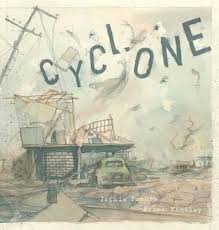
Cyclone


Jackie French can write and publish books faster than I can read them. There's always many, many new books from her waiting to be read (her website lists 9 books scheduled for release this year!), as well as her extraordinary back catalogue of course. So it's never a surprise to find a new book on the shelves at the local bookshop, which is where I came across Cyclone. Naturally I picked it up straight away. Cyclone is obviously a thematic continuation where the fabulous Flood and Fire left off.

Cyclone tells the story of Cyclone Tracy which devastated Darwin on Christmas Eve 1974. I thought of Cyclone Tracy immediately on seeing the cover, but then wondered if she would write of another more modern cyclone- but Cyclone Tracy remains Australia's most devastating tropical cyclone. Eighty percent of Darwin's home were destroyed! 41,000 of the 44,000 population were rendered homeless. 30,000 people needed to be evacuated out of Darwin.

Once again Jackie French has created a moving, yet hopeful, picture book poem out of this devastation.


Outside, a giant
groans and growls,
A wind that batters,
shrieks and howls.
In December 1974 Jackie French was manning the phones in Canberra in her new job at the Depratment for Urban and Regional Development. She took phone calls from Cyclone Tracy survivors. Cyclone is dedicated to the man who told her of how his family shelter in their backyard barbecue. Decades later Jackie has told his story to us all.


The mood is inadequately captured here in my reproduction
The dark broodingness of the storm
The tiny dots of colour of 1970s Christmas lights
The warmth of the tree and light through the window


And Cyclone has been masterfully illustrated by Bruce Whatley. Bruce used black and white photos taken at the time to research his illustrations and then chose a "toned-down palette" to give a documentary vision to the images. He's captured the building storm, the fury unleashed and the aftermath in an amazing way. The whole design really works. The font is like an old school typewriter evoking the precomputer 1970s.

Teacher Notes for Cyclone.


http://australianwomenwriters.com

Friday, 22 August 2014

Bronasbooks's War Book List

The recent centenary of the start of World War One has been felt and remembered around the world. Reading the stories of war is a perfect way to remember the sacrifices made by those who fought and died. 

There have been many, many books written about war and wars for both children and adults. Recently my friend Brona at Bronasbooks suggested a great list of war books intended for children. I've slightly modified it here.


As always the books I've read are in red.


World War One


A Day To Remember - Jackie French and Mark Wilson (see my review)

A Rose For the ANZAC Boys - Jackie French
A Soldier, a Dog and a Boy - Libby Hathorn
ANZAC Biscuits - Phil Cummings & Owen Swan

And The Band Played Waltzing Matilda - Eric Bogle, Bruce Whatley (illustrator) (see my review)
Anzac Ted - Belinda Landsberry (see my review)
An ANZAC Tale - Ruth Starke & Mark Holfeld (see my review)
Biggles series - Captain WE Johns (see my review of The Camels are Coming)

Digger. The Dog Who Went to War - Mark Wilson (see my review)
Dont Forget Australia
 - Sally Murphy
Evan's Gallipoli - Kerry Greenwood
Fromelles - Carole Wilkinson
Gallipoli - Alan Tucker
In Flanders Field - Norman Jorgensen
Jack's Bugle - Krista Bell
Light Horse Boy - Dianne Wolfer


Light House Girl - Dianne Wolfer

Line of Fire - Barroux, Sarah Ardizzone (translator) (review coming soon)
Loyal Creatures - Morris Gleitzman (see my review)
Memorial - Gary Crew
My Father's War - Sophie Masson
My Mother's Eyes - Mark Wilson

One Minute's Silence - David Metzenthen & Michael Camilleri (see my review)
Private Peaceful - Michael Morpurgo (see my review)
Simpson and His Donkey - Mark Greenwood & Frané Lessac
Soldier Boy The True Story of Jim Martin the Youngest ANZAC - Anthony Hill

Stay Where You Are and then Leave - John Boyne
Tank Boys - Stephen Dando-Collins

The Red Poppy - David Hill & Fifi Colston
The Beach They Called Gallipoli - Jackie French & Bruce Whatley
The Silver Donkey - Sonya Hartnett
War Games - James Riordan
War Horse - Michael Morpurgo (see my review)
When We Were Two - Robert Newton


World War Two


Angels of Kokoda - David Mulligan
Boy in the Striped Pyjamas - John Boyne 
Carrie's War - Nina Bawden (see my review)
Children of the King - Sonya Hartnett 
(see my review)
Diary of a Young Girl - Anne Frank (see my review)
Forgotten Pearl - Belinda Murrell
Goodnight Mister Tom - Michelle Magorian
Hero on a Bicycle - Shirley Hughes


Heroes of Tobruk - David Mulligan
Hitler's Daughter - Jackie French (see my review)
I Am David - Ann Holm
Kokoda - Alan Tucker
Once - Morris Gleitzman (review coming soon)
Then - Morris Gleitzman
Now - Morris Gleitzman
After - Morris Gleitzman
Soon - Morris Gleitzman
Maybe - Morris Gleitzman
Pennies for Hitler - Jackie French
Photographs in the Mud - Dianne Wolfer & Brian Harrison-Lever (see my review)
The Bombing of Darwin - Alan Tucker
The Book Thief - Markus Zusak
The Boy at the Top of the Mountain - John Boyne
The Island on Bird Street - Uri Orlov (see my review)
The Silver Sword - Ian Serralier
The Wrong Boy - Suzy Zail


Other Wars


Amina - J L Powers
Caesar The War Dog - Stephen Dando-Collins
Emilio - Sophie Masson
Naveed - John Heffernan
Shahana - Roseanne Hawke
Vietnam Diary - Mark Wilson


Clearly war books is a vast topic, even those written for children. It is hard to keep up. This year the Children's Book Council of Australia published Mud and Blood and Tears. An Annotated List of Children's Books about War and Conflict. 


I expect that this list (which does not attempt to be exhaustive) will inevitably grow with time. Certainly there has been a flurry of books about WWI this year, and they will keep coming with the centenary of Anzac Day next year. I know that Jackie French and Bruce Whatley have a new book coming out in November- The Beach They Called Gallipoli. It's important that we remember their stories, and do not forget. 

Friday, 21 February 2014

Fire


Any new book by Jackie French is exciting, but I was particularly thrilled to find Fire in my local bookshop recently. I read it standing there in the shop, and then bought a copy. Fire is clearly styled to be a companion book to the amazing Flood of 2011. Jackie French and Bruce Whatley have paired up again to bring us another extraordinary picture book about all the other of the all too familiar ravages of the Australian environment.

Jackie French has written a moving, true representation of the fires that attack parts of Australia every year. Many of our children are much too familiar with fire as a threat- they have lived through it, they have lost houses, or lost loved ones. Those that haven't experienced it themselves have seen the devastation played out on the nightly news, or watched stories like this one by children's news shows like Behind the News, often watched in primary school classrooms.

Jackie French has seen fire threaten her own country home. She was a volunteer bushfire fighter when she was younger, and her first hand experience with fire is obvious to see. Fire is an amazing poem.


Hills bleached gold, a baked blue sky
Leaves lay limp in air sucked dry. 

All masterfully illustrated once again by Bruce Whatley. Bruce has captured the heat and intensity of a bush fire beautifully. He doesn't seem to have used his non dominant hand to create these images like he did in Flood (Bruce Whatley was actually so interested in the way that art is created by non-dominant hands that he has done a PhD on the subject, Left Hand Right Hand), but his illustrators note at the back of the book tells us that fire "has been the hardest thing for me to capture in paint".


The erratic shapes are so random- there is no pattern or shape that becomes the foundation for the rest of the drawing. And then there is the heat and intensity. The brightest mark I could make on paper was none at all, letting the white of the paper shine through. The reds and yellows then create the shapes. What makes the fire intense is the surrounding darks. 


I'm off to a bit of a slow start for this years Australian Women Writers Challenge, but happy that my first read was Jackie French- very appropriate as she was the Aussie Women Writer that I read most last year and she is our new Australian Children's Laureate.


http://australianwomenwriters.com

Tuesday, 24 April 2012

Flood


Australia is famously a land of droughts and flooding rains. There have certainly been plenty of both recently, and Queensland has borne the brunt of much of it. Jackie French wrote Flood in response to the floods that devastated huge areas of Queensland in 2011. At least 35 people died. The whole country was affected. 

Jackie French grew up in Queensland. Her family still live there. So naturally she had a strong emotional reaction to the floods. It was a personal, family emergency as well as a national one. This beautiful and moving book is Jackie's response to this disaster.

Flood starts with the end of drought.


But then the rain kept coming and coming. Too much rain. And the river went from being a friend to being an enemy. 

Jackie French doesn't mention the deaths. Instead she focuses on the response to the floods. The human response. 

The kindness of strangers bloomed like flowers after rain. 

Quite a few pages feature the huge boardwalk that tore away and the tug that steered it safely through the maze of bridges, without causing more damage.


Bruce Whatley did an amazing job with the illustrations. He painted vertically on an easel to get the paint dripping, which adds so much to the flood soaked atmosphere of the book. A lot of his illustrations are from the dog's eye point of view. People are shown in some dangerous situations, but they are shown being rescued.


He writes a very interesting paragraph at the end describing his illustrative technique.

Humour is easy but producing illustrations that show serious emotion is a very different thing. Recently I discovered I have more success producing images that have elements of self-expression and 'art' with my left hand.

Bruce illustrated Flood with his non-dominant hand! I find that incredible- to be so talented to be able to use your non-dominant hand to get more emotion in your work. 

Flood was one of my top reads of 2011. It was printed in Queensland. A copy was donated to every primary school in Australia, and my son has read it at his school. I think that's a fantastic idea. Profits from the sales of the book were donated to the Queensland Premier's Disaster Relief Appeal. 

An Illustrated Year is hosted by An Abundance of Books.