Showing posts with label Holland. Show all posts

Friday, 9 September 2016

The Secret Diary of Hendrik Groen 83 ¼ Years Old


This absolutely delightful read was an impulse buy while I was in Melbourne recently. Bought on the cover alone really. Of course it wasn't that I hadn't taken enough books with me to Melbourne. Always fearful of being caught short I did take 6 books to a writers festival.


And read a mildly respectable two of those. 


And I bought/obtained nine more while I was there.

Actually it was ten... I missed one. 

I'm not quite sure why I was so keen to buy and then immediately read a book about an old man living in a Dutch nursing home. Although that Victor Meijer drawing on the cover helped, and glowing blurbs from Graeme Simsion (author of The Rosie Project- see my review) and John Boyne (I saw him speak in Sydney in May, and remain rather smitten) didn't hurt either. Flicking through the book randomly as we readers are wont to do my eyes touched on a random sentence: "There is a great buzz about plans for a euthanasia clinic." The back cover told me that Hendrik Groen was a "cultural phenomenon in his native Netherlands". That's it, I was in. 


I thought that a diary format might be a good book to read on my journey home from Melbourne (an all day extravaganza) and it was. I started reading Hendrik whilst still in Melbourne and it kept me fully occupied for my day of travel. Hendrik Groen is in fact 83 ¼ at the start of his diary, January 1 2013. 


Another year, and I still don't like old people. Their Zimmer-frame shuffle, their unreasonable impatience, their endless complaints, their tea and biscuits, their bellyaching.
Me? I am eighty-three years old. 

Hendrik has been living in his North Amsterdam nursing home long enough to be aware of the occasions that mark the passage of time. 


The last Saturday of the month: bingo night. Geriatric gambling addicts competing for a box of cherry-liqueur chocolates. 
 Hendrik and his friends embark on a series of new adventures, the close band of friends set up an "anarchic" Old-But-Not-Dead-Club which stirs things up in the "House of the Setting Sun".
You have to keep both body and mind active, especially the prefrontal cortex, the part of the brain that controls functions such as planning, initiative and flexibility. Well, we may presume that the management of this place doesn't care much about the prefrontal cortex. Neither money nor trouble is spared to keep the oldies docile, passive and lethargic, camouflaged by bingo, billiards and 'Feel Good Fitness'.
He has quite a bit of wisdom to pass on to us. 

When you're young, you can't wait to grow up. As an adult, until the age of sixty, you want above all to stay young. But when you're as old as the hills, you've got nothing left to strive for. That is the essence of the emptiness of life in here. There are no more goals. No exams to pass, no career ladders to climb, no grandchildren to raise. We are too old, even, to babysit the grandchildren. 

I loved the way that Hendrik wove actual events from 2013 into the story, it worked really well. 2013 was quite a big year too it seems. Pope Francis was elected in March and the Dutch Queen Beatrix abdicated in April, handing over power to her son. There were a number of notable deaths including Margaret Thatcher and Nelson Mandela. Anouk represented Holland at Eurovision in Malmö in May. And I was in Amsterdam in June! I remember that 33 degree day quite well as I climbed the second highest church tower in Europe that day (barefoot as it turned out). 

Hendrik is mildly obsessed with bitterballen as a snack whilst drinking. Actually there's a lot more drinking going on with Hendrik and his friends than might be expected of gentle nursing home folk, and much of the humour arises from it.

My Bitterballen experience whilst drinking
 Amsterdam 2013

Translator Hester Velmans did an extraordinary job as The Secret Diary of Hendrik Groen reads as if Hendrik was a native English speaker.


See John Boyne's review at The Irish Times. 


From the start Hendrik's voice was not what I imagined of an octogenarian, and indeed it may not be as Hendrik Groen is a pseudonym and the hunt is on for the true identity of the author. I don't really mind who wrote it, it was fun. And good news - The second book is on the way! John Boyne isn't sure that the formula will stretch to a second book, but I'm more than willing to give it a go. 

Saturday, 28 March 2015

The Dutch Twins


The Dutch Twins was the first title in what was to become a popular and enduring series of Twin Books by Lucy Fitch Perkins. She wrote more than 25 Twin books, it was a popular series and other writers continued it after her death. It's readily available online

The Dutch Twins is certainly of it’s time (1911). Gentle stories of every day life in Holland for two young twins, Kit and Kat, not yet big enough to be called by their real names of Christopher and Katrina. The twins live with their parents on a traditional Dutch farm. They help their parents with chores- tending the vegetables, and helping feed the animals- the cow, the geese, chickens and ducks. The six stories are snatches of their ordinary life- a fishing trip, going to the market with their father and going to church on Sunday.

There is typical sibling rivalry, gentle ribbing, and quite a lot of comment on the difference between girls and boys. Kit is always expressing how much better boys are than girls. He is sometimes rebuked either directly in words, or other times by the events that follow. Sometimes it is reinforced. 

“No,” said Vrouw Vedder. “Girls shouldn’t think much. It isn’t good for them. Leave thinking to the men. You can stay home and help me. "

Theirs is a simple rural lifestyle. They travel on a barge on the canals to town for market. They skate on these same canals when they have iced over in the winter. Their diet is rather modest and yet fascinating. It reminded me somewhat of the diet described in Heidi- although the twins did have a better variety of food available to then. For breakfast they often had bread and milk. Their father grows potatoes, cabbage, beetroot and carrots, and this forms a large part of the diet. The twins are allowed to drink weak coffee on Sundays and special days like Christmas. I was surprised to see that salt herring didn’t rate a mention until page 106. 

I am a great fan of Dutch Breakfast, having experienced it in 2013 so I was intrigued enough by the mention of buttermilk porridge to try it out. I checked out an online recipe this week. It was ok. I used  coconut sugar which is not traditional I'm sure, but I had some in the house and figured it would give it a nice caramel colour- which it did. 


I suspect that I made it too thick also. My Dutch sources tell me that karnemelkpap is more drinking consistency when you buy it in the supermarket there. 

On the whole it was a sweet story through most of it. Although I was surprised when in the final story Grandmother tells a story, much like a traditional fairy tale with child killings and even pickling of children. 

The Cambridge Guide to Children’s Books in English says that she wrote the Twin books  to encourage “mutual respect for the best which other nations bring to this shore (America).” At times it is a little too earnest, such as the inclusion of the Dutch National Anthem. It was a very interesting historical detail to learn about dog drawn milk carts. I’d never heard of this before though it seems it was quite a widespread practice. 

I do know that this style of book would have been a difficult sell to my son when he was younger. I wonder how modern children (and their parents) would take to it? I guess I almost see it as more of historical interest now. 


260/1001


This post is linked to Weekend Cooking
a fabulous weekly meme at BethFishReads

Saturday, 14 March 2015

Dick Bruna Huis

I've been reading some books set in Holland this month, and it got me to reminiscing about our lovely stay in Holland in 2013. It was all too short, but there were many highlights packed into just a few days.

One was a visit to Dick Bruna Huis at the Centraal Museum in Utrecht. It was opened Feb 16 2006 by HRH Princess Laurentien of the Netherlands as a tribute to Dick Bruna.


I loved the gold Miffy welcoming you inside. 


Every museum and exhibition I saw in Holland was really cool. They put a lot of effort into how things are displayed, and do it imaginatively. Dick Bruna Huis was no exception. 

So many Miffys!

So many translations.

Cute Miffy seats. 

Dutch museums made great efforts for us English speakers.
It seems Miffy is popular in Japan too. 


Lots of floor height activities for the littlies. 

Animation figures for Miffy the Movie

There was an exhibition called With Miffy in the Attic, a rather odd intersection of Miffy with Contemporary Art. 


I don't pretend to understand it. 


I always find it interesting to see displays on how an author/illustrator/artist does their work. I don't think I knew that Dick Bruna did as much non-Miffy work as he did. He designed thousands of book covers and posters for the family A.W. Bruna & Zoon including Maigret covers. 


Did I mention that I really loved gold Miffy?

The gift shop was loaded with many cool things, and everything Miffy. 


Who wouldn't want a Miffy lamp?
I might have bought one if it wasn't
Completely Impractical to get back to Australia. 

Saturday Snapshot is a wonderful weekly meme
 now hosted by 
WestMetroMommy

Saturday, 14 June 2014

The Birds of Vondelpark

This time last year we were preparing for a big trip to Europe. I was pretty excited. And rightly so. It was an absolutely amazing holiday. I've only ever shown you tiny glimpses of it really. Particularly my first trip to Holland. So different to France of course. We loved our time in Holland.

I was of course keen to see some different birds in Holland. In Amsterdam we went to Vondelpark one afternoon. A large park in central Amsterdam. I was a bit disappointed with the park itself- it smelt really quite strongly of beer in some places. The majority of parkgoers seemed to love it though. Master Wicker just reminded me that he renamed this park Bogaan Centraal. Apt.


My first sightings of Egyptian Geese (Alopochen aegyptiaca)
-introduced obviously, it was early summer so there were many geese
families

I'm still not quite sure if that red spot around their eye is creepy or cool.

Eurasian Coot (Fulica atra)
Very familiar to Australians, there are some out the back of my house,
and I've shown you them in Tasmania before

You don't always get a chance to see the ungainly, messy
(and particularly difficult to photograph) Coot youngsters though

Grey Heron (Ardea cinerea)
Possibly a juvenile Grey Heron

 Black-Headed Gull
(Larus ridibundus)
An exciting spotting at the time-
many, many more to be seen in Paris

Eurasian Jackdaw (Corvus monedula)
I think I've seen this before in Ireland

Another introduced bird, the Rose-Ringed Parakeet (Psittacula krameri)
a surprising glimpse of the tropics in Europe
there are quite large feral populations in many centres!

Gulls can be tricky when you really don't know the area. I think this is
an European Herring Gull (Larus argentatus)

Not all of the birds were happy to be in the park, some were angry birds.
I'm not totally familiar with all these birds, and am prepared to be considered wrong on some of the IDs.

Saturday Snapshot is a wonderful weekly meme
 now hosted by 
WestMetroMommy

Saturday, 23 November 2013

Anne Frank Huis

It's hard to call a visit to Anne Frank Huis a highlight, but it certainly was one of the very memorable stops on our trip to Amsterdam in June this year.

There's always a long line. It's a bit slow moving.
But it's totally worth it.
You can buy tickets on line but we weren't sure that we would be able to squeeze  in a visit,
also it's really hard to access  a printer while you're travelling,
although you can also use a smartphone or tablet.
It's  astonishing to walk through the secret door that kept Anne hidden for all that time during the war. To climb the same narrow stairs that she did, and stand in the small rooms that held her life, where she did her lessons, read her books, listened to the radio, ate her meals, and where she wrote her diary (see my thoughts about her diary). If you can't make it to Amsterdam sometime soon you can take a pretty cool online tour


There is a moving exhibit at the end of the rooms. Sadly no photos were allowed inside. 

Anne Frank Huis has kept up with the times,
with an iPhone app.

 I haven't and don't really know what to do with these things,
or how they could add to my experience.
I must learn. 

Perhaps the 50th anniversary of Dr Who is weighing heavily on my mind (it's this weekend and the Wicker boys are Very Excited about it), but doesn't the little logo in the corner look ever so slightly like a tardis? If only The Doctor had been able to visit Anne. 

A statue of Anne nearby. 
Saturday Snapshot is a wonderful weekly meme now hosted by WestMetroMommy

Friday, 22 November 2013

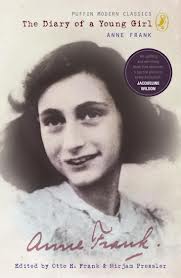
The Diary of a Young Girl


I'd been meaning to read Anne Frank's diary for many years. It was clearly a rather large omission to have not read it before this. But there was nothing like an upcoming trip to Amsterdam for the first time to get me there finally.

I started off reading this book out loud to Master Wicker as our night time reading. He didn't enjoy it from the outset (not nearly enough dystopian fantasy world for him, and no aliens, all major drawbacks), and it was hard going as a read aloud book. Which in turn made the reading drag. I did enjoy it much more after I gave up on the read aloud aspect (we switched to The Hunger Games which had a much more favourable reception) and just read it for myself.

Anne Frank and her diary are justifiably very famous. Anne and her family spent two years in hiding, living in cramped, crowded conditions in a factory annexe in Amsterdam during World War II. Of course Anne famously didn't survive the war, so the end is no mystery, but it's such an important story to tell.

I feel dreadful that I didn't love this rather beloved book. Even more because I didn't really like Anne's voice. I didn't like Anne all that much actually, which makes it difficult to read her first person narrative. I was interested in her plight of course, in everything she had to say, her descriptions of her experience of the war, and her living conditions and her moods. I feel my lack of enjoyment was more a failing on my part than hers.

It was shocking to read the limitations of freedom begin.

After May 1940 the good times were few and far between: first there was the war, then the capitulation and then the arrival of the Germans, which is when the troubled started for the Jews. Our freedom was severely restricted by a series of anti-Jewish decrees: Jews were required to wear a yellow star; Jews were required to turn in their bicycles; Jews were forbidden to sue trams; Jews were forbidden to ride in cars, even their own: Jews were required to do their shopping between 3.00 and 5.00 pm; Jews were required to frequent only Jewish-owned barbershops and beauty salons; Jews were forbidden to be out on the streets between 8.00pm and 6.00am; Jews were forbidden to go to theatres, cinemas or any other forms of entertainment; Jews were forbidden to use swimming pools, tennis courts, hockey fields or any other athletic fields; Jews were forbidden to go rowing; Jews were forbidden to take part in any athletic activity in public; Jews were forbidden to sit in their gardens or those of their friends after 8.00pm; Jews were forbidden to visit Christians in their homes; Jews were required to attend Jewish schools, etc. You couldn't do this and you couldn't do that, but life went on. 

I was really surprised to read Anne writing quite knowledgeably about what would later be called the Holocaust in August 1942.

If it's that bad in Holland, what must it be like in those faraway and uncivilised places where the Germans are sending them? We assume that most of them are being murdered. The English radio says they're being gassed. Perhaps that's the quickest way to die. 

I hadn't known that these things were actually known during the war. I'd thought that it was only after the war that people found out what had been happening. It was terrible reading Anne's descriptions of the privations of the family's time in hiding. The radio was constantly on as the families listen desperately for news and updates. The boredom, the fears of disease, of discovery, of destruction from falling bombs, and the terrible, rotting food.

It was heartbreaking to see Anne's moods over time, as she was robbed of her liberty, and her youth, and eventually of course her life.

I wander from room to room, climb up and down the stairs and feel like a songbird whose wings have been ripped off and who keeps hurling herself against the bars of its dark cage. 

And yet somehow Anne remains optimistic til the end.

It's utterly impossible for me to build my life on a foundation of chaos, suffering and death. I see the world being slowly transformed into a wilderness, I hear the approaching thunder that, one day, will destroy us too, I feel the suffering of millions. And yet, when I look up at the sky, I somehow feel that everything will change for the better, that this cruelty too will end, that peace and tranquility will return once more.

Anne wanted to be a writer and journalist and she's done that.

I don't want to have lived in vain like most people. I want to be useful or bring enjoyment to all people, even those I've never met. I want to go on living even after my death!

Anne is still living after her death. Her thoughts and words are still alive in the 21st century. And still worth reading.

See some photos from my visit to Anne Frank Huis.

Sunday, 29 September 2013

Dutch Breakfast

I've been taking quite an interest in the sugar debate this year. I read Sweet Poison, and I Quit Sugar, still I was more than astonished to learn last week that Holland may be the first country to criminalise sugar.

I thought back to our lovely, but too brief visit to Holland in June. We stayed with friends and got to participate in the ritual of a Dutch family breakfast. These people love their sugar! I do wonder if it's just one man's plan? I'm not sure that I can see it catching on.


Master Wicker learning about the joys of travel broadening tastebuds,
 and the magic of vlokken
They have a literal wall of vlokken
at the supermarket

The Dutch make an astonishing sugar bread (Suykerbrood). Basically like a brioche with lumps of sugar.

So delicious!
Great sliced with butter
But even better toasted!
It was funny to go to Holland and learn that toasting
 is a rather Australian preoccupation
This post is linked to Weekend Cooking
a fabulous weekly meme at Beth Fish Reads