Showing posts with label Nonfiction Monday. Show all posts

Thursday, 21 March 2013

London Not for Parents!


It's quite hard for me to put aside my Paris obsession and concentrate on other cities for my upcoming Grand Tour. But sometimes it must be done. Hardship as it is. This year I'm planning to make my first ever visit to London. I'm very excited about it, and have begun a bit of pre-reading. London Not for Parents was an obvious place to start.  I read the companion Paris volume in 2011 and loved it. They're from a great series of books from the folks at Lonely Planet.

There's so much in London that I want to do, I know that we won't have time to do it all.

At least now when I ride the London Eye, I'll know that I'll be as tall as 26 giraffes (135m).

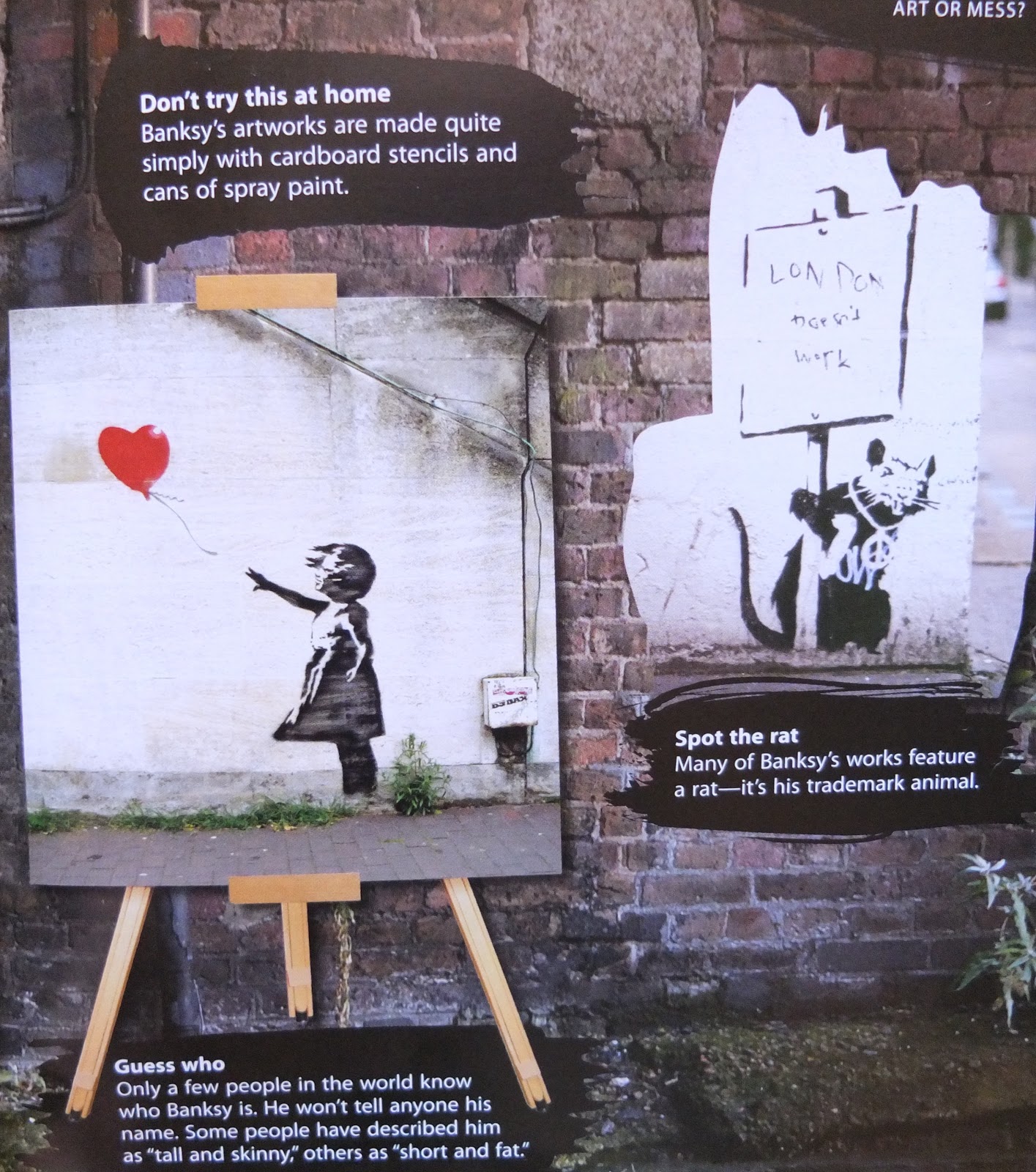
I want to see some of Banksy's art. But will I recognise it? Apparently his work is simply made with cardboard stencils and spray cans, and he often features a rat.


When I visit St Paul's I'll know that it is the 5th incarnation on the site. The previous four cathedrals all being timber burned down over the ages, the last one in The Great Fire in 1666- started by a baker cooking two big bits of bacon in his oven in Pudding Lane.

The Great Fire burned for six days

There is a Christopher Wren designed monument to the Great Fire near Pudding Lane where the fire started. You can climb it! I think I will.

3,000 people are buried in and around Westminster Abbey.

More than 100 people have been hanged, beheaded, or shot at the Tower of London over the centuries. The Tower was the prison, while the executions were mostly carried out on Tower Hill. If you were an important person like a baron, earl or the wife of a king you were beheaded in private, usually on Tower Green in the Tower of London.

Charles II kept exotic birds in a cage (including a crane with a wooden leg on Birdcage Walk.

Too good not to repost

By law sturgeons, whales, dolphins or porpoises caught in British waters belong to the current monarch. The wild swans that live on the River Thames are part-owned by the kings and queens of England. Every year the swans are counted and given a royal health check. The tradition, which started 800 years ago, is called swan "upping".


Sunday, 25 November 2012

One Small Island


I was very excited about this title when it came out last year, it's a shame that it's taken me so long to read it. It's a fabulous book, about a fascinating part of the world. Little did I know how fascinating it really is.

One Small Island tells the tale of Macquarie Island, a small island in the Southern Ocean between New Zealand and Antarctica. But like all good things that good possibly be construed as belonging to New Zealand, we found it first and claimed it for Australia.

Macquarie Island was discovered in July 1810 by Captain F Hasselborough, who had been blown off course while heading to Campbell Island, another subantarctic island. He named it for Lachlan Macquarie, the new Governor of New South Wales. Actually, much of New South Wales is named either Lachlan or Macquarie, and I'm sure the ongoing popularity and use of the name Lachlan in Australia stems from this time also.

Macquarie Island was a natural refuge to huge colonies of seals and penguins. A sealing industry was immediately set up in 1810, and in the ten short years that followed the sealers killed more than 100,000 fur seals, until there were none left. Naturally a lack of seals didn't stop the ravenous desire for oil, the elephant seals were the next target, and when they were all but gone then penguin oil became the industry. It seems rather impossible that there was a penguin oil industry at one time, I'm glad we live in a somewhat gentler time.


I've known about conservation efforts on Macquarie Island for some time, the recent efforts to rid the remote island of rabbits and rats. I didn't know that previously there were feral cats, dogs and wekas amongst many others!

There is a lot of information packed into this book, so much so that both endpapers include even more.


The book itself alternates large illustrative double pages


with beautiful, intricate pages crammed with information in various formats- imaginings of primary journals from early explorers and sealers, newspaper accounts, maps, drawings. There are a few lines of text at the bottom of each page, that reads quickly as a stand alone story. I was too keen to read the story so read through the bottom first and then came back for a slower reading of the informative pages. It's a very clever design, easy to read just the text for younger children, but then with much more information that older children and adults can digest. Although young children do love pouring over illustrative detail.


While One Small Island is a tale of ecological destruction and (mis)adventure, it is ultimately optimistic and hopeful. We have stopped the slaughter of seals and penguins. Although it is sadly too late for the Macquarie Island parakeet, the seals and penguins have come back. The wekas, cats and dogs have gone. There rabbits and rodents are on their way out due to expensive, large scale government efforts. The books message that it's important to care for our "precious places, no matter how small or faraway they are" is a vital one.


An Illustrated Year by An Abundance of Books


Thursday, 19 April 2012

Monarch and Milkweed


I somehow stumbled across this book in my library catalogue- it offers book suggestions the way that Amazon does. I judged the book by the lovely cover and reserved a copy. And I'm very glad that I did.

The astonishing story of Monarch butterflies and their plant host, Milkweed. I find the notion of migrating butterflies to be just extraordinary. It's amazing enough that 20gm swallows can migrate thousands of kilometres. And now here is the notion of a mere puff of colour migrating thousands of kilometres to find a specific stand of Oyanel fir trees in Mexico! How is that even possible? And in a rather fascinating twist explained in the note at the end of the book, one butterfly makes the entire southward migration, and yet it takes two to four generations of Monarch butterflies to make the return journey.


This is a beautifully illustrated book.


The palette and style of the illustrations are just gorgeous. Although my photos don't do justice to the full saturation of the colours in the book.


We learn about the lifecycle of the Monarch butterfly. While Milkweed is their host plant for laying the eggs, the adults feed off many different flowers. 

I was hoping that the illustrator would get to have a paragraph at the back as they sometimes do now to explain their technique, but sadly Leonid Gore didn't have that chance.


An Illustrated Year is hosted by An Abundance of Books.


Friday, 16 March 2012

Joan of Arc


I became interested in Joan of Arc last year. Of course she's very famous and most everyone is aware of her to some extent. But I came across a rather fascinating section about her in Jim Leavesley's Mere Mortals. This is the second junior nonfiction book that I've read about her now. Both were very interesting.

Her basic story is fascinating of course. As a teenage girl Joan began hearing voices from Heaven. 


These voices told her that God had chosen her to save Orleans- a French city under siege by the English during the latter years of the Hundred Year War, and then to take the Dauphin to be crowned as King of France in Rheims (also held by the English). She sets off to see the Dauphin.


The Dauphin is aware that Joan is coming, and decides to test her, by dressing as one of his courtiers. Joan immediately walks straight up to the Dauphin. Joan arrives in Orleans by the back gate (surely it can't have been that easy?? Is it really a siege if you can just ride in the back gate?). But Joan did save Orleans. She was later captured by the English, stood trial, and famously burned at the stake in Rouen. 

So, what did I learn from this book specifically?


Joan was injured by an arrow during the battle for Orleans. The surgeon is said to have dressed her wound with olive oil and lard. 

That Joan was captured at Compiegne after the French Captain of Compiegne raised the drawbridge behind her forces, locking her out of the town. She was outnumbered, overpowered and taken prisoner.

I knew that after her capture and imprisonment Joan had jumped out of a tower window. Here, we are told that Joan was so injured after her jump that she wasn't able to eat or drink for two days. 

The judge at her trial in Rouen, which was the English capital in France at the time, Cauchon, the "wicked Bishop of Beauvais" was paid by the English to rig the trial, and find her guilty of heresy. 

Her life becomes more fascinating with each book. I was initially put off a bit by this book, just because the cover illustration seemed a bit grim and drab. Although I guess her life was grim and drab really. The other pictures within the book are brighter, and more appealing to me. I'm not sure that I would have put that particular one on the cover.


An Illustrated Year is hosted by An Abundance of Books.


Thursday, 8 March 2012

Gorgeous Georgians


Nothing like a sick morning in bed to get a bit of reading done. My son and I have been watching the totally fabulous tv series based on these books recently, so of course I was curious about the books. This was perfect fare for a morning of dozing and feeling not quite right.

It's always quite astonishing what seems completely sensible when you actually think about it for the first time. I don't think that I've ever pondered what the Georgian moniker actually meant, turns out that it is the period of time ruled over by the Four Georges in England, 1714-1837. D'Oh. 


It's hard to keep away from the tv show!


Gorgeous Georgians doesn't pretend to be an all inclusive history of the Georgian era. Rather it is a mixture of the gross, funny and scatological maximally designed to appeal to primary school aged children. And there is nothing wrong with that. Nothing at all. And so here is a random collection of interesting facts. 

Cricket was legalised in 1748. Why was it illegal, and needing legalisation? That isn't explained. But I could have been saved from many summers of torture if it had remained illegal. 

The fans so fashionable with ladies could be used to hide rotting teeth or bad breath, as well as for signalling messages. 

Poaching fish was punishable by death. 

Silk beauty spots helped to hide smallpox scars. 

Mallow flowers and mashed up snails is a great cure for ague (fevers and rigors). Squashed fish eyes is a great cure for toothache. If you have cancer you should drink a libation of sugar, nutmeg, woodlice powder mixed with your own urine.

Godfrey's Cordial ( a mixture of opium, treacle, water and spices) was used to quieten many crying orphans at night, (and used commonly by working class families), many of these poor children never woke up. Of course, child mortality was dreadful, one in three didn't live to 15

False teeth were fashioned out of tusks or pottery. Or if you were rich, dentists could take a tooth out of a poor child to replace your rotten tooth. 

The Georgians used hot houses to grow fruits such as grapes, peaches and pineapples. There was a new fashion to eat fruit raw!  More astonishing to realise that until the Georgian era noone in the world enjoyed toast or sandwiches!

There were a number of intriguing mentions of Daniel Defoe. Besides famously writing Robinson Crusoe (which I'm excited to be reading in the next few months), he formulated a seven class hierarchy of British society. 

These were certainly fascinating times. Times that make you glad to live now, no matter what our more modern problems. I guess I'm still slightly surprised that these books are so wildly popular with kids. But they are. I'm very glad that they are- I think the whole Horrible Histories phenomenon is fantastic. And it's about to get bigger. I remember how history was taught at school. Awful. They finally have made history fun for all of us.