Showing posts with label Australian Women Writers Challenge 2014. Show all posts

Sunday, 4 January 2015

Australian Women Writers Challenge 2014 Wrap Up


2014 was my third year of participating in the Australian Women Writers Challenge. It's such an important activity and vital to support our Australian Women Writers. And you get to read lots of great books. 

Kids books


Little Dog and the Christmas Wish
Bully on the Bus

Kissed by the Moon

The Treasure Box
Violet Mackerel's Brilliant Plot
A House for Donfinkle
The Red Shoe
Alice-Miranda in Paris
Fire

Adult fiction

Lost & Found

Adult Nonfiction
I Quit Sugar for Life

A Family in Paris
Found in Translation
Last year I read and blogged 15 books, and hoped for 16 for 2014. But I only got 13 this year. I'll have to strive for more this year. I can see that I really need to work on adult fiction reading this year too. I'll try for 16 again this year.

http://australianwomenwriters.com

Thursday, 25 December 2014

Little Dog and the Christmas Wish


I bought quite a few new books on my recent trip to Melbourne. Books are always impractical to buy when you're away and have to comply (somewhat) with airline baggage restrictions. Or at least look like you might be trying to. Some were bargains that I couldn't pass up. This one was a new picture book. About a dog. And Christmas. And Melbourne. All rather irresistible.

There was a big stack of them at the must visit
The Little Bookroom

And a gorgeous display inside

of original artworks


Little Dog and the Christmas Wish is a sweet little vision of Christmases Past by Corrine Fenton (I thought she was new to me, but I've read her delightful The Dog on the Tuckerbox). Set in a retro, yet rather timeless Melbourne (well apart from the horse drawn baker's cart), it is a lovely lost dog story. Jonathan and Little Dog are inseparable friends, getting into all sorts of mischief. But then on Christmas Eve Jonathan has to go shopping with his mother and Little Dog is left home alone. He is scared by a thunderstorm and takes off to find Jonathan. 


Picture source

Gorgeous, evocative illustrations of a familiar, yet long-gone Melbourne by Robin Cowcher, in her first picture book.

australianwomenwriters.com

Tuesday, 23 December 2014

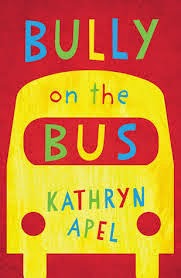
Bully on the Bus


I’m so glad that Steven Herrick has taught me to appreciate verse novels this year. It’s really opened up my reading, and made me not frightened to take on a verse novel from time to time. I’ve been keen to read Kathryn Apel’s Bully on the Bus for a while now, and a recent Sydney-Melbourne flight was the perfect time.

Leroy is in kindergarten. He takes the bus to and from school each day with his older sister Ruby. DJ is an older high school girl who enjoys tormenting Leroy each day. She is the bully on the bus. Leroy is sick of being bullied.

I feel the red-hot
lava spill out of the
bully’s mouth and ooze
over my face
burning it
clumsy red. 

I’m good at maths.
Mrs Wilson says so.
But the bully makes me feel
dumb.

He doesn’t want to go to school anymore, despite being a good student. He is anxious and apprehenisve. Always wondering. 

What will the bully do today?

Kathryn Apel has written a great verse novel expressing that ever present dread of the bully, so often lurking on a bus, who must be faced every day. Kathryn lives and writes on a Queensland farm, and draws inspiration from Australian rural life for her stories. Kathryn's website, she coordinates a Month of Poetry each January. 


australianwomenwriters.com

Wednesday, 26 November 2014

Lost & Found


Like many Australians I first heard of Brooke Davis when she appeared on Australian Story earlier this year. It was such a poignant and moving episode about a young woman trying to come to terms with the sudden death of her mother in a rather senseless accident. Her first book Lost & Found seems to have come out of this grieving process, it is a trip through love and loss, through family, disillusionment, grief and hope. 

There was quite a bit of hype about the book midyear, I came to see it everywhere,  and became very keen to read it. I bought a copy for a friend and gave it away. Still I wanted to read it. I knew that my trip to Europe was coming up and thought it would make an excellent book to read on the plane. Then an opportunity to meet Brooke at a signing came up, and I knew I'd buy it, and knew I'd read it on the plane. 


I thought I'd read it on the plane going over, but evening/night flights are better for staring at screens, so I ended up reading it travelling from Zurich to Singapore in that perpetual fake night of the daytime flight.


Around about the time I discovered that they serve Cointreau in Economy.


It almost compensates for the lack of bubbly. Almost.
Lost & Found was the perfect companion for that long, long flight. I was entranced from the first paragraph. Lost & Found is the story of three unlikely friends- 7 year old Millie Bird, 87 year old Karl the Touch Typist and 82 year old Agatha Pantha. All have been abandoned. Millie's father has died and her mother leaves her in the womens underwear section of the local department store. Karl is widowed and he escapes from the nursing home his son has left him in. Agatha Pantha is also widowed, she hasn't left the house in seven years, and passes judgement on everyone who walks past her Chair of Discernment. 

Millie has charming, magical thinking.

What if everything could fly? she whispers to her gumboots, watching the fly bounce from leaf to leaf. Your dinner could fly into your mouth and the sky could be covered with trees and the streets might switch places, though some people would get seasick and planes wouldn't be that special anymore. 

And she uses the Quirky Capitals of Emphasis. I do Love Those. It is all rather preoccupied with death, but it never becomes too much. Brooke Davis' light touch makes sure of that. Whether writing about the rituals of death.

When her husband died, neighbours suddenly dropped by unannounced, appearing on her doorstep from behind huge, hulking casseroles full of dead animals, and pity. Their children carried slabs of coconut ice and looked put out. 

Or nursing homes.

It was still light outside when Karl walked down the hallway to the dining hall for dinner. The clock on the wall said 4.30 pm, and as a plate full of unidentifiable foodstuffs was pushed in front of him, Karl though, So this is it. He sat on a long table, like the sort he'd seen in movies about prison. 

It is quirky, beautiful writing. Lyrical and descriptive. Our three main characters are memorable and eccentric. If 7 year olds can be eccentric. The plot got a little towards farce for my liking at one stage, but that didn't put me off overall. Perhaps it was the Cointreau. I don't normally drink and read. Is Lost & Found perhaps this years The Rosie ProjectQuite possibly. It certainly is another quirky, original, must-read debut Aussie novel. 

You can hear Brooke Davis interviewed about Lost & Found on Books and Arts Daily, and of course I love that Roald Dahl inspired Brooke to write in the first place, and that she holds Matilda as a masterpiece.

Lost & Found will be published in 25 countries and translated into 20 languages next year.


australianwomenwriters.com

Wednesday, 24 September 2014

I Quit Sugar for Life


I'm doing Sugar Free September this month. I wasn't planning to. Actually I hadn't even heard about it before, but then a friend suggested it on Facebook because she was doing it, and after a brief hesitation I decided to do it too. A bit of acting in haste perhaps, and there has been a little bit of repenting at leisure. But it's been an interesting experiment, I've tried lots of new things this month, and it hasn't really been that hard (most days). Although I did have to miss the Best. Lamingtons. Ever.

I planned on getting I Quit Sugar out from hiding. I read it last year, and had modified a few things, learnt lots, but not really changed all that many behaviours. For the life of me I can't find it in the house, so I bought Sarah Wilson's new title I Quit Sugar for Life. It has a very similar feel to the original I Quit Sugar- very similar layout, font and vibe- which is not a bad thing. The content is quite different, and there are 148 new sugar free recipes to try.

I Quit Sugar helped people go through Sarah's 8 week sugar detox program. It's been wildly successful, and over 250, 000 people have done the 8 week program so far (the current one started today). I Quit Sugar for Life is designed to be the next stage. It's not as prescriptive as the first book, and I think could easily act as a standalone piece. I Quit Sugar for Life offers The I Quit Sugar Wellness Codes, a series of 9 mantras to help us live a sugar free, healthy life.

Keep on Keeping Off Sugar
Eat Fat and Protein
Ditch the Diets
Maximise Your Nutrition
Have a Morning Routine
Exercise Less
Cut Snacking
Shop Differently
Cook Differently

I really like what Sarah offers with these codes. They're not just about food, they're about lifestyle too. She cares about the environment, food wastage, getting us organised and healthy. And she's not afraid to speak her mind. She's a confirmed omnivore and not at all convinced about vegan diets, but gives suggestions for many other forms of modern eating- paleo, gluten free, vegetarian. Her suggestions are very creative, perhaps too much for some people, but she encourages us to get more vegetables into our diet every day with lots of great ideas- there must be something there for everyone I think.

There are plenty of delicious sounding recipes- Carrot Cake Porridge Whip, Paleo Choc-coco Muggin, Spiced Pumpkin Granola Bars, Festive Popcorn (flavoured with ras el hanout- one of my very favourite spice blends), Fennel Tarte Tatin, Vietnamese Chicken Curry. There are many suggestions too- the one that intrigues me the most (but I haven't tried yet) is to stave off snack attacks by eating a tablespoon of coconut oil. I'm not sure that I ready for that, but will give it a go- one day when I work up the courage.

I am still not intending to do sugar free for life, being sugar free for September is perhaps enough- but it's an interesting experience that I will extend somewhat in October, and I do enjoy thinking more about the food we eat and the life we live. News today that Sarah is hard at work on her next cookbook.

Foodies Read 2014!

australianwomenwriters.com

Monday, 21 July 2014

A Family in Paris


I was very relieved to finally finish this book recently. Not that I didn't enjoy it, quite the opposite in fact, but it just spent too long on the bedside table. I was reading snippets of it between other more pressing reads, and that was ok, but it didn't quite give A Family in Paris it's due. And then I let the review slip away for months- it was like rereading to pick it up again.

A Family in Paris is partly a diary of an Australian family moving to Paris, a memoir of their six and a half years there, but it is much more, it is also a travel guide with wonderful suggestions of thing to do, see and eat in Paris. 


The Paech family moved to Paris in the late 90s. An Australian family, they had been living in New York when the opportunity rose to move to Paris- who could resist? There are many difficulties along the way- the famous French bureaucracy of course


 Bureaucracy is the art of making the possible impossible- Javier Pascal Salcedo

marathon trips to IKEA, French washing machines that take more than 2 hours for a cycle (I've never understood this, our clothes are perfectly clean with a 30 minute cycle, how do the French ever manage to leave the house at all?), the problems of trying to make pavlova overseas without access to cornflour.

Jane and her husband moved their with three young daughters, so they navigate the French school system as well, which makes for particularly captivating reading. The French system, their approach, is so different to what we are used to in the English speaking world. "The typical French primary school, where providing a holistic education that meets individual learning and developmental needs in a nurturing environment is not the priority. Rather the exceptionally disciplined and rigorous education system is singularly focused on churning out intellectuals."


In return for long and arduous school days (including Saturday morning) French children are given Wednesday off.

Six and a half years in Paris gives you a wealth of insider knowledge and Jane is happy to share this with us.
What's unique and remarkable about Paris is that so many elements of life are raised to an art form. If the French do something, they do it properly and perfectly, with enormous attention to aesthetics. Style is infused into every intricate detail, even down to the eye-pleasing, patterned air vents on the outside of buildings. 
Whenever a recipe calls for water, replace it with wine and always add cream before serving. 
Small amounts of wine or Champagne are offered on special occasions from around the age of ten so that, slowly, children are able to from an appreciation and respect of alcohol, and develop healthy habits. 

Jane attends a scarf tying workshop, but feels like a fumbling four year old rather than a stylish Parisienne. I'd love to go to a scarf tying workshop, it would be such fun, and I would learn the art of Intricate Scarf Tying too. I haven't found one yet. 


Girls will have been dabbed behind the ears with good French perfume as a baby and learn from an early age when to extend a handshake or offer a cheek. Generally, French children have impeccable manners in public, are respectful, keep conversations low, and can sit perfectly still for hours in restaurants without any sign of petulant behaviour. 

Jane has a passion for small Paris Museums, just like I do. She lists some and extolls the virtues of them. 


Hidden in historic mansions and secluded in greenery, the countless small museums of Paris offer a refreshing alternative to the long lines at the Louvre. Their manageable size means they can be enjoyed in the space of an hour or two, creating a delightful diversion in a busy day. Intirguing and intimate, they range in style from classic to quirky to downright eccentric. As well as museums devoted to fashion, art and history, there are museums dedicated to Edith Piaf and Baccarat china, a fan museum, a museum of money, and even a post office museum. 

I heartily agree. I've been to some of these museums- Musee Maillol, Musee de l'Assistance Publique- Hopitaux de Paris, Musee Rodin, Musee Victor Hugo and Le Petit Palais- and thoroughly enjoyed all of them and plan to go to many more. Actually I've been to others and need to share them- they're all extraordinary Paris experiences. 

There are many other random, fun 
details, such as a French nursery rhyme learnt at piano lessons, J'ai due Bon Tabac (I have some good tobacco, which does appear to start I have some good tobacco, but you can't have any),  and that cats have seven lives in France!


Incredible to think that February in Paris may be an abyss. But I have experienced that in the long, long Canadian winter. I would love to experience the rhythms of the French year sometime. 


And yet the longer I live here, the more I find that the frustrating side of French life and the city's sharp angles are adequately compensated for by the allure of the capital and its mysterious power of seduction. Exasperating and exhilarating in equal measures, it is never dull. 

Jane Paech has just recently released another Paris book, Delicious Days in Paris. She blogs at knifeandforkintheroad, and has written about how A Family in Paris came to be here


Dreaming of France is a wonderful Monday meme
from Paulita at An Accidental Blog


Books on France, a great 2014 challenge
 from Emma at 
Words and Peace

Thursday, 17 July 2014

Kissed by the Moon


Alison Lester is a very big name in Australian kids books. She was one of our joint inaugural Children's Laureates. She helps children tell their own stories and create their own books. Alison has published over twenty pictures books including many iconic titles- Noni the Pony, Are We There Yet?, Imagine and Magic Beach. So any new book is highly anticipated. Kissed by the Moon is no exception. Indeed, it's exceptional. A beautiful book to read to babies and young children Kissed by the Moon is a perfect gift for new parents.

Beautifully illustrated with a subtle, evocative palette Kissed by the Moon is a lullaby of sorts, wishing an active, imaginative and thoughtful life for the new baby. It encourages us to be out in nature and to treat our fellow creatures well.


Kissed by the Moon is bound to become an Australian classic. It is shortlisted for CBCA Early Childhood Book of the Year Award, with the winners to be announced on August 15. I hope it wins- although I haven't read all the other books shortlisted yet, so may still develop a new favourite, but I don't think so.

http://australianwomenwriters.com

Sunday, 29 June 2014

The Treasure Box


The Treasure Box is another collaboration between two big names in Australian children's books- author Margaret Wild, and illustrator Freya Blackwood. Both are prolific, and usually feature in many awards.  I've featured a few Margaret Wild titles before- The Dream of the Thylacine and Tanglewood.

I'm always rather astonished at the breadth and depth of topics covered in picture books for children. The Treasure Box, like so many others, deals with war. In a nameless war, "the enemy" bomb Peter's city, and everything including the books in the library burns.


Only one book survives. A special book, treasure by Peter's father, "a book about our people, about us".

Peter and his father are ordered out of their home by this faceless enemy, so they join others fleeing their city. They take the precious book with them.


The Treasure Box raises issues of war, death, refugees and oppression. It also deals with hope, perserverence and the power of the human spirit. Just your average picture book stuff.

I always love Freya Blackwood's illustrative style. Her book with Ireland's Roddy Doyle, Her Mother's Face, is one of my favourite picture books ever. Her style is quite distinctive, but she really mixed things up here, and adopted a different approach. She still does her beautiful, soft, emotive drawings but has combined them with texture and layering which give the images even more impact for this war time setting. Freya wrote about the process on her blog back in 2012 when she was working on it.

The stunning endpapers are made from foreign language editions of Sonya Hartnett's The Silver Donkey, and Morris Gleitzman's Once and Then- all books with an obvious wartime theme.


The Treasure Box is shortlisted for the 2014 CBCA Picture Book of the Year (winner to be announced August 15 2014).

http://australianwomenwriters.com

Thursday, 26 June 2014

Violet Mackerel's Brilliant Plot


I've been meaning to read this book (now a series) for quite some time. I finally met Violet Mackerel this week- I can only wish that I'd done it sooner. Violet Mackerel is a dreamer, a daydreamer, and the book is completely charming. Violet lives with her mother and older brother and sister. Her mother has run a stall at the Sunday markets selling knitted objects since her husband left. Violet goes along with her family to the markets each week, and busies herself with finding small things, becoming an archaeologist and her imaginings.


Violet needs a brilliant plot to be able to buy a blue china bird she has seen at the market. Of course, she doesn't have any money, but she has a very creative mind. Her mother tells her to "think outside of the box" and that "if you can see it you can be it". Author Anna Branford has a lovely website, where she thinks outside the box, knits and makes small things, and has many activity sheets for kids to do. Violet Mackerel is the perfect book for her to write, you can see how she invests her energy and soul into the story.


Violet's mother even dreams of Paris too! When the kids are grown up she sees herself living in Paris, speaking French and knitting for fashionable Parisian boutiques.

Gorgeously illustrated by Sarah Davis, Violet Mackerel's Brilliant Plot is a delight to read. Quite rightly it was an honour for the CBCA awards in 2011.

http://australianwomenwriters.com