Showing posts with label Joan of Arc. Show all posts

Friday, 28 December 2018

Les Misérables A Few Pages of History/ Quelques Pages d'histoire V4B1


Well this is a tough book to get through when you're trying to sprint to the end of the volume. A  Few Pages of History, yes. More like Five Chapters of History. Dense, intellectual history that I wish I knew enough to truly appreciate and understand. 


In (very fast) French
but with subtitles


The first five chapters of this book are a history lesson about the two years following the July Revolution of 1830. Much quieter than the well known French Revolution of 1789, the July revolution saw Louis-Philippe installed as King of the French. It seems Victor Hugo was quite the Louis-Philippe fan, even though he said that "the hour has not yet struck when history speaks in its venerable and impartial voice" to pass the "final verdict on this king". Yet he is "one of the best princes who ever sat  on a throne". "He was born a prince and believed that he had been elected king."

Louis-Philippe was a king of total transparency. While he reigned there was press freedom, parliamentary freedom, freedom of conscience and freedom of speech.
Louis-Philippe sounds a rather fascinating man. 
He was a bit of a builder, a bit of a gardener, a bit of a doctor. He bled a postilion who fell off his horse. Louis-Philippe went nowhere without his surgical knife, any more  than Henri III without his dagger. The royalists jeered at this ridiculous king, the first ever to shed blood as a cure. 
We now know of course that the last thing a horse rider needs after a fall, and presumably decent trauma is further blood loss, and we would do the exact opposite and transfuse them if required, but the 19th century was interesting times. 

There is just so much detail and knowledge jam packed into every sentence of this book. I have a particular fascination with Joan of Arc, and so I was most interested to read:

One of Louis-Philippe's daughters, Marie d'Orléans, won for her distinguished family's name a place among artists, as Charles d'Orléans had won for it a place among poets. She carved a statue of her soul and named it 'Joan of Arc'.
Fascinating! This statue still exists and is on display at Versailles. I've visited Versailles many times. I don't remember seeing this statue in particular, but will have to trawl through my photos sometime, as I always take a picture of any Joan statue that I see. I'd thought that I'd visited Versailles enough but perhaps I will need to return. It seems the original is marble and there are several bronze replicas about the place (New York, Orleans and Domrémy at least), and there is even a painting by Auguste Vinchon of Louis-Philippe visiting the statue that I now need to see. 


The royal family in front of the statue of Joan of Arc
Auguste Vinchon, 1848

Aaaah, If only I could get to Versailles before February 3 I could see the current exhibition Louis-Philippe and Versailles! Louis-Philippe turned Versailles into a museum, and now 32 rooms not normally open to the public will be open for this exhibition. (There is a magnificent 76 page Press Kit to download from that page for those of us stuck in the Southern Hemisphere, or otherwise not near Versailles)


This book is really quite philosophical as well. 

Some people have wanted wrongly to identify the bourgeoisie as a class. The bourgeoisie is simply the contented section of the people. The bourgeois is the man who now has time to sit down. A chair is not a caste. 
And I think gives us an insight into Victor Hugo's own vision of the future. 
Solve the two problems, encourage the rich and protect the poor, eliminate destitution, put an end to the unjust exploitation of the weak by the strong; curb the iniquitous envy, in the one who is making his way up, of the one who has arrived; set the wages for a job fairly and in the spirit of fellowship, foster the development of childhood with free compulsory education and make knowledge the foundation of manliness, develop minds while keeping hands busy; democratise property not by abolishing it but by making it universal, so that every citizen without exception may be a property owner, something easier to achieve than people think. In short, lean how to produce wealth and how to distribute it, and you will have both material greatness and moral greatness. And you will be worthy of calling yourself France. 
In chapter 6 Enjolras and His Lieutenants we once again get back to the narrative. Enjolras is assessing the strength of numbers.
How many are we?... Revolutionaries should always feel a sense of urgency, progress has no time to lose.
All quotes are from the 2013 Penguin Classics Deluxe Edition, translated by Christine Donougher. 

Tuesday, 17 May 2016

Messenger of Fear


I'm really surprised by how much I enjoyed this book. To be honest I'm really surprised that I enjoyed this book at all. Horror and supernatural themes not being my favourite kind of reading. I've read my share of genre fiction in the past- sci fi and police procedurals/ forensic fiction in the main, but I don't normally read books with warnings on the back...


And now I wonder about that warning. Cruelty and some violence. Why not just cruelty and violence? I guess it softens the warning a bit- cruelty and some violence. Master Wicker tells me that all his books have that same warning.

But I was soon to see Michael Grant as part of the Sydney Writers Festival and so was keen for a taste of his writing. Master Wicker has read and loved Grant's blockbuster Gone series, and had read this one, and been suggesting that I read it for some time, he thought it would suit me better. So now was the time. I didn't know anything about the story, or Grant's style at the outset, but was vaguely aware that it wasn't the usual fare for Ladies who Lunch and Read. Michael Grant had helped me accidentally learn about titles on the spines of books in English and French, and for that I was grateful.

The story begins with 16  year old Mara waking up in a strange location. She seems to be in a field. And there is a threatening mist surrounding her, it is the colour of "yellowed teeth" . Yes, there is emotive, creepy, dark language from the start. Things are clearly not right with the world. There is descriptive threat all around.

The mist swirled slowly, sensuously, and it touched me. I don't mean that it was merely near to me; I mean that it touched me. It felt my face like a blind person might. It crept up the sleeves of my sweater and down the neckline. It found its insinuating way under rough denim and seeped, almost like a liquid, along bare skin. Fingerless, it touched me. Eyeless, it gazed at me. 

Mara doesn't remember anything about her life. She struggles to remember her name, her family, her home and her friends. She wonders if she is dead. I was a bit frustrated with this early on, and felt manipulated by the author, but came to realise that we the reader only know as much as Mara does, and we struggle to understand just as Mara does as she meets the Messenger of Fear.

I felt the tickling of panic. Somehow amidst all the evidence  of overturned laws of physics, all the unnatural flouting of the unseen but omnipresent laws, it was this, this creeping, sentient mist that most impressed upon my strained senses and raw emotions that I was in a place that was fundamentally at odds with reality. 
There is an interesting back and forth between the real world and an odd supernatural plane. But not all the threats are supernatural, there is plenty of real world bullying and violence- both planned and random. Some scenes are quite disturbing, and yes there is cruelty and some violence. I was pleasantly surprised by the sudden appearance by Joan of Arc at one stage, although in Grant form things turned nasty rather quickly.

Messenger of Fear was a quick, enjoyable read on the whole, although a bit distasteful for me at times, and now I find myself being in the unanticipated position of actually being a bit tempted to read another one...

Friday, 22 April 2016

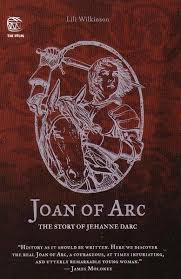
Joan of Arc. The Story of Jehanne Darc


I'm really quite obsessed with Joan. It's an impossible story. Fantastic. Extraordinary. Almost surreal. But it seems to be real. So I was keen to read this book when I found out about it. Joan of Arc was Lili Wilkinson's first book. It was commissioned, and so far remains the only non-fiction book that she has written. I was very pleased to find that my library had a pack with the book and an audio version. I made the most of my recent trip to Newcastle and listened to the audiobook three times!


Fifteenth century France was quite a different one to the France of today. Much of Northern France was under English control. The Hundred Year war between England and France was three quarters of the way through when Jehanne Darc was born in 1412.

Legend says that when Jehanne Darc- Joan of Arc- was born at midnight on 6 January 1412, all the roosters in the village crowed, as if they were heralding a new sort of dawn. 
The story starts and ends at a rather obvious place, Joan's very public death in the Old Market at Rouen.

People who watched Joan die claimed that they saw angels around her head; that a dove flew from the heart of the fire; that the words Jhesus-Maria were written in the flames; that a halo appeared above her head; that her heart remained full of blood, even when the rest of her was reduced to ashes.

Joan's" trial" was pure farce, as I suspect many medieval trials were.

The man chosen to break Joan was the Bishop of Beauvais, Pierre Cauchon. Cauchon was 60 years old, a Burgundian, and a very intelligent, cunning and cruel man. Cauchon had been promised by the English that if he could find Joan guilty, he would be made archbishop of Rouen. 

Any wonder that Joan was found guilty then? She did make him work for it even though the odds were seriously stacked against her.

On the prosecution side, there sat a cardinal, six bishops, 32 doctors theology, 16 bachelors of theology, seven doctors of medicine, and 100 other clerics. On Joan's side, there was just Joan. 

Once again Charles, the king that Joan put on the throne, comes under heavy criticism.

From the day Joan was captured, till the day she died Charles made no attempt to help her. The laws of chivalry stated that any noble or captain could be ransomed, but Charles never offered to ransom Joan. 
Charles waited 21 years to save Joan. He then wrote a letter to the pope seeking to have an official trial of rehabilitation, which could officially annul the Trial of Condemnation where Joan was declared a heretic.

I've seen many images of Joan before,
but not this one I think

The structure of the audiobook was a bit confusing at times, as there are historical notes and asides liberally peppered throughout the narrative- which is of course obvious in the book format but not so much in the audio. Covering interesting topics such as Women in Medieval France, Saints especially Saint Michael, Catherine and Margaret who spoke to Joan, these notes give an invaluable historical background to Joan's story. Lili Wilkinson also uses many primary first hand accounts of Joan's life, actions and her trial which while fascinating, did not always slip easily into the audio either. This book is the second I've read about Joan that strongly recommends Regine Pernoud's Joan of Arc by Herself and her Witnesses. I must have it. Lili Wilkinson did a great job of telling Joan's story, I look forward to reading some of her fiction too.


French Bingo 2016

http://australianwomenwriters.com

Saturday, 21 November 2015

La Basilique de Saint Denis

Saint Denis has been in the news this week, for all the wrong reasons. It is never good to be reduced to a hashtag. #SaintDenis. Thankfully I have happier memories of Saint Denis in 2013.

The area of Saint Denis is not really on the tourist trail. It is a northern suburb of Paris, easily accessible on the Metro, and the draw for me was a visit to the rather amazing Basilique de Saint Denis, an incredible gothic cathedral which serves as the Royal Necropolis for France. Fascinating stuff. I meant to do this post way back in 2013, but well I didn't, and so I've forgotten some details.

A side view

Poor old Saint Denis always without his head

The front was undergoing restoration
when I visited in 2013


Joan is never far away at any French church as there is usually a statue of her,
but Joan actually visited here for a blessing in 1429.
Incredible.

Extraordinary robes and crowns used in
anniversary services for the death of
Marie-Antoinette

I always love a rose window

François 1er and Claude de France


Tomb of Louis XII and Anne de Bretagne


Louis XVI and Marie Antoinette


Their feet were most often resting on animals, often lions,
sometimes dogs or other animals. 


Henry II and Catherine de Médicis


The crypt was amazing. I still remember how cool and eerie it was on this rather hot Paris summer afternoon. 

The tomb of Saint Denis


Poor old Saint Denis again.
I think they could have left out the spurting and dripping. 
The heart of Louis XVII
(son of Louis XVI and Marie Antoinette)

I felt sad for Louis XVII that his heart was in a jar centuries after his death. He saw his parents beheaded, the monarchy overthrown and he was to die just a few years later himself in 1795, still only a boy of 10. I'm not sure how it came to be that his heart was in a jar, but it was given to the Basilica in 1975 and after authentication it has been on display since 2004.

I read the marvellous Paris to the Past (see my review) as preparation for my visit to the basilica and I certainly appreciated it all the more because of it.

I spent a fabulous few hours in Saint Denis Basilica, the admission of 7,50 € is definitely a bargain. As ever I would suggest you get the audio tour if you're lucky enough to visit.

Saturday Snapshot is a wonderful weekly meme
 now hosted by 
WestMetroMommy

All About France a monthly
love fest for France

Friday, 12 June 2015

Fattypuffs and Thinifers


I'd never heard of the French classic Fattypuffs and Thinifers until I saw it on the (UK) Telegraph's recent list of 100 Best Children's Books Ever. Naturally I recognised that the author had a French sounding name, and my curiosity was piqued and so here we are, a few short weeks later, I've tracked down the book (not so hard actually with the recent lovely Vintage Classics edition) and read it. And what a delight it is.

Two brothers, Edmund and Terry find a secret entrance to a subterranean world while out on a walk with their father. Naturally the two inquisitive boys are soon heading down a moving staircase into the depths of the unknown.

Edmund and Terry would never have believed that a staircase could be so long. Down and down they went for more than an hour; down and down, through a half-darkness occasionally broken by red and green electric lights. 

The boys find themselves in a very strange world indeed.

The two boys were immediately caught up in the crowd. They passed through a doorway, and as they did so a fresh, cool breeze blew on their faces. They found themselves out in the open air and overlooking the sea, but although the light was very bright they could see at once that it was not sunshine. When they had another look they discovered that the whole countryside was lit up by huge luminous balloons floating in the sky. 

This odd subterranean world is home to the warring nations of the Fattypuffs and the Thinifers. Fattypuffs are rather large as their name would suggest- they eat a meal every hour, and then sleep for a quarter of an hour. While the Thinifers

are an extraordinary race who inhabit the opposite side of the gulf. They are horrible to look at, being excessively thin, bony as skeletons and yellow as lemons. They live in the most ridiculous way. They scarcely eat anything, they drink nothing but water and they even work without being made to. But all that wouldn't matter if they weren't so downright nasty. 

André Maurois was indeed a French author. He had a rather incredible life- running his family textile business, being an interpreter during the first World War, and becoming an author. Patapoufs et Filifers was first published in Paris in 1930, and translated into English in 1941. There are certainly echoes of the war to end all wars- while the prospect of Fattypuffs making trench warfare logistically difficult is treated with humour,  Maurois does not shy away from the harsh realities of war, the senseless death, destruction and injury. Joan of Arc even rates a casual mention. There are still words very relevant to the modern reader.

'But all the same, just because two nations have different tastes, that is no reason why they should shoot things at one another, and wound people and burst their balloons.'

Fattypuffs and Thinifers remains a delightful read even though it is over 80 years old. I'm not sure if this is a modern translation though as the translator is not credited (another translator labouring in the shadows). Some have suggested that the Fattypuffs and Thinifers is an allegory for French German relations, it may well be, and it can certainly be read as such I think, but it is more than mere allegory, it's a great story- funny, thought provoking and entertaining.


The Vintage Classics edition is beautifully illustrated by Fritz Wegner, who sadly died in March.


French Bingo 2015

Monday, 10 June 2013

Joan of Arc


I really thought that I'd love this book. It should have been a no brainer for me. Michael Morpuro is fabulous, his Private Peaceful remains one of the most moving books that I've ever read. And I've been quite fascinated by Joan of Arc since 2011. Sadly though, it wasn't meant to be.

While I'm still fascinated by Joan's story I found this book hard going. Michael Morpurgo uses a story within a story technique to tell Joan's rather famous story. Sixteen year old modern girl Eloise Hardy grows up in Montpellier under the shadow of a portrait of Joan of Arc.


Eloise is quite fascinated with Joan, and after her family moves to Orleans she enters an essay competition to win the chance to be Joan for a day, leading a procession to mark the anniversary of the relief of Orleans on May 8. Which is ok, but then Joan's story is told with Joan being kept company by a white sparrow called Belami. For some reason this annoyed me from the get go, and my interest in the book never recovered.

Of course there are interesting facts along the way (and I do believe that this is rather a faithful retelling of Joan's life).

15th century France was quite different
Joan hates the Burgundians even more than the English who have occupied Northern France for many decades.

They're of our blood, they're French, and they ally themselves with the English, parcelling up the country, my country, as they see fit. English, Burgundians, they raid and rob wherever they want, and we have no power, nor any will, it seems, to stop them.

Joan jumped from the tower at Beaurevoir

Joan was betrayed by the very king that she spent her life fighting for, the king she saw crowned in Reims. 

King Charles himself, it seemed, the king she had restored to his throne, had personally ordered the bridge to be destroyed, and the attack on Paris to be halted. Behind her back he had come to terms again with the Burgundians and the English. Paris and the north of the country would be left to the Duke of Burgundy and the English, if he could keep all the conquests to the south. The king was going to disband his army, her army, leaving the English still in France. 

Throughout Joan refers to the English as Godoms, a term unfamiliar to me, and one that I've had no success Googling. There is no glossary, and it isn't in my Shorter Oxford Dictionary either. These English Godoms were to pay 10,000 pounds for Joan. 

After her trial, Joan was sentenced to death in the cemetery at Rouen, she then recanted her story about her voices, her apparitions. The next day she was to retract her recanting, and was of course burnt at the stake in the market place of Rouen.

There were no cheers now. Many cried openly at what they had just witnessed. 'We are lost,' said one of the English soldiers. 'We have just burnt a saint.'


Also published as Sparrow
Books on France, a great 2013 challenge from Emma at  Words and Peace

Dreaming of France, a great Monday meme
from Paulita at An Accidental Blog

Monday, 1 April 2013

France


I'm a great fan of Horrible Histories on the tele. There are many, many books of course, and like most things the books came first. I haven't read all that many of the books. I read Gorgeous Georgians last year and loved it. As more research for my upcoming Continental Grand Tour I've just read France, even though I was more than slightly outraged at Terry Deary's recent comments about libraries

I didn't love France as much as Gorgeous Georgians. Perhaps it was familiarity with content to some extent. I found the early parts about France in the Dark and Middle Ages to be quite confusing. Of course Horrible Histories doesn't always try and present a cogent, linear narrative of history- they are too busy chronicling the terrible, grisly deaths of many of our forebears. And that's ok to get kids interested and reading history- which is what the series has achieved, but if you are trying to understand the history not just find an assortment of gross facts then it may not be what you are after.

Still, I think it did put the French Revolution in some context for me. Even though I studied the French Revolution in my own personal Dark Ages of High School, I'm not sure that I remember all that much from those studies. Of course I've learnt some things as an adult which helps. France helped me realise that in the 1000 years leading up to the revolution of 1789 the French people had lead a very marginal existence with poor diets, too many taxes, and often being killed in droves by soldiers. Rich kings and starving peasants had been the norm for centuries. There were flour wars in 1775. Which perhaps helps explain the rather extreme laws regarding bakeries to this day in France- bakeries are regulated so that they can't all be closed in a particular area, they are also given a schedule as to when they can close for holidays.

France did of course also present many interesting facts. Here are some of my favourites. 

In the Middle Ages the French made a sport of catching young swans.

Joan of Arc didn't defeat the English, but she united the French, and the English never recovered from the defeats they suffered at her army's hands. 

Charles VI (1368- 1422) really was quite mad, among other things he imagined that he was made of glass, and had steel rods put into his clothes so he wouldn't shatter if he fell over. At one time he was treated with 250 oranges, and apparently this cured him for a while. I've come across fascinating snippets about Charles before. I must find out more about him. 

Francis I (1494-1547) was quite the patron of the arts. He acquired the Mona Lisa from Leonardo da Vinci. France claims that he hung it in his bathroom. I'd forgotten about the Leonardo- France connection despite accidentally finding an exhibition about him when we toured the Loire in 1998, and having walked the double helix staircase at Chambord that is attributed to him. 

Marie de Medici wore the most expensive dress in history. Worth 10 million pounds today, it had 3,000 diamonds and 39,000 pearls. She wore it once.

Picture source
I imagine that it was this one, her coronation dress, worn on 13 May 1610 at St Denis (I'll be going there!). What a week that must have been. Crowned Queen of France one day. Her husband assassinated the next day, and she then became regent until her eldest son Louis XIII came of age. 

France banned tobacco sales in 1635! Seems it's true

Louis XIV adopted wigs because he was bald, and heels because he was short. 

The French helped the American people to rebel against the English. 

Louis XVI helped advise Dr Joseph Guillotin with his terrible invention. Later Louis XVI's neck was too fat to be killed swiftly at the guillotine. This seems surprising as he had been imprisoned for some time before his death, and even if he had a fat neck I would have thought that a period of imprisonment would have corrected that. 

Napoleon sold off the land in the Louisiana Purchase to America in 1803 to raise money for a war against the British. Napoleon may have been killed by arsenic poisoning. 

Madame Tussaud was a real person (I had never thought about that) who made wax masks from the severed heads filling guillotine baskets. Her page on wiki is quite fascinating.

Somewhat controversially I think France claims that the Eiffel Tower was built for the 100th anniversary of the Revolution, and that her 289 metre height was in reference to the date of the revolution. Would Gustave Eiffel have designed his famous tower in metres in the 1880s? I can see that the 1889 World's Fair/ Exposition Universelle was held in France as a centenary event, but I'm just not sure about the height having any deeper meaning. Further research is required I think. 

Books on France, a great 2013 challenge from Emma at Words and Peace

Dreaming of France, a great Monday meme from Paulita at An Accidental Blog

Saturday, 29 September 2012

Surprising Melbourne

I always love going to Melbourne. I love the known and the unknown of it. Some things you know will happen, and they will be wonderful. Some things are unexpected, and also wonderful. I knew the Melbourne Writers Festival would be fantastic. I didn't know that I'd go in for a bit of big game hunting.

I used to visit Melbourne quite often.

Now I only get to visit once in a Blue Moon
Some things stay the same.

They're crazy about football in Melbourne
While some things are new.
A Paris style bike hire scheme
but in Melbourne you can hire helmets too
 They seem incapable of designing a new building that has flat walls.


Glimpses of spring


Asparagus!

 Sometimes you see a massive goose in the city for no apparent reason!


I've seen this guy before- in the middle of nowhere in NSW.
Instantly recognisable in his wacky racers garb

Sometimes you find a little unexpected flash of France

Joan of Arc stands guard
 at the entrance to the State Library of Victoria

While I saw a real peacock at Melbourne Zoo, there were lots of peacock hued girls. Fashion?


Or advertising?


Saturday Snapshot, is a wonderful weekly meme from at home with books