Showing posts with label Read Out Loud. Show all posts

Friday, 22 November 2013

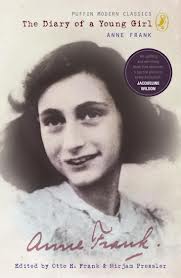
The Diary of a Young Girl


I'd been meaning to read Anne Frank's diary for many years. It was clearly a rather large omission to have not read it before this. But there was nothing like an upcoming trip to Amsterdam for the first time to get me there finally.

I started off reading this book out loud to Master Wicker as our night time reading. He didn't enjoy it from the outset (not nearly enough dystopian fantasy world for him, and no aliens, all major drawbacks), and it was hard going as a read aloud book. Which in turn made the reading drag. I did enjoy it much more after I gave up on the read aloud aspect (we switched to The Hunger Games which had a much more favourable reception) and just read it for myself.

Anne Frank and her diary are justifiably very famous. Anne and her family spent two years in hiding, living in cramped, crowded conditions in a factory annexe in Amsterdam during World War II. Of course Anne famously didn't survive the war, so the end is no mystery, but it's such an important story to tell.

I feel dreadful that I didn't love this rather beloved book. Even more because I didn't really like Anne's voice. I didn't like Anne all that much actually, which makes it difficult to read her first person narrative. I was interested in her plight of course, in everything she had to say, her descriptions of her experience of the war, and her living conditions and her moods. I feel my lack of enjoyment was more a failing on my part than hers.

It was shocking to read the limitations of freedom begin.

After May 1940 the good times were few and far between: first there was the war, then the capitulation and then the arrival of the Germans, which is when the troubled started for the Jews. Our freedom was severely restricted by a series of anti-Jewish decrees: Jews were required to wear a yellow star; Jews were required to turn in their bicycles; Jews were forbidden to sue trams; Jews were forbidden to ride in cars, even their own: Jews were required to do their shopping between 3.00 and 5.00 pm; Jews were required to frequent only Jewish-owned barbershops and beauty salons; Jews were forbidden to be out on the streets between 8.00pm and 6.00am; Jews were forbidden to go to theatres, cinemas or any other forms of entertainment; Jews were forbidden to use swimming pools, tennis courts, hockey fields or any other athletic fields; Jews were forbidden to go rowing; Jews were forbidden to take part in any athletic activity in public; Jews were forbidden to sit in their gardens or those of their friends after 8.00pm; Jews were forbidden to visit Christians in their homes; Jews were required to attend Jewish schools, etc. You couldn't do this and you couldn't do that, but life went on. 

I was really surprised to read Anne writing quite knowledgeably about what would later be called the Holocaust in August 1942.

If it's that bad in Holland, what must it be like in those faraway and uncivilised places where the Germans are sending them? We assume that most of them are being murdered. The English radio says they're being gassed. Perhaps that's the quickest way to die. 

I hadn't known that these things were actually known during the war. I'd thought that it was only after the war that people found out what had been happening. It was terrible reading Anne's descriptions of the privations of the family's time in hiding. The radio was constantly on as the families listen desperately for news and updates. The boredom, the fears of disease, of discovery, of destruction from falling bombs, and the terrible, rotting food.

It was heartbreaking to see Anne's moods over time, as she was robbed of her liberty, and her youth, and eventually of course her life.

I wander from room to room, climb up and down the stairs and feel like a songbird whose wings have been ripped off and who keeps hurling herself against the bars of its dark cage. 

And yet somehow Anne remains optimistic til the end.

It's utterly impossible for me to build my life on a foundation of chaos, suffering and death. I see the world being slowly transformed into a wilderness, I hear the approaching thunder that, one day, will destroy us too, I feel the suffering of millions. And yet, when I look up at the sky, I somehow feel that everything will change for the better, that this cruelty too will end, that peace and tranquility will return once more.

Anne wanted to be a writer and journalist and she's done that.

I don't want to have lived in vain like most people. I want to be useful or bring enjoyment to all people, even those I've never met. I want to go on living even after my death!

Anne is still living after her death. Her thoughts and words are still alive in the 21st century. And still worth reading.

See some photos from my visit to Anne Frank Huis.

Wednesday, 17 October 2012

The 26-Storey Treehouse


Silly me, I thought The 13-Storey Treehouse was a standalone title! But no, here in a timely fashion is the sequel, and I see  in the back that the third in the series, The 39-Storey Treehouse is scheduled for release September 2013.

Andy Griffiths and Terry Denton are a prolific Australian writing and illustrating kids lit powerhouse. Their books are extraordinarily popular. Andy Griffiths had one of the longest signing queues I saw at the recent Melbourne Writers Festival.

Here, Andy and Terry are still living in the their treehouse, although they have added on an extra 13 fun-filled storeys including an anti-gravity chamber, a dodgem car rink and an ice-cream parlour with 78 flavours run by an ice-cream serving robot Edward Scooperhands.

The 26-Storey Treehouse tells the rather tall stories of how Andy and Terry met, and how they met their friend and neighbour Jill who lives on the other side of the forest. It involves emergency self-inflating underpants, open-shark surgery, pirate captains with wooden heads and large fish who smell like blue cheese. It's all rather improbable, and that's a whole lot of the fun, right there. I enjoyed this book more than the original, whereas my 11 year old preferred the 13-Storey Treehouse.

You can hear Andy Griffiths speaking about The 26-Storey Treehouse on Books and Arts Daily recently at Radio National. Or his rather eclectic selection of his top 5 favourite cultural items on Top Shelf.

Friday, 3 August 2012

Henry VIII's Wives


Sometimes my son picks an intriguing choice for our read aloud bed time reading book. Yes, even though he's 11, I still read aloud to him whenever my work and his tv watching schedule allow. It's a time we both enjoy. Most often we're reading mythic tales of magic and dragons. Sometimes we're reading historical fiction. We've read a few books in this series now. Marie Antoinette. Titanic. And a few others that I thought too awful to blog about. I'm not sure why he's so keen on these but he liked them even before his passion for Horrible Histories developed.

He likes this series so much that he reads these books on his own also. He had already read Henry VIII's Wives, and when I needed a thematic break from magic and ancient monsters he was keen for us to read this one together. I'm glad we have. I don't really know all that much about Tudor England. It was certainly an extraordinary time. I was a bit confused with the diary format here. Our diarist narrator, Beatrice is just 10 years old when she starts her diary. She seems to be a servant in Henry VIII's court, but it's all a bit confusing. She's a servant but the servants seem to spend quite a bit of time with the members of the royal family- it seems that they are part of the court.

I was a bit bored with the overall format by the time we got to the end of this one. The structure was quite confusing being a melange of the diaries of several girls, and the narrative jumped back and forth in time over 30 years or so. And there was a bit too much about affairs and whether marriages were consummated for my liking for comfortable bed time reading.  But there were lots of interesting historical snippets to learn. I'm sure these things are known by most people with more than a passing interest in Tudor England.

Catherine of Aragon was a mere 15 years old when she initially married Henry VIII's brother Arthur, Prince of Wales. When Arthur died a few months later, Catherine was widowed aged 16. Henry famously married her, but then divorced her because of the biblical passage forbidding men to covet his brother's wife.

And if a man shall take his brother's wife, it is an unclean thing; he hath uncovered his brother's nakedness; they shall be childless.

While she was queen Henry left Catherine in charge of England while he went to war with the French, Catherine fought a war with Scotland and won.

Anne Boleyn and Jane Seymour were both servants before becoming queen. Indeed the whole servant/royal relationships as portrayed here were very confusing.

Anne Boleyn's uncle presided over her trial.

Anne Boleyn and Katherine Howard were cousins, as well as the two royal wives who were beheaded.

Katherine Parr was a published author! (You can buy her book on Amazon)

Henry and the Tudors are certainly still intriguing even in modern times. Historical fiction sells and sells, and the hugely popular Wolf Hall is set in Henry's court. Modern people have video fun with Henry.


And of course the Horrible Histories folks love Henry too of course.


Wednesday, 23 May 2012

Wondrous Words Wednesday 23/5/12


Wondrous Words Wednesday is a fabulous weekly meme hosted by Bermuda Onion, where we share new (to us) words that we’ve encountered in our weekly reading.  


I've been reading this series out loud to my 11 year old son. He loves them, me, not so much. I think he got a bit bored with this one, it took quite a while to get through. The Sorceress is Book 3 of Michael Scott's The Secrets of the Immortal Nicholas Flamel series, and moves the main action from Paris to London. Once again we are dropped right into a good versus battle with new monsters. Too many monsters I think. Still it gave me lots of new words.

1. Parvis (Noun)

Standing on the parvis in front of the cathedral in Paris, feeling the raw power flow through his body, watching the animated stone gargoyles shatter to dust, he had realized just how powerful he and his sister were.

i) An enclosed courtyard or space at the entrance to a building, especially a cathedral, that is sometimes surrounded by porticoes or colonnades.
ii) One of the porticoes or colonnades surrounding such a space. The Free Dictionary.

The faithful filling the parvis of Notre Dame

2. Mottes (Noun)

3. Barbican (Noun)

There are mottes and baileys, outer wards and an inner ward, a barbican, towers and keeps.

Mottes

i) (Historical term) A natural or man-made mound on which a castle was erected.
ii) (Texas) A copse or small stand of trees on a prairie
iii) (Upper Southern US) A tuft of human or animal hair standing up on the head or body. The Free Dictionary.

I love how all three usages are quite similar. Windsor Castle is a motte and bailey castle.

Picture credit
Barbican

A tower or other fortification on the approach to a castle or town, especially one at a gate or drawbridge


Picture credit


4. Buckram (Noun)

Leather bindings stood beside dusty buckram and yellowed vellum were shelved side by side.

A coarse cotton fabric heavily sized with glue, used for stiffening garments and in bookbinding.

5. Sepulchre (Noun)

Although he'd known about its location for decades, he'd never had a reason to venture down to face the Sleeping God before, and everything had happened so quickly yesterday that he hadn't had a change to examine the sepulchre.

A burial vault, tomb or grave.

I know I've seen this word before, but it's not one that sticks.

6. Triune (Adjective)

Others changed with phases of the moon or the seasons, while still other triune goddesses were simply different aspects of the same person.

Being three in one. Used especially of the Christian Trinity.

This one was reasonably obvious from context, but I still thought it was an interesting word.

Friday, 17 February 2012

Marie Antoinette


I've read a couple of these books now. Titanic, which was ok. And Pompei, which didn't inspire me enough to actually blog about it. But you can check out the Wondrous Words it inspired. Twice. Neither of those was a Royal story, and of course I'm quite interested in France, so was interested to try Marie Antoinette. Although of course, Marie Antoinette was actually Austrian, not French.

We meet Marie Antoinette as a 13 year old Austrian Archduchess, Maria Antonia, about to become engaged to Louis-Auguste, the Dauphin of France, who was to become Louis XVI. It's rather astonishing to realise that one of the most famous women in history. One of the most famous queens in history was married at 14.

The descriptions of her preparations to travel to France, the journey and her early days in Versailles make captivating reading. Maria Antonia becomes engaged to a man that she has never met, has never seen, and doesn't really know anything about. She waits anxiously for months for a miniature portrait of Louis-Auguste to be sent to her, and a painter comes from France to paint a portrait of her to be sent to Versailles.  Through the marvels of Wikipedia we too can see her likeness.

Very hard to believe that she is 13

Dolls were sent to her in Australia to model potential dress designs for her to choose. Rather ingenious really. Her journey to France as described is extraordinary. Coaches with chandeliers! What a rattle they must have made. She was then forced to strip naked to step onto French soil on an island in the Rhine River, as a symbolic rebirth as a future French Queen leaving behind her Austrian self.

The descriptions of court life at Versailles are also extraordinary. The family dine in public several times per week, with hundreds of people watching them eat. Three times a week everyone is required to attend the Grand Levee (Rising of the King), where the king goes through a reenactment of getting up and dressed. Every action is strictly controlled by etiquette, but there aren't enough toilets in Versailles, so visitors frequently void up against the walls or in the corners, and so the palace smelled like a urinal! Marie Antoinette's wedding procession passed through the Hall of Mirrors on the way to the Chapel. The book suggests her dress was encrusted with 4,000 diamonds. Certainly, it was a lavish affair, which would put modern day celebrity weddings to shame.


It's amazing to think that now just anyone, even Aussie tourists can wander the halls


and look at the same amazing sights that Marie Antoinette did

Even royal births are public spectacles. Over 150 people crushed into Marie Antionette's bedchamber to witness the birth of her first child, Princess Marie Therese, who sadly was to die before her first birthday. For such a rarified, privileged society this all seems truly bizarre. And this is before we start considering the behaviours involving official mistresses.

I hope she at least had some bed curtains to hide behind
The epilogue and historical note at the end of the book outline the rest of her tragic life. She had 4 children only one of whom was to survive into adulthood. And there goes my notions that one day my excursions into family history will turn up Marie Antoinette as a distant cousin.

In reading fictionalised history it's always difficult to know what's true. Certainly the facts of her life are true. Married at 14 to a 15 year old future king. The diary only covers the period from 1769 to 1771. But it's a fascinating glimpse into this period of world history, and a blessed relief from monsters stalking the streets of Paris.

Monday, 13 February 2012

The Magician, with bonus Catacombes photos


The Magician is the second in a series of six fantasy novels by Michael Scott, proclaimed as the 'King of fantasy' on the cover of each book. This has been the bed time reading for my 11 year old of late. We read the first book, The Alchemyst last year. Fantasy isn't really my genre, and I don't normally want to read long series of books. So I was wondering how I would go with this one. I'd enjoyed the first book well enough, but wondered at the staying power of my interest. Although in the past I have managed to read aloud all 21 of Enid Blyton's Famous Five, so obviously I can manage to keep going long after my interest has waned.

As expected, my interest did wane with this book. I was optimistic at the start as it is set mainly in Paris- and for me that can make up for lots of things. The Paris story line was ok, but I found myself more interested in the storyline set in San Francisco (it was better and more exciting I think). Our reading was disrupted with breaks for holidays and other things, and I think my enjoyment suffered all the more because of that. So while the action in the book takes places once again over a mere two days, it did become a bit long and drawn out as a reading experience. I found myself getting confused about which monster was which, and who smelled of what when they were doing their magic.

We did get through it though, and my son is keen to continue the series. We have three more sitting about the house, and the sixth book is due out mid year. I think his interest in fantasy is larger than mine. And that's fine. I do find it interesting how Scott has managed to blend figures from most of the major world mythologies and turn it into a modern story, and enjoy that aspect.

Much of this book was set in the Catacombes of Paris. We were lucky enough to visit the Catacombes on our last trip to Paris. We even went twice as the queue was much too long the first time we visited, so we returned early one morning to be there when they opened. They are a gloomy, weird and creepy place to visit, and makes an excellent backdrop for a fantasy story. My son really enjoyed that we had been there- even though he was a bit freaked out about it at the time!


It can be a bit overwhelming

Femurs and skulls been placed with such care and artistic precision at the front
(and then there is a big jumble of bones behind this veritable fence of bone)
The Catacombes de Paris were created in the late 18th century because the cemeteries of Paris were overflowing, so there was nowhere to bury the recently dead. A decision was made to use the old quarries that crisscross under the city as a vast underground ossuary. It has been open to the public since 1874. It is a remarkable and sobering place to visit. It is estimated that 6-7 million people now lie interred there.

Friday, 21 October 2011

The Alchemyst


Sometimes it's good to get taken out of your comfort zone. And Irish fantasy is definitely out of my comfort zone. For some reason my 10 year old was captivated with the covers of this series of books, yes kids do judge books by their covers, just like we do. Recently it came the time to start on the first of the series for out bedtime reading. I was dreading it somewhat, although a friend at work had gushed over the series late last year, and she'd read them for herself, not to her kids. If she enjoyed them, perhaps I would be proved wrong? Thankfully I was.

What do we get? Immediate action from the very first page! Fifteen year old twins Sophie and Josh are spending the summer working in shops very near each other in San Francisco. Sophie in a coffee shop, and Josh in the book shop directly across the road. Doesn't sound like the setting for too much excitement, but within pages we are drawn into another world completely. A world where the legendary figures of mythology are real, and still living.

It must be said that my knowledge of mythology isn't that vast. So names like Yggdrasil, Bastet and Scathach don't mean that much to me, and making reading aloud rather cumbersome at times as I stumble across these unfamiliar sounds. But fear not, you don't actually need to undertake an online degree in Norse or Celtic mythology to enjoy the book. Indeed it was only after we finished reading this book, that I wondered if indeed these were indeed real mythologic identities. Michael Scott dips into most of the major world myths and legends at times, to weave an intricate, yet believable fantasy (I know) adventure. But really, once you've suspended one lot of disbelief then whole lot may as well go, no?

It's a classic good vs evil tale. The good here being headed by Nicholas Flamel, and the bad by Dr John Dee. Nicholas Flamel was a real person who lived in Paris in the 14th century. He was a scrivener and an alchemyst. Apparently he figures in the first of the Harry Potter books, but I've only read that once, in 1999, and can't remember. For some reason after he died his grave was opened and found to be empty, thus it was rumoured that he was immortal. There is a Rue Nicholas Flamel and an Auberge Nicholas Flamel in Paris. I know that the young fantasy fan will be keen to see these on our next trip to Paris (there is always one in the planning stages).

Picture credit


The evil is headed up by Dr John Dee, who again was a real person, living in 16th century England, and an advisor to Elizabeth I. Michael Scott describe him as "one of the most brilliant men of his time" in the Author's Note at the back of the book. Here he is working at the behest of the Dark Elders, and has a stench of sulphur when performing his acts of magic. There is an incredible array of monsters that must be battled in their various forms. It's great fun.

Quite incredibly all the action of this book takes place over a mere two days, starting in San Francisco, and moving to various places in California. It's all tied up a bit neatly in the end, but I think we can forgive him that at this stage. I'm quite keen to move on to the second book in the series, The Magician. I'm not sure if the enthusiasm will last for all six books (I'm not all that good with really long series), but hopefully we can get through the first five and be ready to await the final instalment, The Enchantress, sometime in the middle of 2012.

Friday, 19 August 2011

Mr Popper's Penguins x2

It's not often that I prefer the movie version, and the Jim Carrey movie version at that, to the book. I am usually rather sceptical of any Jim Carrey offering. I was however pleasantly surprised by the recent movie version of Mr Popper's Penguins. I knew nothing of the story, indeed I've only heard of the book in the last few years. It wasn't all that well known in Australia prior to this years movie. I took my son one afternoon during the school holidays, the cinema was rather packed with children who all laughed away at the movie. I got the occasional laugh too. Farting, honking penguins slip sliding around will always be funny.

It turns out that the move version bears scant relation to the book. The characters do generally have the same names. There is indeed a Mr Popper who receives penguins in the mail. The movie Mr Popper lives in New York, where he is separated from Mrs Popper, and has some sort of mercenary real estate job. He lives in a flash apartment and has buckets of money.


The Mr Popper of the book is rather poorer, working hard to support his family as a painter and decorator in Stillwater. He too receives a penguin in the mail, although from a different source than the movie version.

Perhaps because I didn't grow up with this book, it seems a bit dated? I read this book aloud to my 10 year old son for bedtime reading after we had seen the movie. We finished it, but he was never that enthused, and I must say neither was I. As a read aloud book it was rather tricky- too many times Papa and Popper where in the same sentence!


Tuesday, 10 May 2011

Titanic

I have always loved the nightly ritual of reading to my young son. It has been an ongoing pleasure for both of us, and not one either of us is ready to give up yet, even though he is 10 1/2 now. We don't get to read every night, as he will want to watch tv shows some evenings, and my work roster interferes quite frequently. But I try to read to him a few nights a week at least.

Recently the selections for bed-time reading have taken a somewhat unexpected turn. For months I had been plodding through Series 1 of Emily Rodda's Deltora Quest with him. We have finished book 6 of 8, which coincidentally is how far he got when he read them by himself. It takes quite an effort to get through 8 books that are essentially the same. Although a few years ago I did read ALL 21 of Enid Blyton's Famous Five books out loud. And I still haven't received my nomination for mother of the year!

Lair of the White Worm redone for kidlit?

We left behind the seemingly endless battles with fearsome monsters in the seemingly endless Deltora Quest, and turned towards...... Princesses and Girl's Diaries? It all started with this book, which my son has read, and I have not. The librarian at his new school shows the children all the new books that the library has acquired. For some reason this book captured his imagination, he borrowed it immediately, and read it on his own over the next 7-10 days. Rather unusual behaviour for him, he doesn't often read on his own, but is starting to recently.


He then went on to search out other books in this series, and the companion My Story series. Thus we have just read Titanic. An Edwardian Girl's Diary 1912.


I have been somewhat bemused by my son's fascination with this series of books. I've read and enjoyed some of the Australian series, My Australian Story before, but had not read any of these. I remember quite an engrossing account of the Spanish Flu of 1918-9 affecting a family in Melbourne read in this way. Perhaps it's the diary format that intrigues him? Needless, I was very interested to read this book with him.

Titanic is the story of Margaret Anne Brady, a fictional oprhaned girl of Irish extraction who has been put in a London orphanage for girls by her brother, her only surviving family member, when he could no longer look after her. Somehow Margaret Anne is selected to be the travelling companion for Mrs Carstairs, a rich American who is returning to America on board the very real Titanic on her maiden voyage.

The American version, published as part of a  Dear America series


The book has a rather formal feel to the writing, which is I guess representative of the time, but seems a bit stilted to read at times. I think it must be very difficult to get the tone and voice of a child narrator, especially one born a 100 years or so before our time. Thirteen year old Margaret Anne borrows Henry James, Ralph Waldo Emerson and Emily Dickinson from the Titanic library, and comments on the prostitutes in church when Sister Catherine takes her to Easter Mass before leaving London!

Mrs Carstairs and I took tea in the Cafe Parisien, instead of the lounge. The atmosphere is much less formal than the dining saloon, and we had a harmonious time. There is a light, airy feel to the room, complemented by numerous plants and wicker chairs. 

The vocabulary is interesting, and certainly there are many words my son asks the meaning of. Words that seem rather common-place to an adult reader- rivet, vicariously, petticoat, but which make you realise how a modern 10 year old has had no need for them until now.

These books seem more clearly aimed at girls, but somehow they have a very strong pull for my Dr Who obsessed 10 year old son. Actually I think Dr Who has something to do with some of his selections at least. Of the books that he's most keen to read- Titanic, Pompeii, Cleopatra, most have been featured in the new series of Dr Who. And he's certainly curious about anything Dr Who related. Of course as long as he keep reading I'm quite happy to read to him.

Indeed, I was very interested in the historical features of the book. There is some quite detailed historical information and photos at the end of the book. Of course I knew the Titanic sank in 1912 on her maiden voyage. I did not know that it was her Captain's last planned voyage before retirement, but of course he went down with his ship. I did not know that so many people died because there were only lifeboats for about 1,100 people, but that there were approximately 2,200 people on board (and this was more than they were required to have by law at the time! It seems astonishing with hindsight). Even so, many of the lifeboats were lowered only partially filled. And even knowing that the Titanic set sail with five grand pianos, a marmalade machine (?), and 12 cases of ostrich feathers is not enough to make me seek out the movie version of Titanic, which I proudly have not seen.

I just had to google marmalade machines!