Showing posts with label Guardian Children's Fiction Prize. Show all posts

Wednesday, 30 September 2015

The Village By The Sea


I knew from the outset that this would be an unusual book. The back cover blurb set the scene:


With their mother ill and their father permanently drunk, Hari and Lila have to earn the money to keep house and look after their two young sisters. In desperation, Hari runs away to Bombay, and Lila is left to cope alone. 

Cheery stuff indeed. Yes, although the main characters are children, they hardly have child like concerns. Lila and Hari are basically bringing up their two younger sisters as their father is incapacitated by drink, and their mother by illness. I did wonder if the mother was depressed, and wondered if it was possible for a third world mother to take to her bed. Probably not. 


Lila went in with a tumbler of tea for her mother. She stopped to add a little extra milk to it. Then she went past the curtain in the doorway to the room where her mother lay on the string bed on some old grey sheets. She herself looked like a crumpled grey rag lying there. She had been ill for a long time. No one knew what was wrong. She had no pains and no fever but simply grew weaker and weaker all the time. Now she could not sit up to drink her tea. 

The family live in a small fishing village called Thul, and while just a few kilometres from Bombay, it is a completely different world. Hari is forced to take on the role of provider for the family even though he is still a boy. 


What could he do? He worked in the field, he climbed the trees and brought down the coconuts to sell. When he had time, he took a net and fished along the shore. What more could he do? He knew it was not enough but it was all he could do.

The Village By The Sea is a family story at its heart but it's definitely set in the harsh economic situation and environmental risks of the real world. Overfishing threatens not only the livelihood of the professional fisherman, but means that Hari rarely catches a fish near the shore. Overpopulation, the rise of consumerism, overt threats from the chemical industry, and the many other threats to the rural village way of life are all highlighted. But the need to learn, to change and adapt to be successful is quite a pervasive theme throughout the book. 


Hari is overwhelmed by his arrival in Bombay- as I'm sure I would be too. His employment at the restaurant whilst lucky for him is dreadful in its own way too. 


The work was not easy in that firelit kitchen of the Sri Krishna Eating House that seemed to grow hotter and hotter and never to cool down even at night. The eating house never quite shut and customers had to be served with tea and bread or bread and lentils whenever they demanded it, day or night.... What he minded was not being able to leave the eating house and go home when the work was done. He was confined to it day and night: he worked in the kitchen and in the front room, washed and bathed under the tap at the back, ate his meals at the table when there was no customer around, and slept on the bench or sometimes on the dusty back floor. 

My favourite passage naturally enough was about birds. 


'The birds are the last free creatures on earth. Everything else has been captured and tamed and enslaved- tigers behind the bars of the zoos, lions stared at by crowds in safari parks, men and women in houses like matchboxes working in factories that are like prisons. Only the birds are free and can take off and fly away into space when they like.'

At the beginning of the book we are told that Thul is a real village on the Western coast of India. The story and these characters are based on real people in a town where Anita Desai spent many holidays. In the end I'm not quite sure what to make of The Village By The Sea. I wanted to love it, I wanted to get swept up in the grandeur of India- the colours, a life complete unknown to me. But I never was, and to be honest I found it slow going and well, a bit boring at times. The Village By The Sea won the Guardian Childrens Prize in 1983. But I wonder what kids think of this book? Both the western children for whom it was presumably written, and Indian children too.


275/1001

Sunday, 15 December 2013

The Peppermint Pig


The Peppermint Pig has one of the best opening lines I've ever read.

Old Granny Greengrass had her finger chopped off in the butcher's when she was buying half a leg of lamb. 

That's just fantastic. What kid doesn't want to read more about Old Granny Greengrass and her fingers? Sadly Old Granny Greengrass isn't much of a figure in the family story of The Peppermint Pig. The Greengrass family are living in London in the early years of the twentieth century. James, the father works as a coach painter, but has to leave his employment under rather odd circumstances. The four Greengrass children and their mother move to Norfolk to stay with family. There they take in Johnnie, the titular Peppermint Pig of the title. Johnnie was a runt, and sold off cheap by the milkman.

'Runt of the litter,' the milkman added. 'Too small for the sow to raise. He'd only get trampled on in the rush.'

 Johnnie soon becomes the family pet, and house trained.

"a pig has more brains than a dog, let me tell you."

But Johnnie isn't the main character of our story either. An intriguing slice of life, The Peppermint Pig gives us a great sense of life in Norfolk in 1910/11. Already historical fiction when written in the 1970s, we have a great glimpse of life in the pre-antibiotic era. The fear of sore throats when they could end a young life. Fever carts. Passing bells. Carbolic acid sheets and washes- although it seems it was also used as a medication. Nina Bawden uses such a wonderful vocabulary suitable for the time, and I love it when children's authors use words like slatternly.

The Peppermint Pig was quite an unknown entity for me. I'd heard of author Nina Bawden a little bit, she's most famous for one of her other children's books, Carrie's War, although it wasn't to win any particular prize on publication. The Peppermint Pig won the Guardian Children's Fiction Prize in 1976. Nina was a rather extraordinary woman, with the rather rare ability to write for children and adults- whilst she is most famous as a children's author, she was shortlisted for the Booker Prize in 1987 for Circles of Deceipt. Always one with strong political views, they helped shape her writing for both children and adults.

The initial impulse to write for children, she once explained, had come after she found herself depressed by the books her sons were reading, with their “wooden characters uninvolved in any reality I recognised. I think I wanted to give my children something that would encourage them to feel they could make a difference to what happened in the world.”

Nina Bawden often used family stories or personal experiences as the inspiration for her stories, or for added authenticity. Her own war time evacuation to Wales famously formed the basis for Carrie's War.

A great-grandfather on her mother's side was another skeleton, an "old tramp" who had taken to drink but still dropped in on the family from time to time. When Bawden put this character into The Peppermint Pig, her mother was furious, railing against the disgrace and against Nina's uncle, who had failed to keep the secret.

224/1001

Thursday, 5 September 2013

Thursday's Child


For some reason I was vaguely apprehensive approaching Thursday's Child. I'm not sure why. I know and respect Sonya Hartnett, and I've even seen a stage production of Thursday's Child a few years ago- it was an extraordinary piece of theatre, very moving. Perhaps it was the cover, which I don't think I like? I don't know. 


Any concerns I had were swept away in the first few pages as I was immersed in the world of the Flute family, primarily through the eyes of Harper Flute, who is 4 when we meet her. Her family eek out a marginal existence in rural Western Australia in the 1920s. Harper's father is a returned soldier and now supporting the family by trapping rabbits and selling the pelts. Da has been injured physically and mentally by the war, and now he drinks a bit more than he should, and we see the start of the Depression unfold through Harper's eyes. We see the day to day struggle to survive through very realistic words. 


This time, however, she hauled me to my feet and, with her free hand, slammed Da over the head. 'Don't you take your miseries out on a child,' she snarled. 'You're a coward,  you are, taking on like an infant. Do you think you're the only one living this life? You aren't. The children and I didn't ask for this. Get to your feet, you disgust me.'

We also see the subterranean world of Tin, Harper's younger brother, and the Thursday's Child of the title (Thursday's child has far to go), who takes to digging tunnels under the family house (always described as a shanty), spending more and more of his life underground. An impossible, improbable story that would be ridiculous in the hands of a lesser writer,  but Sonya Hartnett draws us effortlessly into the rather bizarre home life of the Flute familyEach time I picked up this book I found it compelling all over again, and was immediately drawn back into the Flute world.


Yet Tin's story isn't real. It can't be real, can it? But in Hartnett's hands I can easily suspend disbelief and not be worried by that too much. I generally don't like stories with magic realism elements, and I'm not sure it's that either. Thursday's Child somehow defies classification for me. I've read a few Sonya Hartnett books before, she has written for children and adults, and they often don't seem to be easily classified reads- it's almost like she creates her own genre, and that changes slightly with each new book. It's not all grim and depressing though, there are moments of great humour. 


I talked to him to keep him distracted, ....... and what would the baby be, a new boy or a new girl? We had two of each already, not counting Mam and Da, so things were pretty equal as they stood and it would be a hard blow to the side that came away the minority. I thought it was a shame that only babies could be born,whichever it turned out being. I could think of plenty of other things I would have preferred to get for nothing. 

Thursday's Child is such a powerful, moving story. Beautiful writing stopped me in my tracks on many, many pages. 


My heart is calm now, although it is an uneasy, fitful calm, like the sleep of an ailing person.

I should start a list of books that I mean to reread, and I should put Thursday's Child on that list. 

Tuesday, 28 May 2013

Flambards


I'd never heard of Flambards or KM Peyton before it came up on my 1001 Quest. I'd gone through the requisite horsey phase as a young girl, and read my share of horsey books too. Clearly I missed this book and the BBC miniseries of the early 80s.

Early on I got strong vibes of The Secret Garden, but the echoes of that book didn't last all that long. Christina's story is the classic orphaned tale in many ways. Orphaned as a young girl, she has been in the care of various relatives before being sent at 13 to live with her mean uncle at his estate Flambards. Uncle Russell is obsessed with fox hunting, something that made the story seem particularly dated for me. Hunting was banned in Scotland in 2002 and the UK in 2004. Young horsey girls growing up now may not know about the fox hunting activities of the past. 


Christina arrives on the very day that her cousin William has a bad accident whilst out hunting and breaks his leg very badly. William hates everything about horses, riding and hunting. I learnt quite a bit about hunting that I didn't know. I hadn't realised that hunting was so seasonal, or that people would go out three times a week chasing foxes about the countryside. Uncle Russell is a rather broken and embittered man since his own hunting accident which left him crippled and unable to participate in the sport that he loves so much. He seeks much solace in port, and is a cruel drunk in charge of an estate that is not well maintained, and actually crumbling about them. 


The roles of the servants and the misfortunes of their lives is a big theme. The horses and stable have many more servants than do the people living in the house, reflecting the status of the different buildings. Dick, the groom who teaches Christina to ride is the most sympathetic character in the book, but I was disappointed in the choices he made.


The Edwardian setting was interesting too with the advent of both the car and flying. While I enjoyed the setting I was never fully involved in the story. I didn't find Christina an engaging heroine for some reason. I think that I found her prospective involvement with her cousin as the most disturbing aspect of the book- more than the drinking, the violent behaviour towards humans and animals, and two families in decline. 

Monday, 1 October 2012

Watership Down


Somehow I didn't read this book in the 70s. I don't know how. It was certainly famous enough. I can't even think about the book, without the song flooding my consciousness. Perhaps a book about bunnies wasn't appealing enough to my teenage self?

So I was intrigued to start reading it recently. And feeling some pressure to love it I must say. Of my 12 friends on goodreads who have read Watership Down, 9 gave it 5 stars, the other three gave it 4 stars. It seems it is  a well loved book.

I was surprised to see it start with a rather bloody quote from Aeschylus' Agamemnon. Each chapter starts with a rather suprising quote actually- Greek plays, classic poems, Napoleon quoted in French. Shakespeare. Cosi fan Tutte in Italian. No dumbing it down for the kids there.

Most chapters are a mere few pages, making it easy to sneak in an extra chapter whenever you have a free couple of minutes during the day. A great way to make quick progress on what is a rather thick book. Watership Down was originally created as stories for Richard Adams' young daughters to pass the time during long car trips. The family were driving to Stratford-upon-Avon to see Judi Dench in Twelfth Night, when his daughters clamored for a new story, and their father began telling them a story about two rabbit brothers, Hazel and Fiver.

The book starts with immediate action, young Fiver senses a distressing premonition of danger for the warren.

But it's not exactly danger that I seem to feel about the place. It's- oh, I don't know- something oppressive, like thunder: I can't tell you what but it worries me.

Fiver's sense of impending doom drives an all male band of rabbits from their home at Sandleford Warren. They risk life and limb in their search for a suitable place to establish a new warren, and then attract some does to join them. I did wonder if the two other warrens that our band come into contact with, the odd group at Cowslip's warren who appear to have sold out, and the rather regimented life at Efrafra under the tyrannical General Woundwort were allergorical for a larger socio-political view. It was the early 70s after all. But no. Richard Adams denies that outright. He was just telling a story. With goodies and baddies, who just happened to be rabbits.

I enjoyed my time with Hazel and Bigwig and Fiver. I learnt quite a bit about rabbits along the way. Much of it makes sense if you think about it. They spend half their life underground. In burrows generally dug by does. Rather astonishingly in an overcrowded warren expectant mothers may actually resorb their litter if they are too stressed.

It's changed my life to learn that rabbits pass two kinds of poo. There were multiple references to particular rabbits eating pellets, which I passed over initially, but then wondered how wild rabbits could actually be eating pellets. Turns out it wasn't the pellets I was thinking of at all. Not manufactured food pellets, after all, that can't be. Rabbits pass two kinds of poo! Which makes no sense at all, but it's true. The hard droppings that we're probably all familiar with and soft viscous pellets that they reingest almost immediately, and I've never seen or heard of before. Happily for the rabbits they swallow these pellets without chewing.

It's hard to imagine how one tube of gut can produce two different sorts of poo. Like much of life it seems it's all in the timing. Food that enters the caecum (the first part of the large bowel) in the morning, undergoes little further processing and is then covered by a special mucus. These are called soft or night pellets, or caecotrophes if you want to be fancy. Food that enters the caecum at other times of day is processed differently- most of the water is extracted and the typical hard rabbit poos form. From the diagrams I found it seems that rabbit caecums are more of a sidestreet than it is in a human intestine. A fact of anatomy for which I for one shall remain eternally grateful.

Picture source
I really enjoyed this glimpse of the bucolic English countryside- so many plants, which of course would be vitally important to rabbits, and they would know all the names (if they spoke I guess). They have such wonderful names in English. Figwort. Fleabane. Pimpernel. Speedwell. Heartsease. Persicary.

The real Berkshire setting

And maybe, just maybe, I'll name my next dog Rowsby Woof. Or Fairy Wogdog.

Read as part of my ongoing quest to read 1001 Childrens Books You Must Read Before You Grow Up.

Friday, 18 November 2011

Finding Violet Park


This author and book were new to me. I was quite keen to read it, for some reason I really liked the cover even though I knew relatively little about the book. 

Finding Violet Park is the story of a 15 year old boy, Lucas, who comes across an urn of ashes in a minicab office. Lucas becomes quite obsessed with the ashes, the mortal remains of Violet Park, and he wants to free her from the drudgery of her final resting place. Someone had left Violet's ashes in the back of a cab a number of years earlier, and they sat there, unloved and unclaimed. Lucas wants to find out more about her.

If you think about it, a person being dead isn't any barrier to finding out what they are like. Half the people we learn about in school have been dead for ages. People write whole books about William Blake and Henry the Eighth and Marilyn Monroe, and they've never met them and they still sound like they know what they are talking about. 

I do have a soft spot for books written in an engaging first person narrative. While I wasn't completely swept away by Lucas, as I was by Cedar B. Hartley recently, I did enjoy it very much. As with all young, quirky first person narrators, Lucas is somewhat precocious in his observations. And naturally Lucas's life is fragmented, his father has disappeared several years ago, and Mum is doing her best to keep the family together.

The book deals with some serious subjects, but has a great sense of humour mixed in. There is a wonderful anti-smoking rant quite early on which starts with Lucas railing against the fact that tobacco 

"doesn't get you high. What's the point of being addicted to something that will kill you and doesn't even make you laugh or feel good or anything?"

Which makes a great deal of sense when you think about it. In one of my favourite sections Lucas is talking about his grandmother, Pansy.
Pansy has a dog called Jack (Russell) and sometimes I have no idea if she's talking about the dog or Grandad.
"He's been under my feet all day and his breath smells terrible." (Dog)
"he's not been for three days. I think he needs a good walk." (Norman)

Lucas ponders the pivotal moments in a life "chance happenings that end up meaning everything." And wonders if "all most people do when they grow up is fix on something impossible and then hunger after it."

We learn a number of interesting things along the way- such as Agatha Christie famously disappeared for 11 days in 1926. Was she really in a fugue state? Or did she deliberately run away? And thugs as a concept comes from 14th century India!


Wednesday, 14 September 2011

The Illustrated Mum


I was very excited to finally get to read a Jacqueline Wilson book. She is a children's book phenomenon. She has written over 90 books, selling more than 30 million books in the UK alone, and was Children's Laureate in the UK from 2005-2007. She has had a long term partnership with illustrator Nick Sharratt, which gives her books a very distinctive feel, much the same as the Roald Dahl/Quentin Blake partnership makes those books instantly recognisable.

Jacqueline Wilson is particularly famous for writing children's books that deal with non-traditional families with all too common problems- marital breakdown, drug and alcohol problems, mental illness. Her families aren't perfect. The Illustrated Mum is certainly one of those books. Marigold is the illustrated mum of the title. She is possibly alcoholic, she certainly drinks much more than is good for her, and she has untreated manic depression. She has two girls, Star and Dolphin, who she does love and is doing her best to bring up despite the chaos of her own internal world. Marigold uses her skin as a canvas for self-treatment and believes that each new tattoo will make things better, or at least represent her life struggles. 

As with many families where the parents aren't fully around for whatever reason, the children are older and wiser beyond their years, yet still wanting their mother to love them and parent them. The girls generally take care of things- shopping, cooking, getting themselves to school, although Dolphin has taken to wearing the same black,witch dress every day to school which she thinks gives her magic powers. She and her clothes probably aren't all that clean. But she certainly loves her mum, despite the chaos and uncertainty in each and every day.

Marigold's backstory is hinted at -the abuse whilst in foster care when she was a child, stints in psychiatric hospitals, and a stream of men with whom she has tried to find happiness or love. However she is still infatuated with Micky, Star's father, and dreams and plots of getting back together with him, even though she doesn't  know where he lives. Indeed, neither girl has met their father. 

I liked this story well enough, but wasn't as bowled over as I was expecting to be. Perhaps it was too much like a family I would see at work? Marigold, Star and Dolphin were certainly very real characters to me.  My copy (Corgi Yearling 2007) has an introduction by Jacqueline Wilson where she recounts her inspiration for this book. She was sitting in Central Park, New York with her daughter Emma when they noticed "a thin tattooed mother walking with two little girls in dress up clothes, tiaras in tangled hair, and skinny ankles wobbling in big silver high-heeled sandals". I certainly admire the fact that she can take this brief sighting on the street and turn it into such a thought provoking book. 

I find it really interesting that this book, and indeed this style of book is so overwhelmingly popular with young girls- and clearly they are. There is no doubting that. Jacqueline Wilson gets mobbed by her many young fans whenever she makes public appearances. Perhaps kids can see more of the family striving to go forward together no matter what the difficulties? Whereas as an adult reader I concentrate on the parental short comings and see what it is doing to the children? I am definitely looking forward to reading more of Jacqueline Wilson's work.

A few times Marigold and the girls dance around singing" I should be so lucky, lucky, lucky", this is a very obvious reference to an early Kylie Minogue song (a superstar here in Australia and in the UK, but she never had all that much success in the US)- ah the 80s! Ah Stock, Aitken and Waterman! We were all so young back then....


Monday, 16 May 2011

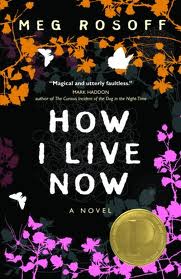
How I Live Now


I've been looking forward to reading How I Live Now since the enthusiastic reviews were published on the books release in 2004. Lots of glowing stuff. The Guardian labelled it an instant classic. Clever folks at The Observer wondered if she had dramatised adolescence itself, and externalised its inner landscapes. It won many prestigious prizes. Mark Haddon is quoted on the cover sprouting "A magical and utterly faultless voice".  The Australian reviews of the time were just as glowing. I was very keen to read it. Which is always a problem when you do eventually get to reading a book. What book can stand up to 7 years of hype and hope?

Still, I am glad to have finally read How I Live Now. It just didn't wow me in the way that I was hoping that it would. It's an interesting tale, well told. I like first person narratives. Here, we are inside the mind of fifteen year old Daisy, a New Yorker who goes to England to spend the summer with her aunt and four cousins that she has never met. Daisy likes using Capitals For Emphasis Quite A Lot. 

Very early on we get rid of all the responsible adults in the way of classic childrens books. Daisy's mother died in childbirth. Her father is married again to the pregnant, evil stepmother, so is essentially lost to her. Daisy has disconnected herself from them at least.  Daisy then travels to England, and her aunt has to leave the country on business for a week. All conveniently gone within pages of the start. 

How I Live Now is part of a larger trend of dystopian YA fiction that has been growing in popularity for the last 10+ years. I actually found it moderately similar to John Marsden's Tomorrow When the War Began, but not quite as compelling a page-turner for me.

Soon after Daisy arrives in England the country is invaded by an unnamed force, that quickly brings the country to its knees by bringing down the electricity and water supplies. Daisy and her four cousins are forced to cope on their own with their rapidly changing circumstances, and are quickly robbed of all the modern conveniences that we take for granted- phones, email, ready access to food, water and transportation. 

The book deals with some other big issues besides war and hardship- eating disorders and consanguinous relationships amongst them. Daisy is anorexic on her arrival to England. She explains this away as "not eating much", and that it came about because she didn't want "to get poisoned by my stepmother and how much it annoyed her and how after a while I discovered I liked the feeling of being hungry and the fact that it drove everyone stark raving mad and cost my father a fortune in shrinks and also it was something I was good at."

I wasn't quite ready for the violence in this book when it started, which is rather silly given that I know it's set in an England at war. But much of the time we are lulled into believing in a rather bucolic lifestyle with apple picking and cow milking. When the violence does start it's quite sudden and very brutal.

Perhaps I shall remember Daisy best for this line:
I don't get nearly enough credit in life for the things I manage not to say.
I feel similarly maligned in my own life. 

This is another book along the way on my quest to grow up.