Showing posts with label Paris. Show all posts

Thursday, 23 July 2020

Heartstopper Vol 1-3


I'm sick this week. Not super sick. In pre-COVID times I would have gone to work and struggled on, But in these times of modern plague no-one wants to see you, no-one wants you at work coughing and spluttering and spreading viral particles, so I've been at home since Friday, seven days and counting so far. I have the rest of the week off for plans that no longer exist so I thought I'd try and knock over 7 books this week. A big ask for me any week. But what better excuse to finally get to Heartstopper?

I've been aware of Heartstopper for some time, but wasn't aware of the genesis and birth of these books. Nick and Charlie the two main characters of Heartstopper were first side characters in Alice Oseman's first novel, Solitaire, which is the story of Charlie's older sister Tori. I haven't read Solitaire, and it's certainly not necessary. Heartstopper stands alone. Nick and Charlie were born when Alice Oseman herself was in high school, and came to life firstly as a web cartoon  in 2016 on Tumblr and Tapas (never even heard of that one), and then helped over the school fence by Patreon and Kickstarter in 2018, becoming a major success and have since been commercially published. 

Charlie Spring is 14 and in Year 10 at Truham Grammar School for Boys. He is the only openly gay boy at school having been outed the year before, he is in a secret relationship with Ben at the start of the book, but feeling used, and not happy about it when he is assigned to sit next to Nick Nelson in roll call. Charlie is the small, quiet, musical nerdy type while Nick is a rugby player in Year 11. 

Volume 1 tells the story of Charlie and Nick becoming friends and even rugby teammates rather than names on a roll. Volume 2 is the story of their deepening relationship, and my favourite volume. While in Volume 3 there is a school trip to Paris. 

Heartstopper is a lovely tale of nervous early days starting a new relationship, true at any age but especially for teenagers as depicted here. Insecurity, anxiety, self-esteem are issues for pretty much everyone, and regardless of the genders of the people involved. Charlie was bullied badly the year before when he was outed and this is a theme that carries through all the volumes. Identity, self-acceptance and kindness are also very well done.

I hope Heartstopper is widely available in libraries and particularly school libraries in Australia and around the world. 

Volume 3 take a school trip to Paris. Which must be it's own kind of hell. They hit all the tourist hot spots. Monmartre. The Eiffel Tower. The Louvre. Shakespeare and Co. Yes, I was going - tick, tick, tick. Been to all of those. Even graphic novel drawings of Paris make my heart beat a little bit faster. And let me sneak in a post for Paris in July, from which I have been sadly rather absent this year. 


Haven't we all been there?


There's great use of social media and texting as befits a modern book about teenagers. 


Heartstopper had a few major surprises for me. Alice Oseman is English and Heartstopper is set in an English high school. I'd presumed it was American. Not sure why.


So English, how could there have been any doubt?

At the end of the first volume there is a mix tape made by Charlie for Nick! Alice Oseman herself has put this list on Spotify. I listened to it while reading Volumes 2 and 3. I impressed myself by recognising the second song. Then realised it was Fleetwood Mac... the only other song I recognised was The Beatles. My teenager did much eye rolling. 

I was hoping for further mix tapes in Volume 2 and 3, but no such luck. 

Volume 4 is coming early in 2021 I believe, I'll be there. 

Saturday, 20 July 2019

French Film Festival

I live in a small town in rural Australia. We don't get a lot of foreign films here. The local film society screens one film a month at the local cinema. I can't always go though.

Of course all of Australia can watch foreign language films on the joy that is SBS. They've just started their SBS World Movies as free to air, which is fantastic. Well I'm sure it would be if I could access the channel. I haven't quite managed that yet.

Each year though there is the Alliance Francaise French Film Festival. And one weekend in winter we get 4 of those French films screened over two days as part of the travelling film festival.

I made it to two of them this year. I hadn't heard of either of them before this event.


Family Photo


The Trouble With You

I enjoyed Family Photo much more than The Trouble With You. Family Photo is an engaging family drama, covering 4 generations, a dementing nana, separated parents, three adult siblings with the daily problems of adult life, and at time tricky interactions with their own children. It was touching and funny, and set in Paris. 


The Trouble With You was a rather bizarre French farce. It was apparently the standout hit of Cannes 2018. Set in Marseilles, it tells a strange story of Yvonne, recently bereaved, and bringing up her young son. She is a policewoman, and her police captain husband died a hero. But all is not what it seems. There were definitely laugh out loud moments and situations, and I really liked our two leading ladies, Adèle Haenel and Audrey Tatou, but the action scenes were too violent for me, and there was a lot of cringing and squinting. 


I missed out on two films. 

Clare Darling
Girl
I'd really like to catch up on  both of those, but Clare Darling appealed more. 


Finding those trailers on Youtube I just discovered that there's already a movie of Heal the Living. Another book in my TBR that is already a movie.


The struggle is real. It's never ending...


Friday, 19 July 2019

Lullaby


I was so looking forward to reading this book. I'd bought the book, and I'd bought into the hype back when it was newly released. We all know what happens next don't we? Yes, of course I ultimately found this a disappointing read.


Lullaby was never going to be an easy read. The cover gives us a major clue with the first two sentences of the text.

The baby is dead. It took only a few seconds. 
But it gets off to a sizzling start.
The baby is dead. It took only a few seconds. The doctor said he didn't suffer. The broken body, surrounded by toys, was put inside a grey bag, which they zipped shut. The little girl was still alive when the ambulance arrived. She'd fought like a wild animal. They found signs of a struggle, bits of skin under her soft fingernails. On the way to hospital she was agitated, her body shaken by convulsions. Eyes bulging, she seemed to be gasping for air. Her throat was filled with blood. Her lungs had been punctured, her head smashed violently against the blue chest of drawers. 
And that's certainly a first paragraph to make you sit up and pay attention. Even if you don't recognise how terribly she is being managed in the back of that ambulance. Like my recent read Scrublands (see my review) this is another whydunit. The crime is once again graphically portrayed in the first few pages. There is no mistaking what has happened, only why. But I never got to why.

After that arresting, short first chapter we go back to fill in the story of how these two young children came to be dead.  It starts with Myriam and Paul, their parents selecting a nanny.

'No illegal immigrants, agreed? For a cleaning lady or a decorator, it doesn't bother me. Those people have to work, after all. But to look after the little ones, it's too dangerous. I don't want someone who'd be afraid to call the police or go to the hospital if there was a problem. Apart from that ... not too old, no veils and no smokers. The important thing is that she's energetic and available. That she works so we can work.'
Soon Louise is hired with glowing references. Yes the murderous nanny is called Louise which makes Lullaby the second book in a row for me with a main character, the baddie, called Louise. See my recent post on State of the Union. Louise has smooth features, an open smile, and lips that do not tremble. "She appears imperturbable. She looks like a woman able to understand and forgive everything."

Soon Louise has become invaluable to the household.

'My nanny is a miracle-worker.' That is what Myriam says when she describes Louise's sudden entrance into their lives. She must have magical powers to have transformed this stifling, cramped apartment into a calm, light-filled place. Louise has pushed back the walls. She has made the cupboards deeper, the drawers wider. She has let the sun in. 
Of course no honeymoon can last, and it is the same with this one. Cracks appear, and the relationship between the family and the nanny deteriorates. 

I found Lullaby ultimately disappointing as a psychological crime novel. I didn't understand Louise, or her motivations, how she came to do what she did. Yes, Louise has a sad backstory and a sad current reality, and she comes under new pressures, but still, horrificly killing the kids is where that takes her? I did enjoy the Parisian slice of life aspect of it. The glimpse into the life of a nanny in Paris. 

Around the children- who all look alike, often wearing the same clothes bought in the same shops, with their names written on the labels by their mothers to avoid any confusion - buzzes this swarm of women. There are young black women in veils, who have to be even gentler, cleaner and more punctual than the others. There are the ones who change wigs every week. 
Louise keeps to herself even here, and they wonder about her like we do.  
About Louise, the nannies know very little..... The white nanny intrigues them .... They wonder who she is this fragile, perfect woman...
Lullaby won the Prix Goncourt in 2016. The Prix Goncourt is the most prestigious and well known of the French literary prizes. I have to wonder about that. I doesn't seem literary enough to be a literary prize winner in English.  Lullaby was inspired by a real life American crime

The New Yorker did a big profile piece on Leïla Slimani in 2018. I read two American articles about her, both made the point that she was "laying claim" to an American story, or "cashing in" on it. Yes, I realise that second one is from the New York Post but it's an interesting view that they take on it. 


Lullaby was my first read for Paris in July 2019.


Thursday, 4 July 2019

Paris in July 2019


Can it really be time for Paris in July again? Seems so. It's certainly snuck up on me this year.

Paris in July is a month long celebration of all things Parisian (or French really) hosted by Tamara at Thyme for Tea. Her sign up post is here.

I had a momentary panic when I realised it was time for Paris in July. I hadn't made any plans for it. What would I read/watch/blog? I'm sure I can find something.

As with every July I will spend 3 weeks staying up late into the night watching the Tour de France. I'm sure there's lots of other French things I could watch on SBS. They even have a new free-to-air World Movies channel with lots of French content (but it seems I'm having trouble accessing it, I need to fix it).

I can go to any of my bookshelves/bookstacks and find some Parisian inspiration, so I quickly bundled some together for this month ....

There is more, a lot more

But the number one thing that I should try and finish reading is Les Mis! To my great shame I never finished it last year with the marvellous Les Mis Readalong. I got 900 pages or so into it. Then I haven't touched it since Dec 31 2018. Quite a while ago now. I need to crack on and finish it. I'm hoping that Paris in July will be the perfect push in the right direction. Even James Corden is pushing me in the right direction...


Sunday, 29 July 2018

La Grand Boucle/Tour de Force


I don't really remember when I bought Tour de Force, but I came across the DVD recently (in a stack in my house) and of course July seemed the perfect time to watch it, and so I put the disc in the player on Day 4 of the 2018 Tour. I wasn't planning to watch the whole thing but I enjoyed it so much that I missed the start of the Stage that night!

The start of the movie is a bit hokey, with a bit of trouble setting up amateur cyclist Francois' motivation to take on cycling the Tour -doing each stage the day before the actual cyclists. I believe lots of people do that, at least a stage or two for mere mortals, and certainly lots of amateur cyclists will take on the more famous tour climbs like the Col de Tourmalet, Mont Ventoux and Alpe d'huez. And in an amazing life imitates art there's an amazing group of amateur women cyclists (Donnons des elles au vélo) doing the full tour to push for a Women's Tour. They do it tough, the roads aren't closed for them.
We respect the traffic signs. We stop at red lights. We respect the rules,” Kalachova says.
Actually they're pushing for the return of the Tour de France Feminin which ran alongside the men's event from 1984-89, it has a fascinating history. I have enjoyed La Course (a women's race on the final day) the last few years, but it's a hard nights viewing. The Australian telecast of the iconic final day of the Tour starts tonight at 2330 and goes til 0400. A hard gig when you're working this evening, doing the school run in the morning, and working tomorrow evening. But I'll be on the couch for part of it and will wistfully think back on 2013 when I stood on the Rue du Rivoli for the final stage. 

Oh wait I'm supposed to be talking about La Grand Boucle... If I hadn't put in the hard yards on the couch over many cold July nights then I don't think I could have enjoyed it like I did. I understand the brigades of mad fans, the rituals and rhythms of the Tour, even the camera angles, classic shots. The Dutch jokes. I can't imagine being able to enjoy it quite so much if you weren't a cycling fan, or at least a Tour fan. There's a lot of in jokes. But it's a nice feel good movie. I'll certainly watch it again, next July, or perhaps even once more this July if I can sneak it in. 


Donnons des elles au vélo link to website in French
Donnons des elles au vélo link to news article in English

Paris in July 2018

Tuesday, 10 July 2018

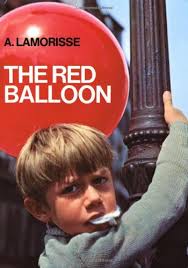
The Red Balloon


I only really learnt something of this book in 2016 when I made my list of Children's Books Set in Paris. I was immediately intrigued by the cover and bought it online that day.

The Red Balloon was the first book that I read for my first Dewey's 24 hour readathon back in October 2016. And I found it really disappointing.


The Red Balloon is actually still photos from a film of the same name and is surely one of the earliest movie tie-ins. The production quality of the book is really quite poor and the translation is terrible. 

Now usually when you let a balloon go, it flies away. But Pascal's balloon stayed outside the window, and the two of them looked at each other through the glass. Pascal was surprised that his balloon hadn't flown away, but not really as surprised as all that. Friends will do all kinds of things for you. If the friend happens to be a balloon, it doesn't fly away. 
Still the concept is delightful even if the execution falls somewhat short of the mark.  What child wouldn't love a balloon friend who will wait for him or her while they're at school and not fly away when your mother throws it out?

Then even more recently I discovered the 1956 film was available on SBS On Demand (this post has been languishing half-formed for quite some time, and sadly it's not On Demand any more, but it is on Youtube).  A mere 34 minutes long it won an Oscar for Best Original Screenplay and many other prestigious prizes including the Palme D'Or for Best Short Film at Cannes. It remains the only short film to win the Oscar for Best Original Screenplay!

This is one of those rare situations where the movie is so, so much better than the book.


The Red Balloon movie is a fascinating glimpse into a 1950s Paris which seems a far grimier Paris than the one we enjoy today. Wiki tells us that it was filmed in a part of Belleville that has since been largely demolished. It is an almost a silent movie with very little dialogue.


And now I see that there is a modern homage to The Red Balloon - The Flight of the Red Balloon/Le Voyage de Ballon Rouge (2008), the first French film by Taiwanese director  Hou Hsaio-Hsien.


I suspect that I'll be watching this sometime soon. It's currently on SBS On Demand for those in Australia. 

Balloons are still a big deal in Paris. Australian Anna Dawson moved to Paris and started walking around with a pink balloon, now she is an Instagram star with more than 135, 000 followers.

Paris in July

Friday, 6 July 2018

Claris The Chicest Mouse in Paris


Somehow I had missed the pre publicity for Claris, and so recently I was walking out of my local bookshop (having already bought four books) when I was stopped in my tracks by Claris in the window display. I hadn't noticed her on the way in, despite stopping to look at the Paris themed window. I gasped, turned around, walked straight back in and bought it. I love Paris, obviously. I love kids books. I love Megan Hess's illustrations. And now she's written a picture book. Such a no-brainer that I would buy it, I would read it immediately and that I would love it. All of those things happened.

Claris is the story of a small French mouse. She lives in the mountains of France but is no country bumpkin. Claris fashions haute couture creations from garbage bags. But her friends and relatives just don't care. She dreams of Paris and of finding the stylish people.

Claris gets a lift in a hot air balloon with two frogs, one in a beret. Claris arrives in Paris and sets off to find somewhere to live. There are some hazards along the way of course, like a grumpy cat, and a nasty girl who is a sneering snitch.


From the very outset (with the totally gorgeous endpapers) Claris is utterly delightful. I just love the contrast between Claris' designer outfits and her hairy, mousey little legs.


The story is told in rhyming couplets and is charmant. 

So while the mice feasted on crumbs of éclair,
 she read about handbags in Vanity Fair. 

My copy came with a delightful little Claris pin.


I'm generally too old to have Instagram envy, but oh, Megan Hess's life on Instagram! Can anyone really be that glamorous?


http://australianwomenwriters.com

Paris in July 

Wednesday, 23 May 2018

Les Misérables The Gorbeau Tenement/La masure Gorbeau V2B4


Oh how have I got myself into such a sorry state of affairs? I've kind of stopped reading over the past month or two. Well I am reading, but just a little bit, one book every few weeks, and then I'm not blogging them. I'm not quite sure why, or how, this has happened, but it has. I guess I'm slumped. Which when I read at a snail's pace at the best of times is more than a little bit dispiriting. Especially as it relates to #LesMisReadalong. 

I thought I was behind when I got back from Cambodia in March, but that was just a minor disruption compared to now. I'm too scared to look at how far I'm behind at this stage. I just need to get back on the reading, and blogging, horse and get on with it. 

The Gorbeau Tenement is quite a short book. It's predominantly scene setting as Jean Valjean and Cosette arrive in Paris. They take up residence in a rundown tenement at one of the very edges of Paris. "Like birds of the wild, he had chosen the most deserted spot in which to build his nest."
It was an inhabited place where there was nobody, it was a deserted place where there was somebody. This was one of the city's boulevards, one of the streets of Paris, a greater wilderness at night than any forest, bleaker by day than any cemetery. 
But naturally there are flashes of Hugo's humour and insight along the way. 
The building as a whole is no more than a hundred years old. A hundred years is young for a church and old for a house. It is as though a man's house is, like himself, short-lived, and God's house shares his eternity. 
We do get some more insights into Jean Valjean, and his relationship with Cosette in Chapter 3 Happiness in Shared Misfortune. 
Jean Valjean had never loved anything. For twenty-five years he had been alone in the world. He had never been father, lover, husband, or friend. In prison he was ill-natured, sullen, celibate, ignorant and unsociable. 
And yet "he felt stirred to the roots of his being" when he rescued Cosette.
This was the second vision of whiteness he had experienced. The bishop had brought the dawn of virtue to his horizon. Cosette brought the dawn of love.  
Cosette of course benefits from her rescue and begins to change. She has become cold-hearted by the age of eight, and no wonder. 
She was so young when her mother left her, she could not remember her any more. Like all children, resembling the tendrils of the vine that cling to everything, she had tried to love. It had done her no good. Everyone had rejected her, the Thénardiers, their children, other children. She loved the dog, which died. 
But I was most surprised when I came upon this sentence:
At times he imagined with a kind of gladness that she would be ugly. 
I initially read that as saying that Jean Valjean saw Cosette as ugly, but now I think that's wrong. He's hoping that Cosette would not grow up to be a beauty, to protect her and keep her with him.

Friday, 5 January 2018

But You Did Not Come Back


I must really have wanted to read this book because I've managed to buy it twice in the past few months. Though each purchase was during a buying frenzy at Basement Books. Entirely explainable. A French sounding author name, and once you pluck this tiny morsel from the shelf you see the cover picture of Paris (a wintry shot of Place de la Concorde by Robert Doisneau) and a blurb from Le Parisian.

One of the most beautiful books of the year ..... you will read it in one sitting.
And on a day when I'm casting about looking for three books I'm guaranteed to finish to reach my Goodreads goal for the year, then this is the time, this is the moment to read But You Did Not Come Back. It was a great, if sobering choice. I did read it in one sitting, albeit somewhat broken by a nap. 

But You Did Not Come Back is a letter written to her father. Marceline and her father were transported to Auschwitz-Birkenau in 1944. A father she lovesHer father wrote her a note whilst in the camps and managed to have it delivered to her. But Marceline can only remember a few words of what he wrote "I try to remember and I can't. I try, but it's like a deep hole and I don't want to fall in."


Marceline lives to return to France after the war, but her father does not, fulfilling his words of prophecy.

"You might come back, because you're young, but I will not come back."
Decades later Marceline is writing to her beloved father. Marceline describes the unimaginable horrors of Nazi concentration camps.
From my cell block, I could see the children walking to the gas chambers. I remember one little girl clinging to her doll. She looked lost, staring into space. Behind her were probably months of terror and being hunted. They'd just separated her from her parents, soon they'd tear off her clothes. She already looked like her limp, lifeless doll. 
More surprising to me perhaps was her account of returning to France. That she needed to sleep on the floor because she couldn't stand the comfort of a bed. That her family did not survive her father not returning, that her siblings and friends died from the camps without ever having been there. Marceline herself fought so hard to stay alive during the war and yet after she was to attempt to end her life twice. 

Naturally she talks a lot of life and death. 
As children, we knew about death and its rites: the black flag, the hearse that moves slowly down the street. We would encounter death and respect it, we were much stronger than people are today, they're so afraid of death...
After the war Marceline marries twice, her second husband is prominent Dutch filmmaker Joris Ivens. She becomes a film maker too, which gives her life a purpose.  
But in order to live, the best thing I could find to believe in, to the point of obsession, like my uncles before me, was that it was possible to change the world. 
Her thoughts on the current world situation are sobering.
I know that anti-Semitism is an eternal given; it rushes in waves along with the crises in the world, the words, the monsters, and the means of every era. Zionists like you predicted it: Anti-Semitism will never disappear. It is too deeply rooted in the world.
She talks of the creation of Israel, 9/11 and the troubled world in which we now all live. 
... I'm changing. It isn't bitterness, I'm not bitter. It's just as if I were already gone. I listen to the radio, to the news, so I'm afraid because I know what's happening. 
Which makes me even happier with my decision to stop watching the news nearly two years ago. It doesn't help. And all of which makes her opening words even more astounding to me.
I was quite a cheerful person, you know, in spite of what happened to us. We were happy in our own way, as a revenge against sadness, so we could still laugh.
An image of Marceline sporting her beautiful smile in her author photo on the back of the dust jacket.


Translated by Sandra Smith


Monday, 25 September 2017

Monsieur Chocolat


Tonight I went along to see my local Film Society showing of Monsieur Chocolat. I had never heard of it, and didn't know a thing about it, just that clearly it was a French film, and I remember Omar Sy from The Untouchables (which I remember fondly and should watch again). I wasn't too sure about the poster, and was nearly put off going, but am happy that I made the effort particularly after a friend who saw it yesterday encouraged me to go. I'm definitely glad I made the effort to get up off the couch. 

Monsieur Chocolat (Chocolat in France) tells the real life story of Chocolat who was the first Afro-Cuban star in France. Beautifully set in fin de siècle France (and Paris, aaah) it is a fascinating look at that time with glimpses of the Lumière Brothers at their work and the brand new Eiffel Tower. Chocolat (at that time working as a charicaturish cannibal Kananga in a rather impoverished provincial circus when he pairs up with Georges Foottit (played by James Thiérrée, Charlie Chaplin's grandson, Georges was in reality George Foottit, an English clown). It seems that the plot takes some liberties with the truth (if Wikipaedia is to be believed, and as always truth is stranger than fiction).


Chocolat finds great fame and wealth, but struggles with the downsides of his fame- the women, the gambling debts, the racism. The racial themes and the discrimination are particularly relevant for the cinema goers of today. There are powerful echoes to the current stories that fill our newsfeeds- a world where kneeling during an anthem is such a divisive controversy and unarmed black Americans are frequently shot by police. (Not that Australia is without racism it just seems to be done bigger and better in America, and we're having our own struggles with marriage equality). Whilst we must view it with our modern eyes it does seem that Chocolat did fight against racial stereotyping and the even more overt racism of his time. 

Monsieur Chocolat is well worth a look. 


Dreaming of France is a wonderful Monday meme
from Paulita at An Accidental Blog  

Monday, 18 September 2017

The Park Bench


I saw a few people talking about The Park Bench on booktube recently (although now I can't remember who) and was suitably intrigued. I was very happy to find The Park Bench on my first bookshop visit in Melbourne recently. 

Chabouté sounded like a French name which added to the appeal, and indeed it is. Christophe Chabouté is a French author and artist who seems to have had at least three of his books published in English this year. Not that The Park Bench requires all that much in the way of translation. An essentially wordless graphic novel (or rather more excitingly a Bande Dessinée, and it's my first Bande Dessinée), there is very little English- some graffiti, a few newspaper headlines. 

It would be fascinating to find and compare the original French version Un peu de bois et d'acier (oh dear, I actually think the English title is better). Actually there is no translator credited and the words appear in the actual images so perhaps Chabouté himself needed to redraw the particular drawings that contained words. It would be fascinating to know, but I suspect he did. I do wonder what the sad old Barbara Cartland reading lady reads in the French version.


The Park Bench uses an ordinary looking park bench in an unnamed  park to share the lives of the many people who use the park- those who quickly walk past on their way to work, those who have the time to sit and read or sit and share a patisserie, those who skateboard over the bench, the dog who likes to raise a leg on it. There is a homeless man who wants to sleep on the bench and a gendarme who chases him away each night, and as someone who has inadvertently transgressed the rules in a French park it is very true that justice is swift. I love that the park maintenance man is never seen without a cigarette dangling from his lips. 

The French use their parks in many different ways, Parisians leave their apartments and enjoy the extra space, the beauty and atmosphere in the parks as an extension of their home (see my glorious Sunday afternoon in the Luxembourg Gardens). I remembered all of this and more as I read The Park Bench. It's a beautiful celebration of community and life in all its forms, and a contemplation on the passage of time and progress. In a beautiful example of art imitating life The Park Bench was given away on some park benches in London. 


Completely drawn in black and white The Park Bench is a very eye catching book. While I was reading I was aware that while it was a super quick read, it must have taken Chabouté quite a time to create the book. There's a French film (and a concert)! This guy has made an animated film of the book it seems, and taken liberties by adding red. 


I'm very pleased to have discovered Chabouté and will be avidly searching out more of his books, in English and in French. 

Dreaming of France is a wonderful Monday meme
from Paulita at An Accidental Blog  

Monday, 29 May 2017

The Family Under The Bridge


The Family Under the Bridge has been in my Paris TBR for some time. I came across author Natalie Savage Carlson a few years ago when I found an old copy of Pigeon of Paris at a used book sale (see my review). So I ordered a copy of The Family Under the Bridge, which appears to be her most famous book, and was a Newbery Honor Book in 1959. I think it was when I was moving books around selecting my stack for the recent Dewey's Readathon that I saw it on my shelves again and knew the time had come to read it.

I suspect that if I knew it was quite a Christmas story then I might have left it to later in the year, but I'm sure I would have forgotten about it again by then anyway. It's a quick little read too, only 123 pages. Armand is homeless, or "an old hobo" in 1950s parlance. It is a cold December day when he gathers his possessions and moves back to his usual winter home under a particular Paris bridge. 

Down the quay he pushed the buggy toward the bridge tunnel that ran along the shore. On the cobbled quay a man was washing his car with the free Seine water. A woman in a fur coat was airing her French poodle. A long barge, sleek as a black seal, slid through the river. It was like coming home after a long absence, thought Armand. And anything exciting could happen under a Paris bridge. 

But Armand finds three redheaded children living under his bridge. They too have become homeless after their father died, and their mother couldn't afford their rent on her wages from her job at a laundry. 

It is a rather simple and wholesome story, with some gypsy characters who are friends of Armand.
"To think we have fallen so low," wept the woman. "My children at home with gypsies."
"What is wrong with gypsies?" asked Armand. "Why do you think you are better? Are you kinder? Are you more generous?"
"I'm honest," murmured the woman through her scarf.
I can't imagine that this book would come anywhere near Newbery Honor status these days. It feels somewhat saccharine sweet. I suspect that I wouldn't have found it appealing at all if it hadn't been set in Paris. 

Naturally, I did enjoy glimpses and insights into 1950s Paris. I was confused at mention of "the Louvre store", but did some searching and realised that it was referring to Les Grands Magasins du Louvre a department store that operated until 1974, and is now Le Louvre des Antiquaires. Les Grands Magazines had impressive doors. 


 "In the good old days of Paris," he told the children, "they used to ring bells in the market places at the close of the day so the tramps would know they were welcome to gather up the leftovers. But no more."


Dreaming of France is a wonderful Monday meme
from Paulita at An Accidental Blog