Showing posts with label art for arts sake. Show all posts

Saturday, 18 February 2017

Versailles Treasures From the Palace

I've visited the Palace of Versailles quite a number of times. On my first trip to France in 1998 we loved Versailles so much that we went back several times. At that time the fountains only ran on a Sunday afternoon so we had to go back to see them in operation. We even spent our last night in France staying in Versailles, the town, not the palace sadly, and had a magnificent dinner at a restaurant overlooking the palace gardens.

I returned to Versailles in 2010 and again in 2013. But Versailles is so vast that there are still areas I haven't been to as yet, and it's a magnificent spectacle each time. Each visit is equally memorable and  there's always something different, and I'd still like to go back to see more.

So last year as soon as I saw an ad for Versailles Treasures From The Palace at the National Gallery of Australia in Canberra, I did a sharp intake of air and knew that I would be going. What I didn't realise then was that it would turn into a family road trip to celebrate a special birthday, but I'm so glad that it did. Most of us had been to Versailles before in 2010 and 2013 and so it was special for all of us. The exhibition is magnificent and we had a great weekend of celebrations as well.

It's a beautiful exhibition. Breathtaking from the very first things you see. 


A 17th century gate
Gilded iron


Bust of Louis XIV 1665-66
Jean Varin or Warin


This was an amazing rug from the passage way between The Louvre (back when it was a royal palace) and The Tuileries (back when it was a palace). Huge and spectacular, this was just one rug of 93 carpets made to line the Grand Galerie linking the two palaces. They were never used though and remain in beautiful condition.


Carpet from the Grand Galerie du Louvre c 1682
wool and hemp
Charles le Brun designer
Atelier de la Veuve Lourdet, weavers, Paris


The French love a reliquary. 
Queen Marie-Thérèse's reliquary, 1665-74
gilded bronze, silver, paint on vellum


Vase with boars and Janus heads 1665
bronze
There were even sections of parquetry from Versailles! Who would think of ripping up the floor boards?


Armchair for Madame de Pompadour's residence at Crécy c 1745
Desk of the dauphin, son of Louis XV 1745

Even functional household objects got the Versailles treatment. 


Barometer 1773-75

There are several rooms that celebrate the magnificent gardens of Versailles. The engineering and plumbing innovations that had to be done to create the fountains that are still unrivalled anywhere else in the world with 17th century equipment and knowledge is incredible. There is a interesting short video displayed as well as artefacts, paintings and recreations of the gardens and fountains- it's an innovative and beautifully displayed. 

I've long held the notion that anything can be art if it's displayed just so.


Keys for turning on the fountains
late 17th-early 18th century, forged steel
I saw these in use in 1998!

One of my favourite part of the exhibition was a recreation of The Labyrinth that was installed in the gardens in the 17th century. I'd never heard of the labyrinth before, perhaps not surprisingly as it was taken down in 1774 and replaced with the Queen's Garden. 

Originally conceived by André Le Nôtre in 1665 as an undecorated maze, the crossroads of each path were furnished in the 1670s with 39 fountains decorated with 330 painted lead animals illustrating classical parables. These new additions were inspired by the publication of Jean de La Fontain's Fables 1668, dedicated to Louis XIV's six-year-old heir. 
 Only 35 animals have survived, and there were four or five presented here in a reimagined maze.


Etienne and Jacques Blanchard
(Fable XI)
The Monkey and his little ones

Much was made in the press before the exhibition about the inclusion of this magnificent sculpture. And rightly so, just getting Latona and her children to Australia was a tremendous undertaking. The statue had to be broken up for transport. But then to see it in place in the exhibition was astonishing. It was surrounded by a gorgeous audiovisual experience to recreate the experience of seeing the fountains at Versailles. It certainly did. I was moved to tears and sat watching it for some time. 


Latona and her children 1668-70
Marble
There was so much fascinating detail and objects that you don't see on a visit to Versailles.


Marie Antoinette's Harp 1775
A register of the menus served to the king in 1751
I was particularly keen on this trio of jam pots. 


Three jam pots and platter 1784
Royal Porcelain Factory of Sèvres


Versailles Treasures From the Palace is on at the National Gallery of Australia until April 17.
I might just go back. And as a member of NGA I already have my golden ticket... If for no other reason than that I totally missed the orange blossom perfume

Dreaming of France is a wonderful Monday meme
from Paulita at An Accidental Blog  

Saturday Snapshot is a wonderful weekly
meme 
now hosted by WestMetroMommy

Saturday, 7 January 2017

White Rabbit Gallery

The White Rabbit Gallery in Chippendale has been open since 2009, but I only heard about it more recently when Brona of Four Seasons went along to see the Vile Bodies exhibition. I was so intrigued by her post that on a recent trip to Sydney I made time to get along and see it, and I'm so very glad that I did. 

White Rabbit Gallery is particularly extraordinary as it is a private gallery that displays billionaire Judith Neilson's  massive collection of 21st Century Chinese Art. Entry is free. 

The atrium is filled with Zhang Dali's impressive Chinese Offspring 2005- it's captivating from every angle. 

Trussed and hung like slaughtered carcasses, Zhang Dali's naked bodies represent the millions of peasants who have quite the safety of family and village to seek work in China's booming cities. Many find themselves no better off for their gamble: poor, ill-housed and deprived of civic rights. "No one will help them," the artist says. But he doesn't know whom he pities more: these brave but desperate strays or the "herd animals" of the cities who close ranks against them. 


Gong Chenyu's Display Animal Taming 2015


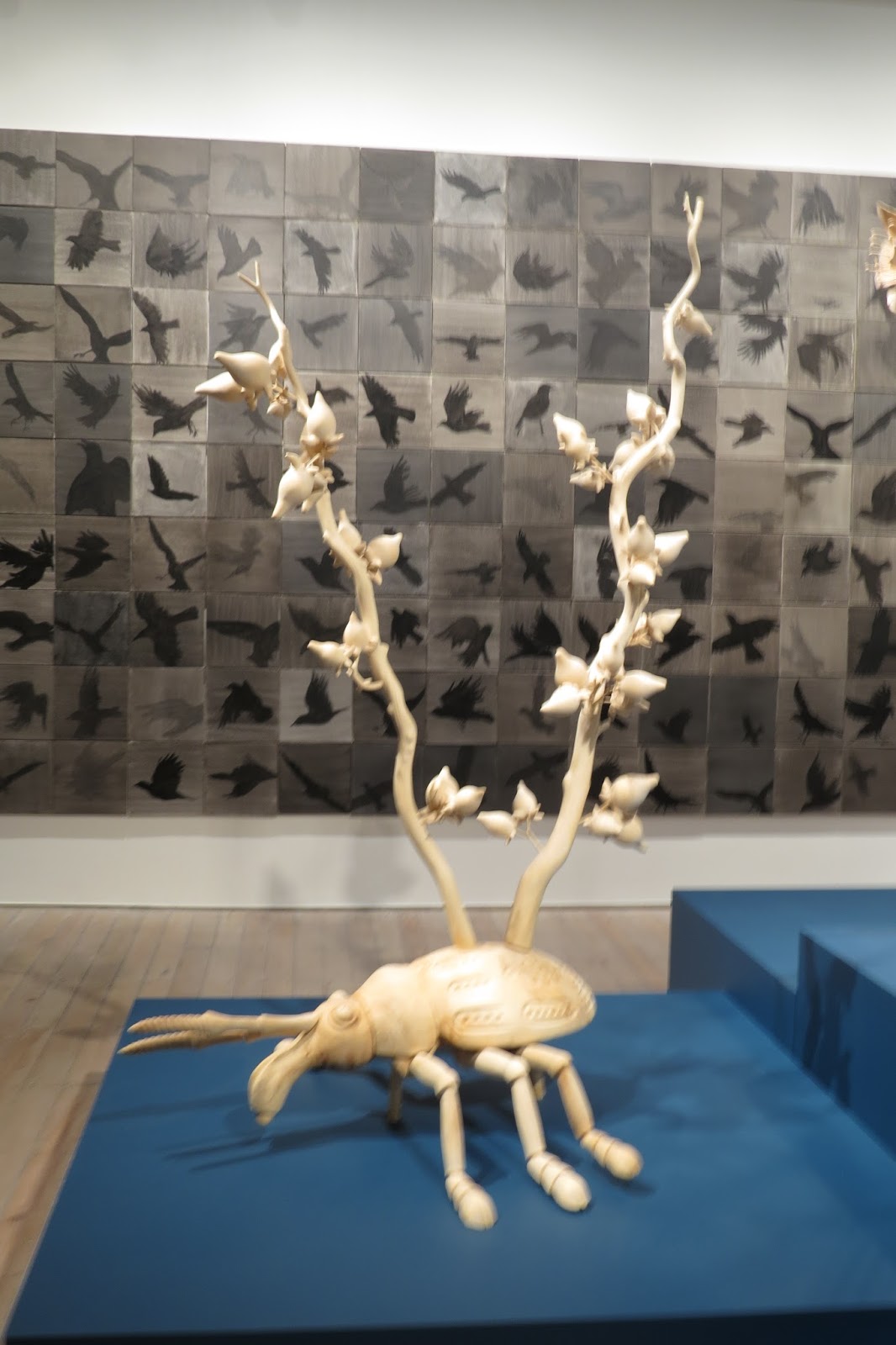
I loved Cheng Dapeng's Wonderful City. Hundreds (?) of 3D printed shapes in forms combining anatomy and nightmare presented on a lightbox that looked like a cloudscape. 

As an architect Cheng Dapeng has a financial stake in China's breakneck urban growth. As an artist, he tries to atone for that role by drawing attention to development's dark side. The neat scale models in real-estate promotions represent "perfectly formatted" visions of the perfect life, he says. But the soulless money-driven reality of China's new cities is more like a social-Darwinist nightmare, a breeding ground for monsters.


Another fabulous room:

Cant Xin's Exotic Flowers and Rare Herbs had a Seussian sense of fun for me. 


White Rabbit Gallery is amazing and I'll definitely be back. Exhibitions change twice a year so there will always be something new to see. Vile Bodies  ends on Feb 5 2017.

Bird cages decorate the teahouse, which I will have to try next time,
as we were quite full of dumplings from Tim Ho Wan

Even the umbrella stands are beautiful
After our gallery visit we walked about Chippendale for a while. I hadn't been in there for years, decades maybe, it used to be grungy and dirty, it's amazing now. 


Halo, Jennifer Turpin and Michaelie Crawford

Turning and tilting with the wind, Halo hovers in finely tuned counterbalance. The 12-metre-diameter carbon-fibre ring pivots atop a 13-metre-high tilted mast. The entire weight of the off-centre ring and arm balances on a ceramic bearing the size of a marble!

Halo responds to the winds of the moment. Gentle breezes set its eccentric rotation in motion, while gusts and eddies cause it to pitch and roll. 

We saw rotation this day, no pitching or rolling sadly. 


 There are heaps of restaurants and shops and a cool Spice Alley


One of the delights that we stumbled across was chocolatier Kakawa. Completely new to me before now, we sampled two chocolates (gone much too quickly to be photographed but I had the Raspberry Delight and the Passionfruit and Mango- both very delicious) and bought some goodies to take away- the vanilla fudge is divine....

Saturday Snapshot is a wonderful weekly memenow hosted by WestMetroMommy

Saturday, 5 November 2016

A History of the World in 100 Objects


On our recent trip to the South Coast Master Wicker and I had a quick stopover in Canberra where we caught a couple of fascinating exhibitions. I showed you Bigger on the Inside last week. We also went to the National Museum of Australia to see the amazing A History of the World in 100 Objects from the British Museum

It was really worth work a look. We spent about two hours there, although I think Master Wicker was done in about an hour. I don't think I've ever seen an Egyptian mummy before, and I'd certainly never seen the chronometer from the HMS Beagle, or realised how very small the worlds first coins were. I will share some of the objects I enjoyed most, or found particularly fascinating, and were easy to photograph. 

A great deal of information can be discovered through the close study of a single object. Individual things, when approached in the right way, can unlock an understanding of how people lived- from how they worshipped to what they ate. 

It was fascinating to see the remnants of the earliest writing. Incredible to see these 5, 000 year old objects so remarkably preserved, and the origins of reading and writing that I hold so dear. 


Early writing tablet
3100-3000 BCE
Southern Iraq
Clay

A cuneiform tablet showing part of the Epic of Gilgamesh, "the first great epic poem in world literature". A man is warned by God of an impending flood, and told to build a boat to save his family. It predates the Old Testament story of Noah and his Ark. 


Flood tablet
700-600 BCE
Kouyunjik (Nineveh), Iraq
Clay
Axes were the principal tool of early humans for about a million years! This beautiful one is near perfect and thought not to have been used. 


Jade Axe
5000-3600 BCE
Biebrech, Germany
Statue of Ramses II
About 1280 BCE
Temple of Khnum, Elephantine, Egypt


Bust of Sophocles
About 150 CE
Lazio, Italy
Marble


Head of Augustus
27-25 BCE
Meroë, Sudan
Bronze, glass, calcite

I learnt that Buddha's long earlobes is a sign of his rejection of wealth - because he was born into wealth he had worn the customary heavy earrings which stretched his lobes, and we see this still after he has renounced the world to seek enlightenment. 


Seated Buddha from Gandhara
100-300 CE
Gandhara, Pakistan
Stone

Master Wicker's favourite object. 


Arabian Bronze Hand
100-300 CE
Yemen

 I think this statue was my favourite object, even though it is quite grisly.


Statue of Mithras
100-200 CE
Rome, Italy

The museum folks have done a great job with the installation of the exhibition- it's a stunning mix of old and new, the objects from antiquity displayed with modern accents, there's a great feel to the space, it's lovely just to be there, despite the admiring hordes. 


Naturally I had an audio tour as I'm an audio tour kind of gal but there was really very good introductions to each area, as well as printed descriptions of each object. Some objects also had short videos displayed nearby introducing the objects by staff of the British Museum. All very informative.


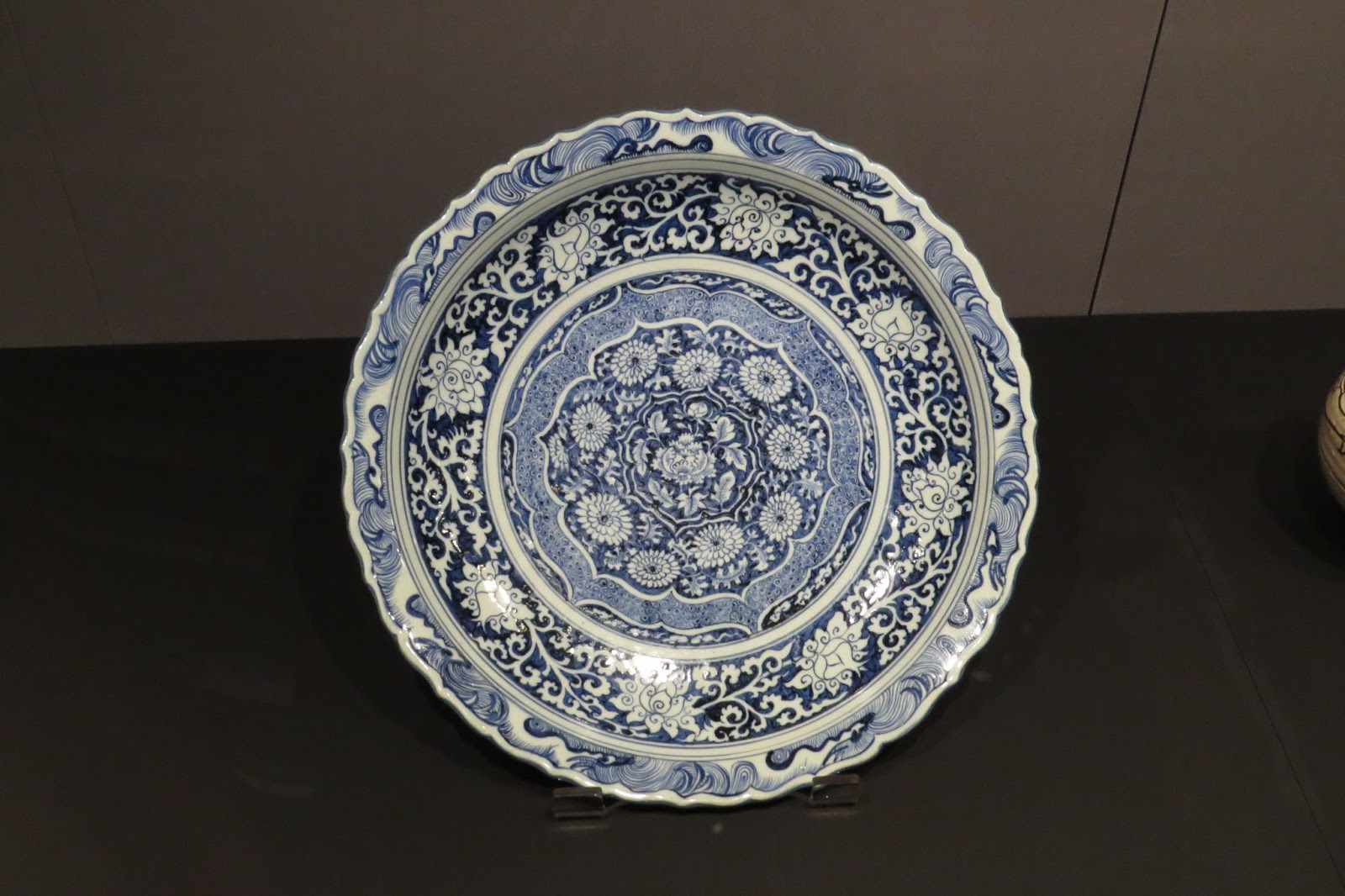
I tend to think of blue and white porcelain as Delftware, but this is a Chinese plate, and the cobalt blue used was imported from the Middle East, possibly Iran, so apparently the Chinese call it Muslim Blue. Which makes sense when you think of all the old mosques decorated so beautifully with blue and white tiles. 


Chinese blue and white dish
1330-1350 CE
Jingdezhen, Jiangxi provence, China
I really liked Dürer's Rhinoceros too- beautifully done, and all the more amazing because naturally he'd never seen a Rhinoceros in 16th century Germany. There was a very cool hologram Rhinoceros nearby. 


Albrecht Dürer's Rhinoceros
1515 CE
Nuremberg, Germany

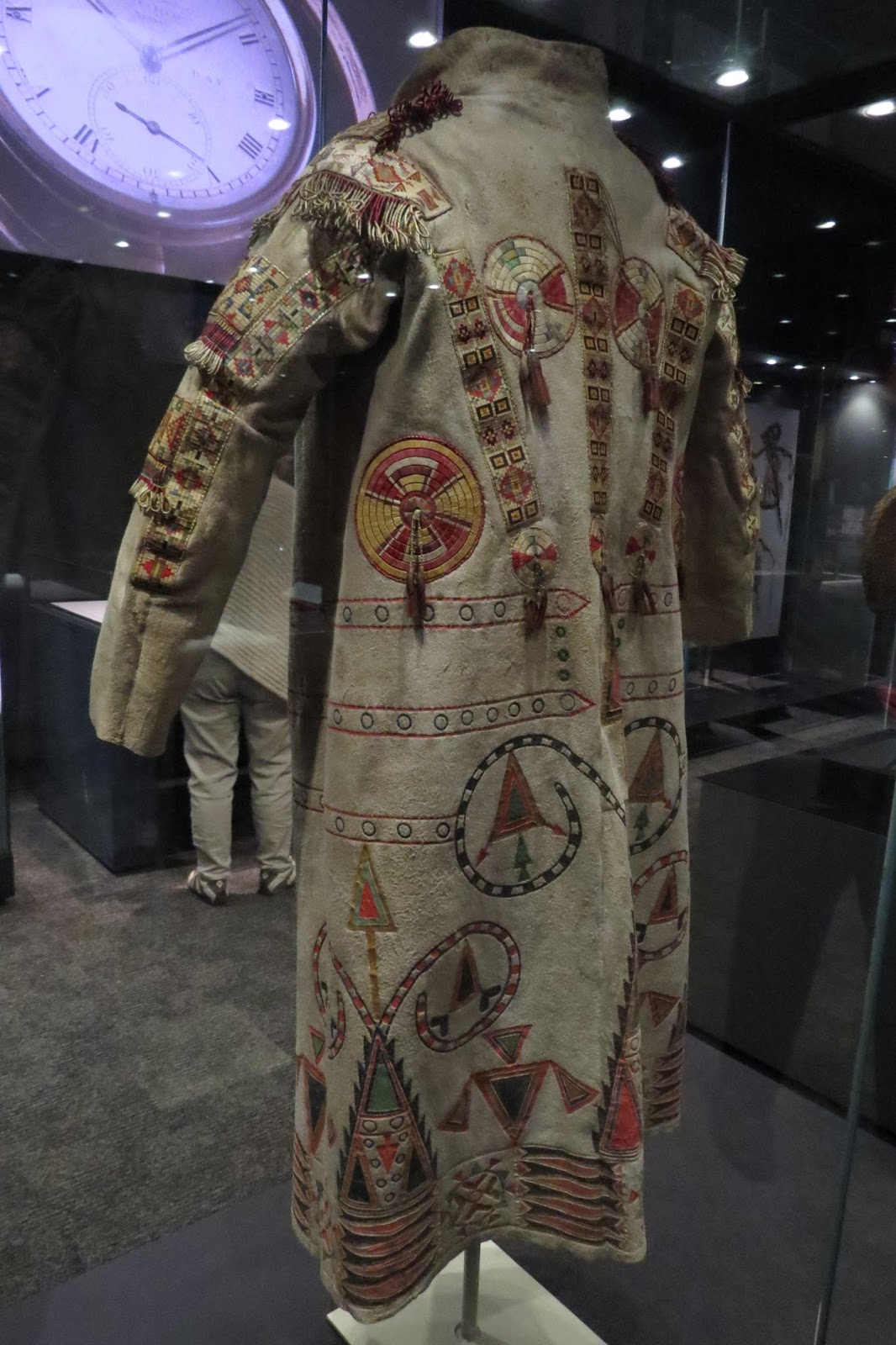
North American Frock Coat
1800-1900 CE
Canada
Painted moose skin, porcupine quills and otter hair


War Shields
1990-2000 CE
Wahgi Valley, Papua New Guinea
Painted wood, metal, rubber, fibre

Outside the exhibition is a wonderful tactile table where you can touch replicas of some objects. There were also Braille descriptions of the objects next to the English. 


We nearly missed this, make sure to search it out. 


National Museum of Australia
Canberra
$20 adults/ $15 concession / $8 child / $45 family / $60 season pass
September 9 2016 until January 29 2017

Saturday Snapshot is a wonderful weekly meme
 now hosted by 
WestMetroMommy