Friday, 30 March 2018

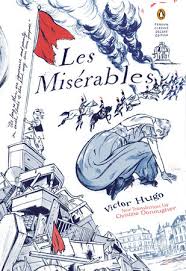
Les Misérables Waterloo V2B1


I wasn't really expecting quite such a history lesson when I took on reading Les Mis this year. But Waterloo certainly gives us one. Even though Hugo tells us "It goes without saying, we have no intention of writing the history of Waterloo in these pages". Which is odd given that he spends 18 chapters doing exactly that. Not that I minded all that much. What did I know of Waterloo? Not much. That 44 years later still not that many people can carry off blue satin knickerbockers?


I really enjoyed this history lesson that isn't. I hope to long remember that I only need to think of a capital A to imagine the layout of the battle ground, and that Waterloo itself was nearby but not really the scene of the battle. 
Waterloo did nothing and remained over a mile away from the action. Mont St-Jean was shelled, Hougomont was set ablaze, Papelotte was set ablaze, Plancenoit was set ablaze, La Haie-Sainte was stormed, La Belle- Alliance witnessed the embrace of the two victors. These names are scarcely known and Waterloo, which made no contribution to the battle, gets all the credit. 
There are always many little acts of fate that conspire to bring about a certain end. 
What we admire above all in a conjuncture such as that of Waterloo is the amazing ingenuity of change. Night rain, the Hougomont wall, Ohain's sunken road, Grouchy dead to the cannon, Napoleon deceived by his guide, Bülow reliably informed by his- the entire disaster is wonderfully orchestrated. 
In modern thinking about error management we call these small actions or events within a system the Swiss Cheese Model. Hugo chose to invoke a higher power. "Napoleon ..... was an inconvenience to God."

I think we can forgive Victor Hugo this lengthy diversion given the import of Waterloo. Both as a political and historical event.
Waterloo is the pivot of the nineteenth century. The demise of the great man was essential to the advent of the great century. 
What is Waterloo? A victory? No. A lottery. A lottery won by Europe at France's expense. 
And the scope of the human tragedy.
Of all pitched battles Waterloo is the one with the smallest front in relation to the number of combatants. Napoleon, three thousand three hundred yards; Wellington, two thousand two hundred yards; seventy-two thousand combatants on each side. It was from this density that the carnage resulted..... One hundred and forty-four thousand combatants; sixty thousand dead. 
On a single day! Nearly as many as those who died instantly when the atomic bomb fell on Hiroshima in 1945.

And like all great classics there are always passages that leap off the page with their eternal relevance. Here talking of Napoleon of course:
The inordinate weight of this man was disturbing the balance of human destiny. This individual alone counted for more than the rest of the world put together. These excessive quantities of human vitality concentrated in a single person- the world going to one man's head- would be fatal to civilisation if it were to continue. 
And England.
But this great England will be annoyed by what we say. After her own 1688 and our 1789 she still cherishes the feudal illusion. She believes in heredity and hierarchy. 
I think Victor Hugo does his most beautiful writing in passages like these, when he is giving background, and not really developing the narrative. 
The darkness was serene. Not a cloud in the sky above. So what, if the earth is red- the moon stays white. Such is the indifference of the heavens. In the meadows, branches of trees broken by shelling but not brought down with their bark still holding, swayed gently in the night breeze. A breath of air, almost a sigh, stirred the scrub. There were quivering in the grass, like souls departing. 
He really describes the horrors of combat in the 19th century.
Where there had been the agonised moans of that dreadful calamity, all was silence now. The hollow of the sunken road was filled with horses and riders inextricably piled on top of each other. A terrible jumble. There was no embankment any more. The corpses ha levelled the road with the plain, and came right up to the brim like a well filled bushel of barley. A heap of dead bodies on top, a river of blood below, such was this road on the evening of the eighteenth of June 1815.
It's fascinating to know that Waterloo is one of the very last sections Hugo wrote, just before Volume 2 was published. Digressions such as this were very common in 19th century literature (and one of the major reasons I couldn't get through Anna Karenina), Buttontapper pointed out that digressions form up to 25% of Les Mis. A great article came our way from the Paris Review whilst we were reading Waterloo, stating that the publication of Les Misérables is still "widely regarded as the biggest publishing coup of all time." I can't wait to get to reading David Bellos' The Novel of the Century. 

Although after 18 chapters of history lesson we do eventually get back to the narrative arc..... "after the victors come the thieves". "The day after a battle always dawns on naked bodies." We have met this "flying rat" before, it is none other than Sergeant Thénardier, who unwittingly saves a life whilst robbing the dead. 
"I shan't forget that name," said the officer. "And you remember mine. My name is Pontmercy."
I do know from listening to a BBC Radio Dramatisation (do beware of that link, my review contains many rather large spoilers) that the Thénardiers are a much bigger part of the story than is indicated in the musical versions. If you already know the broad story of Les Mis then Pontmercy is a familiar surname. I'll be intrigued though to see how this story line pans out- it is not one included in the stage adaptations. 


Thursday, 29 March 2018

Victor Hugo Introduction


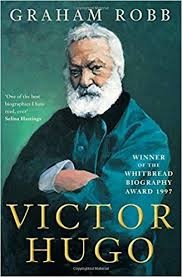
I've had a few Graham Robb books in the TBR for some time. Chunksters like Parisians and The Discovery of France. I knew that he'd written a chunky biography of Victor Hugo, and while I was somewhat interested because of my Francophile nature I was never brave enough to pick it up. Well, my participation in the year long #LesMisReadalong this year has changed all that. You may have noticed that I'm really loving it. A few weeks ago I found myself ordering a copy of Victor Hugo, and tonight I picked it up. 

I'm really not much of a reader of chunky books. I'm such a slow reader that they take me months and I find it endlessly frustrating, and I lose interest long before I'm anywhere near finished. But once you're taking on a 1416 page Les Mis then a 682 page biography of its author can seem like a relative doddle. It helps that Graham Robb already displays such a light touch.
The present biography was intended primarily to provide its author with an excuse to spend four years reading the works of Victor Hugo. 
I think I'm going to enjoy this. Tonight I read just the seven page Introduction. Already there is so much there. So much food for thought.  So much worthy of quoting starting with the very first sentence. 
Wherever one looks in the nineteenth century- there is Victor Hugo....
While I'm no expert on the nineteenth century certainly wherever I go- there is Victor Hugo. Naturally I've visited Musée Victor Hugo in Paris (see my blog post) which really helped me start to understand what a phenomenon he really was. I've visited his final resting place at the Pantheon (several times), and somewhat randomly found the Maison de Victor Hugo in Vianden, Luxembourg in 2010. There was even a link to my recent trip to Cambodia(!) when I discovered that Victor is seen as a saint by the Vietnamese Cao Dai religion, although sadly I didn't get to visit the Cao Dai temple whilst in Phnom Penh.

Victor Hugo was such a prominent nineteenth century figure that many grand statements can be found about him just within the introduction:
By the time he fled the country in 1851, Hugo was the most famous living writer in the world...
His influence on French literature was second only to that of the Bible. 
I was astonished to learn that only two-thirds of Victor's work was published during his lifetime, and 3,000 words were published about him every day- in 1997- probably that would be even more now, with people like me wittering on in our own little way. Given that, it's also surprising  in 1997 at least, there was no "complete, scholarly edition of his works and letters" published in France. 

This was the first time that I have heard of L'Homme Qui Rit, and obviously I immediately thought of La Vache Qui Rit! Really? Is that really a cheesy Victor Hugo reference? Seems I'm not the only person who think so... Oh, and there is a Maison de la Vache Qui Rit! Straight to the wish list. Oh and the 1928 silent movie version The Man Who Laughs inspired The Joker!

It seems that even in the twenty first century Victor Hugo is still everywhere! I can't wait to read on. 

Through the magic of the internet we can still watch Graham Robb speaking about Victor Hugo in 1998. It's worth listening to. 

Saturday, 24 March 2018

The Woman in the Window


I do like the occasional thriller from time to time, especially for holiday reading, and as I had an exotic holiday lined up in March with lots of airplane time, and then I was hoping for lots of down time and relaxation, I picked up The Woman in the Window. I'd seen lots of gushing reviews about the place recently, a rather glowing author profile (The Man Who Was Born to Write Crime Fiction), and I liked the sound of the rather Hitchcockian Rear Window vibe.

Child psychiatrist Doctor Anna Fox lives alone in Harlem, in a house that she once shared with her husband and daughter. She had it all, the successful practice, the happy home, and then it all changed, and she hasn't been able to leave her house since. Shut in, she is drinking way too much, and taking her prescription medications in a rather haphazard manner.

Anna spends much of her time in an online chat room for those similarly afflicted, she plays chess and watches old black and white movies. She also spends a lot of time spying on her neighbours. She knows so much about their lives with a little added online stalking- LinkedIn profiles, Facebook pages, and plain old googling.

In late October a new family move in across the street at 207. Anna takes in their arrival and continues watching. One night she sees something in a house across the street. She believes she's seen it, but no-one else believes her story. Anna's psychiatric problems, her drinking and drug use make her the ultimate unreliable narrator.
I turn to the windows and cast a long look across the park. That house. A theatre for my unquiet mind. 
I started reading on my first flight, and the first chapter is a cracker, but then it changed tone, and I never quite got into Anna's voice in the same way.  I really thought I would totally love The Woman In the Window. I didn't sadly. I did like it on the whole, but I never found it completely consuming, I was never caught up in it as I thought I would be, I got a bit annoyed by all the constant old movie references, and then I worked out the ending from about half way through. That's always disappointing... I was hoping I'd be wrong.

I took three books away with me, but only managed to finish this one.

Friday, 9 March 2018

Les Misérables The Descent/La Descent V1B5


At long last we really get to the meat and bones of Fantine's story- after all this first book is named after her. We've met her before and know some of her story- that she was orphaned, or possibly just abandoned, that she is beautiful, that she has been taken advantage of and then deserted by the bounder Tholomyès. That she has made some other bad choices, and that she has left her young daughter Cosette with the Thénadiers at their inn in a remote town.

In Book Five we encounter Fantine's story full on, but not before a little chapter "Story of an Advance in the Manufacture of Black Glass Jewellery", where we learn that Père Madeleine has built his wealth and influence from his ingenuity and innovation in the process of black glass by substituting shellac for resin, and so dramatically reducing the cost of manufacture. The whole town of Montreuil-sur-Mer benefited from this idea and his tremendous generosity and within five years Père Madeleine has been appointed mayor. 
Père Madeleine expected willingness of the men, respectability of the women, and honesty of everybody. 
In The Descent we begin to see some real differences emerging here between the musical versions and Hugo's original story. It seemed from the movie that the women in the workroom were sewing (although perhaps I just assumed that), I will have to pay more attention next time I watch it. Certainly, the way that Fantine loses her job in the factory is different. Here, the meddlesome Madame Victurnien seeks out to find Fantine's secret, and we are treated to some wonderful descriptions of her. 
The busybody who did this was a gorgon named Madame Victurnien, guardian and doorkeeper of everyone's virtue. Madame Victurnien was fifty-six and her mask of ugliness was overlaid with the mask of old age. Quavering voice, crotchety mind.
Hugo is not a big fan of idle, or  malicious gossip.
Certain individuals are malicious solely because of their need to talk. Their conversation, drawing-room chatter, boudoir gossip, is like those chimneys that burn wood fast. They need a great deal of fuel, and their fuel is their fellow human being. 
The Thénadiers greed grows exponentially and they ask Fantine for more and more money- allegedly for an ailing Cosette. I was interested in the use of the term miliary fever, as it's not one I'd come across before. There is a miliary form of TB (miliary meaning seed form as the chest X-ray appearance looks like millet seeds), but it does not seem to be this. Mozart apparently died of miliary fever, which William Osler described in 1892 as "an infectious disease of dubious nature... characterized by fever, profuse sweats and an eruption of miliary vesicles. The severe cases present the symptoms of intense infection: delirium, high fever, profound prostration and haemorrhage."

Fantine's descent becomes complete when she is forced into prostitution after her sacking from Monsieur Madeleine's factory.  I was most intrigued by the sentence: "The poor girl became registered as a common prositutue." In 1804, Napoleon (he's never far away) had ordered that prostitutes need to be registered and have twice weekly health inspections. This strict regulation continued until the 20th century. 

Fantine's fall is considered in the very next paragraph. 
What is the story of Fantine about? It is about society buying a slave. From whom? From wretchedness. From hunger, cold, isolation, neglect, destitution. A hard bargain. A soul for a morsel of bread. Society accepts what wretchedness offers. 
Quite a lot happens in this chapter, and there is a lot less philosophising than has gone previously. Although I enjoyed his considerations surrounding prostitution, curiosity and idleness. I think of curiosity as an asset, almost a virtue in our modern life. Hugo feels differently it seems. 
Curiosity is a form of gluttony. To see is to devour. 
In Chapter 5 we also encounter Javert once again and are shown much more of his background, and nature, and his growing suspicion for Monsieur Madeleine. Hugo compares Javert to a wolf pup that would need to be killed by it's own mother lest it eat all of his own litter mates. 
Javert was born in a prison of a fortune-teller whose husband was a convicted felon. As he grew up, he believed he was on the outside of society and had no hope of ever being let in. 
Yet Javert joins the police and by the age of 40 he has achieved the rank of Inspector, and has arrived in Montreuil-sur-Mer after Monsieur Madeleine had already become mayor. 
Javert was like an eye constantly fixed on Monsieur Madeleine. An eye full of suspicion and conjecture. 
At the end of the chapter Javert and Monsieur Madeleine clash over the fate of Fantine after she is arrested. Monsieur Madeleine wins this confrontation and becomes Fantine's benefactor. 
... I'll pay your debts, I'll send for your childe, or you shall go to her. You shall live here, in Paris, wherever you like. I'll take care of you and your child. I'll give you all the money you need. In regaining your happiness you'll regain your respectability. 

Friday, 16 February 2018

The Hate U Give


I don't think it's hyperbole to call The Hate U Give the YA book of 2017. It was at number one on the New York Times Best Seller list for more than six months, and I don't think it has fallen below #2 since. It has deservedly won lots of awards already and two categories of the Goodreads Reader Awards 2017. I read it in August/September last year because I was going to seeAngie Thomas speak at Melbourne Writers Festival.


The Hate U Give is the story of Starr Carter who lives in a poor black area, Garden Heights, but attends a predominantly white school across town. Her life straddles the divide between the two. 

As long as I play it cool and keep to myself, it should be fine. The ironic thing is though, at Williamson I don't have to "play it cool" - I'm cool by default because I'm one of the only black kids there. I have to earn coolness in Garden Heights, and that's more difficult than buying retro Jordans on release day. 
Early on in the book Starr witnesses her best friend Khalil be shot and killed by a police officer during a traffic stop.
Khalil stares at the sky as if he hopes to see God. His mouth is open like he wants to scream. I scream loud enough for the both of us. 
The rest of the book is about the fallout and repercussions of Khalil's murder. 

The Hate U Give is a really powerful story and addresses the issues of race, drugs, poverty and injustice for black people in America really well, but I was surprised that the American gun culture wasn't really addressed specifically. 

"Always some shit," he mumbles. "Can't have a party without somebody getting shot."
Starr is 16 and she's seen two of her friends shot. Outside of a war zone I can only imagine one country where this is even possible. 
When I was twelve, my parents had two talks with me. One was the usual birds and bees...... The other talk was about what to do if a cop stopped me. 
Momma fussed and told Daddy I was too young for that. He argued that I wasn't too young to get arrested or shot. 
Wow, that is a talk that I would never even had considered with my son. Or that it could ever be necessary. But for Starr, and all the black kids like her, it is. 
I'm used to gun shots, but these are louder, faster.
In this PBS interview Angie talks about how she set out to make the political personal, and that growing up in Mississippi she didn't she any authors who looked like her. Angie Thomas has written a moving Author's Note at the end of the book outlining her motivations to tell this story, and its origins as a  short story she wrote at university. Angie learned of Emmett Till when she was a young girl, but half a world away I've only heard of him in the past few years. Of course young black American men are still being killed in extraordinary numbers and in extraordinary circumstances. Black Lives do Matter. 

Because of my advanced age there were a number of pop culture references that puzzled me.  Right from the first page "Some rapper calls out for everybody to Nae-Nae.." So I texted Master Wicker. He knows it of course, and is mortified by my asking. "It's so horrible and so old". Ah yes, so old, so 2015. There was a bit of vocabulary that made me feel old and out of touch from time to time, but it in no way interfered with my enjoyment of the story, even if it did sound like another language at times! And I'm clearly not the only parent confused by such things.

I'm somewhat mortified that it has taken me so long to finish this post, but am glad of the push from #Femmeuary to get it done. 

Friday, 9 February 2018

Les Misérables Entrusting Sometimes Means Giving Away/Confier, c'est quelquefois livrer V1B4


Book 4 is a tiny morsel in a giant tome. Three short chapters, a mere eleven pages. I inhaled it in one gulp one afternoon. Book 4 introduces us to both Cosette and the Thénadiers.

From the reading of Book 3 it seemed that Tholomyès wasn't aware of Cosette when he left, but we quickly realise that Cosette is a toddler now, just ten months later, so he was well aware that he was walking out on his partner and child with his "surprise".

Fantine is 22 as she leaves Paris on foot to return to her home town of Montreal-sur-Mer to look for work. She has had no work since Tholomyès has abandoned her and fallen on very hard times indeed.
As for the mother, she was a poor and sorry sight. She was dressed like a seamstress reverting to peasant again. She was young. Was she beautiful? Maybe, but the way she was dressed it was hard to tell. Her hair looked very thick but was austerely hidden under an ugly, thick-woven, close fitting coif tied under the chin, with one blond lock escaping. Laughter shows off beautiful teeth if you have them, but she did not laugh. Her eyes looked as if they had not been dry for a very long time. She was pale. She seemed weary and a little unwell. 
Fantine makes the hasty decision to leave Cosette with the Thénadiers, strangers to her, after a very brief interaction, being transfixed by the two Thénadier daughters laughing on a swing fashioned on a chain under a logging trailer. Victor Hugo is not at all subtle in telling us what to think of the Thénadiers. A chapter entitled First Sketch of Two Shady Characters is a big clue, and then just in case we had any doubts, he takes particular glee in describing them. 
They were of that stunted nature that easily turns monstrous if some dark passion is by chance kindled in them. There was in the woman the essence of a bully and in the man the makings of a scoundrel. Both were most highly susceptible to the sort of hideous progress that occurs in the development of evil. There are souls like lobsters, continually retreating into the shadows, retrogressing rather than advancing through life, using experience to add to their monstrosity, becoming ever more wicked and ever more imbued with an intensifying foulness. This man and this woman were such souls. 
And Madame Thénadier has a fondness for the romance novels of the time. 
Madame Thénadier was just intelligent enough to read books of this kind. They were her staple diet. She steeped in them what brain she possessed.
Once again there is mention of the naming of children. "Now, nonsense cannot be read with impunity", and so the Thénadier girls are Éponine and Azelma, who "the poor little thing was very nearly named Gulnare".
It is not uncommon nowadays for the young cowherd to be called Arthur, Alfred or Alphonse, and for the vicomte- if there are any vicomtes left- to be called Thomas, Pierre or Jacques. This displacement whereby the 'distinguished' name is given to the common man and the rustic name to the aristocrat is nothing other than the stirrings of egalitarianism. The irresistible penetration of the new spirit is in this as in everything else. Behind this apparent discrepancy there is something great and profound: the French Revolution. 
I believe that the Thènadiers play a bigger part in the book than is apparent from the movie or stage adaptations. But they play a particularly important role in the musical adaptations, being a comedic foil to the drama and tension. I do so love the rousing Master of the House. 


We also quickly learn what happens to Cosette at The Sergeant of Waterloo, the Thénadier's inn. They sell off her fashionable clothes, and dress her in "the little Thénadier girls' cast-off petticoats and chemises, that is to say, in rags."
They fed her on everyone's scraps - a little better than the dog, a little worse than the cat. In fact the cat and the dog were her habitual dining companions. Colette ate with them under the table, from a wooden bowl like theirs. 
Cosette essentially becomes a slave.
It was a heart-breaking thing to see in winter, this poor child, not yet six years old, shivering in her tattered old rags of coarse cloth, sweeping the street before daylight with an enormous broom in her tiny red hands and a teardrop in those big eyes. 
 Which of course is one of the most iconic of the still images of Les Miserables, by Emil Bayard. 


Injustice had made her resentful and misery had made her ugly. 
All quotes are from the 2013 Penguin Classics Deluxe Edition, translated by Christine Donougher. 


Wednesday, 7 February 2018

Les Misérables In the Year 1817/ En l'année 1817 V1B3


So much history crammed is into Chapter 1- The Year 1817. So much. We are given five pages of seemingly random facts, yet knowing with Victor Hugo that these are certainly not random facts, and indeed he tells us directly.

Yet these details, wrongly called trivial- there is no trivial fact in the affairs of man, no trivial leaf in the vegetable world- do serve a purpose. The features of the years are what the face of the century is composed of. 
Many of the details overwhelmed me, I felt ignorant, and uneducated, not knowing about so many of the events or personalities. I do wonder how contemporary French readers would have fared, but Les Miserables was published in 1862, and these events take place almost a generation before in 1917. But some names leapt out at me. Napoleon (of course), David, Dupuytren...
Dupuytren and Récamier had an argument in the amphitheatre at the School of Medicine and threatened to come to blows over the divinity of Jesus Christ. (Initially I thought this was the intriguing Juliette Récamier, but it was the more predictable Gynaecologist Joseph Récamier)
Madame Récamier - Jacques-Louis DAVID
I've seen this at the Louvre
I'm learning more about art history than I expected to!
and some of the details were just too delicious, and caused me to pause in my reading.
At 27 Rue St-Dominque, Chateaubriand stood at his window every morning in leggings and slippers, his grey hair in a madras head scarf, staring into a mirror and with a complete set of dentist's instruments laid out before him cleaning his splendid teeth while dictating to his secretary Monsieur Pillage drafts of 'The Monarchy according to the Charter'.
I was very excited to meet Fantine finally and also discover her background which isn't really dealt with in the stage or movie versions that I've seen. Much is made of Fantine's beauty. She is blonde, which was surprising to me, as I've seen Fantine played by brunettes on stage and screen. 
Fantine was beautiful, and remained chaste as long as she could. She was a lovely blonde with splendid teeth. She had gold and pearls for her dowry, but her gold was her head of hair and her pearls were in her mouth. 
Fantine was born in poverty, possibly orphaned, or abandoned at least, she went into domestic service at ten, and went to Paris to 'seek her fortune' at fifteen. Unfortunately for her she finds and love Tholomyès. What a cad Tholomyès is. 
A conquest for him, for her the love of her life. 
An hour later, back in her room, she wept. He was, as we said, her first love- she had given herself to this Tholomyès as to a husband. And the poor girl had a child. 
I found his desertion of her bizarre. 

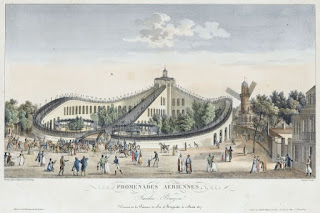
There is much to astonish in In the Year 1817. Firstly there was a rollercoaster in Paris!
At about three o'clock the four gleefully terrified couples were rattling down on the coaster ride, a curious structure which then stood on the Beacon heights and whose serpentine loops could be seen outlined above the trees on the Champs-Elysées. 
Picture source
Rollercoasters have a rather fascinating history, from Russian monarchs forwards, and much lengthier than I expected. 

As someone very interested in names I was fascinated by several references to character's names in Chapter 2, Two Foursomes. Names were fashionable even in the 19th century. 
The pure English style would not prevail until later, as the first of the Arthurs, Wellington, had only just won the battle of Waterloo. 
And Fantine? An unusual name then and now. 
She was called Fantine. Why Fantine? She had never been called by any other name. At the time of her birth the Directoy was still in existence. No family name, since she had no family; and no baptismal name, since the Church was gone. 
I wonder if she was given a novel name to emphasise her aloneness? No family, no friends, not even someone else in the world with the same name as her? The reference to the Directory is intriguing, but I can't find anything specifically about them and names. Did they have an official list of sanctioned names at that time? I need to do further research.

I launched myself down another rabbit hole of research with the mere mention of a white flag. 
The white flag, faintly pink in the sunset, fluttered above the dome of the Tuileries.
A plain white flag was indeed the flag of France from 1814 to 1830. The famous tricolour flag of France was (re)designed by Jacques-Louis David (him again) in 1794! to display colours of equal stripes, an earlier design by Lafayette, had increasingly large stripes, blue then white then red. As an aside, blue and red were the traditional colours of Paris, during the storming of the Bastille the attackers wore red and blue cockades. White was added as an ancient French colour.

Tuileries Palace was of course still standing in 1817. It was later destroyed by arson in 1871 and then demolished in 1882. There has been modern day talk of rebuilding it, making the Paris skyline look like this:


And how gobsmacking to find an anti-sugar rant delivered by Tholomyès:

Well, that's as may be, but remember this, my dears: you eat too much sugar. You have but one fault, O women, and that's nibbling sugar. O rodent sex, your pretty little white teeth adore sugar. Now, listen carefully, sugar is a salt. All salts cause dehydration. Sugar is the most dehydrating of all salts. It draws the blood fluids out of the veins. Hence, coagulation, then solidification of the blood. Hence, tubercles in the lungs. Hence, death. That's why diabetes is little short of consumption. So don't crunch sugar and you'll live!

This week I found this fabulous Khan Academy video of the historical background to Les Miserables (it does contain some spoilers for those wanting to avoid them).


There is so much more to Les Mis than just the story (which of course is fabulous in and of itself). 

All quotes are from the 2013 Penguin Classics Deluxe Edition, translated by Christine Donougher.