Saturday, 31 December 2011

Dreaming of an Aussie Christmas

In Australia we don't dream of white Christmases, we hope for a waterside Christmas- and I had a perfect one this year.


Bubbly for breakfast


French, bien sur

Family

Fun

Lots of fun
There was lots of delicious food too of course, but somewhat strangely for me I forgot to photograph it. Might have something to do with that French for breakfast!

Saturday Snapshot, is a wonderful weekly meme from at home with books

2011 A Year in Books

I wasn't planning on writing a wrap up post, but after having read a few other lists, it got me to thinking. What were the best books I'd read this year? It's interesting to look back and wonder. These are the dozen titles that I gave 5 stars to on Goodreads this year, generally gushed about here, and remembered fondly.

Michael Leunig has still got it


Jackie French Nanberry

Martine Murray The Slightly True Story of Cedar B Hartley

Brian Selznick The Invention of Hugo Cabret

Jackie French Flood 

Shaun Tan The Lost Thing (coincidentally my most popular post by a mile)

John Baxter Immoveable Feast A Paris Christmas (a book I loved so much I did two blog posts about it #1 and #2)

Fred Gipson Old Yeller

Lonely Planet Paris Not for Parents

All the 13 things children should know series that I've read so far.

I started listening to audio books in the car this year when my commute time tripled (from 4 minutes to 15!), I've been listening to nonfiction, and a few of these really won over my affections.

Tim Flannery Country

Dawn French Dear Fatty

Jim Leavesley Mere Mortals

I'm pretty pleased with myself that a full 50% of these books are Australian! Also pretty pleased with the diversity. Fiction. Nonfiction. YA. Picture books. Adult books. Interesting to note that no adult fiction made my list. I hope to remedy that next year. The TBR always looms large.

I really enjoyed participating in the Foodies Reading Challenge and Wondrous Word Wednesdays memes this year. I've learnt so much from these activites, and made new online friends. I look forward to continuing both next year.

Another 5 star discovery this year:
Mango Pancakes!
Yum cha dessert used to be easy. Mango Pudding. No decision. Now I discover Mango Pancakes! Pudding? Pancakes? Such a dilemma!

Monday, 26 December 2011

Paris Not For Parents!


I'm moderately obsessed with Paris. Ok, quite obsessed. So I was immediately drawn to this book. Let's face it I bought it for me, not for Master Strong Belief. He's not really interested in reading it. Even though he is an especially lucky child who ventured to Paris at the tender age of 9. He gave me a shrug and a meh when I asked if he was interested in reading it. Maybe before the next trip he'll be more interested. Sadly it's a fair way off at this stage. So I had to get my Paris fix somehow. And this is a great little book. Sure, it's written for kids, but it's a great format and I still managed to learn stuff, as I generally do with Junior Non Fiction.

All the major stuff is covered. The Louvre. The Eiffel Tower, but it includes cool pictures taken during the construction. The Pompidou Centre. Notre Dame. Le Tour de France.

Place de la Concorde was the site for many of the beheadings in France. It is thought that up to 40,000 people met their grisly end there. The book of course includes a section on the Guillotine -named after Dr Joseph-Ignace Guillotin, who apparently hated that the beheading machine (actually invented by Antoine Louis) was named after him, and indeed Guillotin was actively campaigning for a more humane method of capital punishment. Before 1792 beheading was only bestowed on the rich and powerful, and this typically done with an axe or sword, and wasn't always quickly effective. The poorer citizens of Paris were more commonly hung.
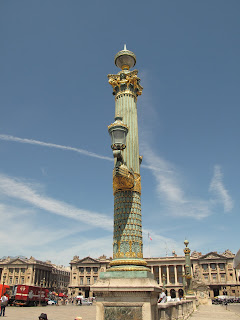
Hard to believe now. A summer day, Place de la Concorde 2010

The more obvious kid-centric topics are interesting too. Asterix the Gaul (who I don't think I've ever read), who is still very popular in France, and has his own theme park, Parc Asterix. Dogs in Paris. Kid friendly food- crepes, baguettes, Galette des Rois (which I am quite desperate to try on a winter visit), and of course the gross stuff like snails, frog legs, and stinky cheeses.

I enjoyed learning about the British art collector Richard Wallace who donated 100 public drinking fountains to Paris in the 19th century. His famous Wallace fountains are still there, and still operational, and although I must have walked past many, I don't remember actually noticing them. They will definitely be on the must find list for next time.


I also enjoyed learning about the siege of Paris. I don't think I'd known that Paris was under siege by Prussia in 1870. Times were desperate and the Parisians ate 70,000 pets and zoo animals including two elephants named Castor and Pollux.

It's always great to make a sudden realisation about a familiar object or substance. I don't think that I had ever thought about the origin of the term Plaster of Paris, even though it's something I deal with most days at work. Plaster of Paris is a mix of water and a powdered rock (gypsum) that was common in the hills of Paris.


There are 4 titles in this fun series from Lonely Planet - Paris of course, New York, London and Rome. 

Saturday, 24 December 2011

Merry Christmas

These photos of trees decked out for the Christmas season are from my recent trip to Houston. Merry Christmas.


Saturday Snapshot, is a wonderful weekly meme from at home with books

Wednesday, 21 December 2011

Wondrous Words Wednesday 21/12/11


Wondrous Words Wednesday is a fabulous weekly meme hosted by Bermuda Onion, where we share new (to us) words that we’ve encountered in our weekly reading.  


This week's first word comes from an article by Amanda Hooton "Plug Me In" in the Good Weekend 10/11/11.

1. Moue

And, as we all know, there is nothing so ageing (apart from a really terrible haircut, or wearing black too close to your face) as making a moue with your mouth.

i) A small grimace; a pout.

The Weekend Australian's Books of the Year (Part 1) was also a source for wordy fun- actually all words that I recognised, but that I didn't really understand.

2. Inchoate

In its arrested, inchoate, David Foster Wallace's The Pale King was not so much a novel as a fictional artefact, but the chance to study his teeming mind wrestle with a work unfinished and perhaps unfinishable was captivating.

i) Just beginning; incipient
ii) undeveloped; immature; rudimentary
iii) (Law) (of a legal document, promissory note, etc) in an uncompleted state; not yet made specific or valid

3. Scabrous (adjective)

Also a scabrous satirical poem about American politics, As Long as It is Big (2005),  by John Bricuth.

i) Roughened because of small projections; scaly
ii) Indelicate, indecent, or salacious
ii) Difficult to deal with; knotty

4. Apogee

In this way, the apogee of my year's words combined Michael Ondaatje's novel The Cat's Table, Joan Didion's memoir Blue Nights and W.G. Sebald's 2002 masterwork Austerlitz: a triptych of memory, remembrance and the tricky nexus between recall and creativity.

i) The farthest or highest point; the apex. (Clearly it's this first defintion, but the other definitions are interesting too).

ii) The point in the orbit of the moon or of an artificial satellite most distant from the centre of the earth
iii) The point in an orbit most distant from the body being orbited.


Tuesday, 20 December 2011

Tintin in the Land of the Soviets


I remember trying to read Tintin as a kid, borrowing a couple of books from the library one time, but I never really got into it. I don't think I ever read a whole book. I remember the covers of course, they're rather iconic. Except I didn't know this one. Tintin in the Land of the Soviets is the first Tintin book, and was published way back in 1929. The upcoming Tintin movie was the impetus that finally got me over the line and reading a Tintin book. Except now I have to read 4! Tintin in the Land of the Soviets is the Tintin title that is included in 1001 Children's Books You Must Read Before You Grow Up. The movie is based on three of the other titles- The Crab with the Golden Claws, The Secret of the Unicorn and Red Rackham's Treasure. I'm hoping to read those before heading off to see the movie after Christmas. 

I don't think Herge liked this book. It is the only one of his books that he did not redraw in a colour edition, and Wiki quotes him as saying "I didn't consider it real work... just a game", and he later described it as a "transgression of my youth". This disdain is quite obvious, the artwork and drawing is rough and crude, showing an apparent lack of care compared to the precision and detail of his other works. 


Herge had even prevented the books publication until 1973, with the English translation not appearing until 1989. Interesting to note that it was originally published in serial form over 18 months 1929-1930, much like Dickens had 70 years before. Of course this was a common way of story publishing, and still remains so for cartoons of course, but I'd always thought of Tintin in book format. Reading through I noticed that Herge signed at the end of every double page, so I presume that that is how it was originally published.
And that Snowy, like most dogs,  is always hungry

It's rather extraordinary to think that it was written as anti-Marxist and anti-Socialist propaganda for children. I don't know many children who get to read anti-Socialist cartoons these days. I wonder if Ben 10 deals with this stuff? Although I suppose most media is biased to some extent, and we all fall prey to propaganda. Wiki tells us that Herge wrote Tintin in the Land of the Soviets based on a single pamphlet published in 1928, and that he did not research Russia independently. This apparently lead to a number of factual errors. LIke guards eating bananas. He likes to have a hack at their food supplies and elections. 


There are some jokes


And of course several references to vodka.


I found Tintin in the Land of the Soviets to be interesting to read for an historical perspective, but I hope some of the other stories will be intriguing in their own right. 

Saturday, 17 December 2011

The Ibis that ate Sydney

I lived in Sydney for nearly 10 years in the late 80s and 90s. I don't think I remember any ibis then. They're certainly there now- and they do appear to be taking over. The Australian White Ibis is an intriguing looking bird.

They were everywhere on my recent trip to Sydney

Drinking water in puddles- note there is actually shadow here!

Hanging out preening in gardens


Sitting in trees (there's three)

They seem to like to take in the major tourist sites
Adorning statues

Outside the Chinese Gardens


Out the back of St Mary's (the first time I noticed their funky feet and their really ugly bald neck)

On the Domain

Supervising the outdoor chess game in Hyde Park (the first time I noticed some of them are tagged)

Wherever you were going there was one going that way too

Joining you for breakfast


Overlooking your lunch
Hunkering down in the wet

Most of the time there was only one or two


But sometimes there were heaps


I've since found out that there is an Australian White Ibis Survey. I've now made a small contribution towards it, and have forwarded my (accidental) photos of banded birds. 

Saturday Snapshot, is a wonderful weekly meme from at home with books