Monday, 16 September 2013

The List of My Desires


I'd never heard of this book when I first picked it up browsing in a book shop. The cute little hardback with buttons on the cover was strangely attractive. Translated from the French. A bestseller in France, it naturally called to me to read it. But I was strong that day and put it back on the shelf. The very next day I was browsing the August edition of Good Reading Magazine, and there was a review giving it 4.5/5 and telling me this book will "enchant and beguile". Too much serendipity. I had to read it. I went back and bought it.

Gregoire Delacourt is a Parisian advertising executive and a new French novelist. His first book, L'Ecrivain de la Famille won 5 French literary prizes! The List of My Desires is his second book, and has apparently been a "runaway Number One best-seller in France", with rights sold in 27 countries. It is the first of his books to be translated into English.

Jocelyne Guerbette is 47, living a small but apparently happy and comfortable life in Arras, a town in northern France. She is married, with two adult children, she runs a small haberdashery shop and a blog  tengoldfingers about "the pleasures of knitting, embroidery and dressmaking" that has a loyal following. One day Jocelyne get the chance to decide what her life will be like.

I enjoyed the French setting of the book. I haven't been to Arras, but Jocelyne goes to Paris one day, and I have been there....

Oddly enough, even surrounded by cars and horrible scooters, jammed between the Rue de Rivoli and the Quai Voltaire, the particles of air look cleaner and clearer to me.

Just the memory of that place makes me happy. When Jocelyne is shopping on Rue Cambon I practically gasped out loud. I shopped there! Only for icecream at Pierre Herme, but still... I was there. I know where it is. The Paris Tragic in me loves this stuff.

I was annoyed by many little things in this book though, which tempered my enjoyment of place and glimpses into French culture. I wonder unknowable things like if French hairdressers really do pick their Lotto numbers using their ideal weight. Or do married French couples really watch 5 seasons of Grey's Anatomy together? It seems improbable to me. Everyone looks like a European actor who invariably I've never heard of. There are many, many (too many) references to Belle du Seigneur, a 1968 Swiss novel by Albert Cohen that must have an enduring popularity in France, although I see there is a recent English film version, perhaps I will get to see that at some stage. Checking out the book  online I see that it is 992 pages- chance of me reading it = 0%.

I was confused from the outset. Jocelyne also uses words like boring, dreary, uneventful. Is she really all that happy?

My own dreams have fled.

Now that's not a happy woman. Yet she feels she has a "huge, flaming, unique happiness". Her husband said unforgivable things to her when their third child is stillborn, and that makes him stop drinking. But Jocelyne appears to have forgiven him, even though she remembers. Really? Do I really believe this?

But this is inexcusable in any language:
I'd already been working there for two years when the owner swallowd a button as she was biting it to make sure it was genuine ivory. The button went down the wrong way, it slipped over her moist tongue, got into her laryngopharynx, hit a cricothyroid ligament and stuck in her aorta, so Madame Pillard didn't hear herself choking to death. 

Aorta? Come on. Does anyone proof read this? Was the mistake in the original French or the English translation?

Still, The List of My Desires is a very quick, enjoyable read even with the flaws. Printed with quite a large font it almost feels like a Large Print book. I read it in under a day, just a few hours really. It's like sneaking a delicious French morsel in amongst my more typical leaves and dust Anglophone reading diet.


Just for a bit of French random advertising fun. 


Dreaming of France is a wonderful Monday meme
from Paulita at An Accidental Blog


Sunday, 15 September 2013

Road Trip- Turner from the Tate

Recently we took another lovely day trip to Canberra to see the Turner from the Tate exhibition at the National Gallery of Australia.

First we went to the National Portrait Gallery to see the Richard Avedon People exhibition. It was amazing. The first Australian exhibition of his work. On until 24 November 2013, and well worth a look.


Then we ducked over to the NGA. Turner from the Tate was a really magnificent exhibition (it's sadly finished now). The largest Turner exhibition ever to tour outside Britain. Somewhat uncharacteristically for the NGA you were allowed to take photos inside the exhibition.


It was spacious, and well set out
with plenty of places to sit and have a look at the catalogue
It was interesting to see Turner's work progress from his younger days, watercolours and more traditional works through to his later works with glowing atmospheres and radiant light that is more familiar as his style for people like me who don't know all that much about art.

I got the audio tour (always worth it, but this one was particularly fabulous). I learnt so much. The son of a barber, Turner was born in central London. His sister died young, and his mother was committed to an asylum. He had a precocious talent and he drew in spilt milk as a child. His first exhbition was at age 15.

Turner was highly successful in his lifetime, but always very conscious of his reputation. He retained or re-acquired many of his paintings, which he was to bequeath to the British people in his will. The Turner Bequest at the Tate. Turner appeared to have been bettering himself with his dying wishes too, as he asked for his work to be hung with one of his idols Claude Lorrain (who I wasn't familiar with at all) in the National Gallery- a request that is honoured to this day.


I got the impression that JMW Turner was a prickly personality- there were many references to his competitive nature, his moodiness, that he maintained long friendships despite his awkward and difficult character. Turner was apparently intensely ambitious and competitive. He sought to elevate the role of landscapes by incorporating classical allusions and imitated compositions of the old masters. He deliberately sought royal commissions, as I suppose many have done, and continue to do.


Turner would modify his paintings at the very last minute before they were shown, so that he could add touches of colour at the last minute. He was often experimenting with new techniques and materials, but was notoriously secretive about his methods. From the 1820s his work was often mocked and his methods ridiculed- he was accused of using 'cream, chocolate, yolk of egg, or currant jelly'. The audio tour suggested that his interests lay ahead of the taste at the time, which is a lovely way to put it.

I'm always astonished by the little books for studies that artists take away on tour. In one trip abroad Turner filled 23 sketchbooks in 6 months!


Turner's first painting- age 13!
Oxford from the Southwest

The children's room was being put to good use

An awful snap of the most extraordinary painting,
A Disaster at Sea
I was in tears before it
A Disaster at Sea is such a powerful image (even good digital photos don't convey the emotion of the painting, people always say that but I think this was the time that I felt this most profoundly). It depicts a shipwreck off the coast of France in 1833. A British transport ship, the Amphitrite, en route to Australia foundered and sank. The captain apparently refused offers of help from the French because he was only charge with taking the prisoners to Australia and had no authority to let them land in France. So he committed all but three to drown instead. Turner avidly followed the Napoleonic wars, and many of his seascapes were to showcase Britain's naval strength.

I somehow managed to resist all temptation in the well-stocked shop at the end of the exhibition.


There were all manner of desirable British books and objects. 

Saturday, 14 September 2013

Sensational Butterflies

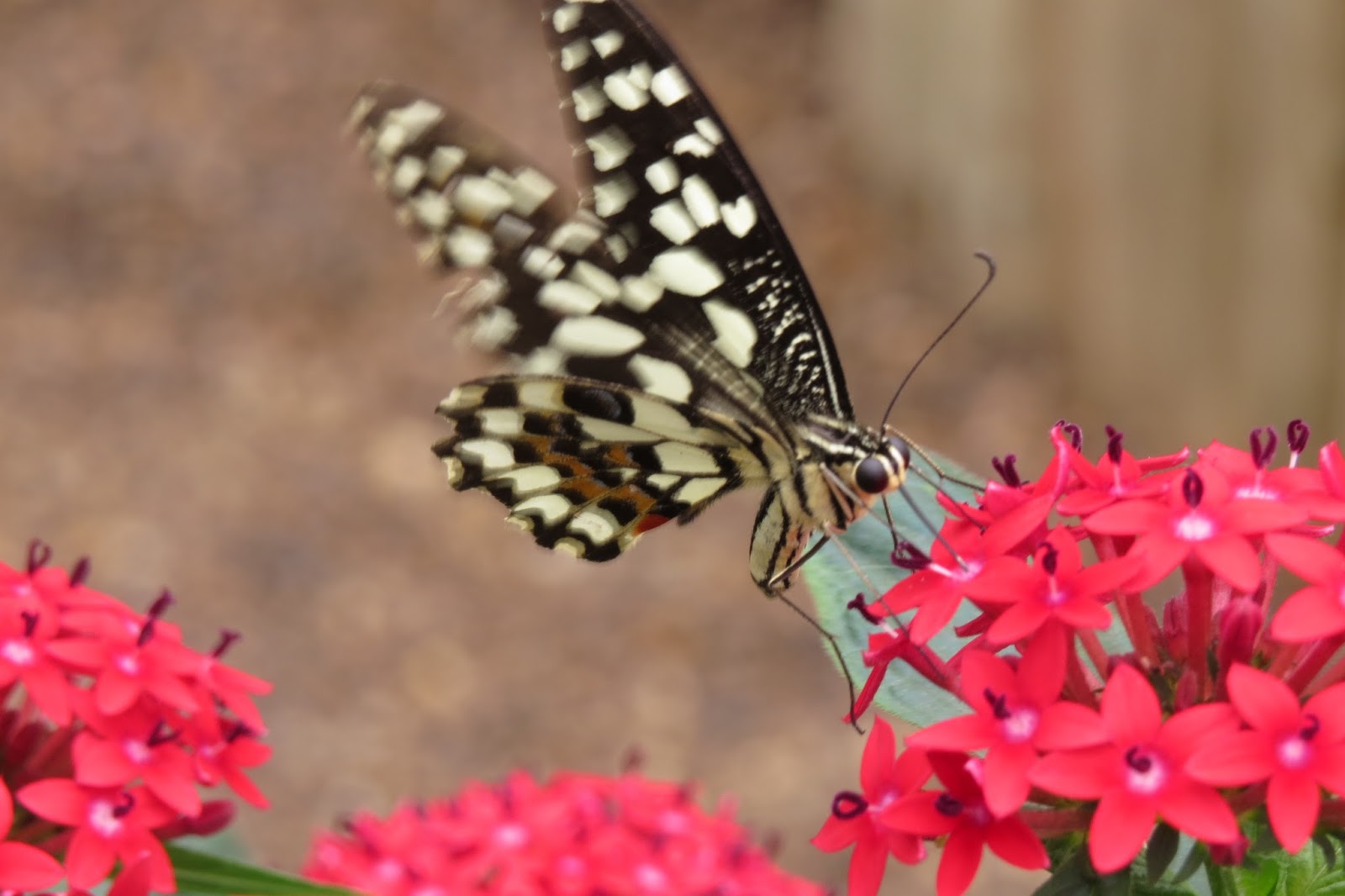
I always love a butterfly house. This was a good one, and unexpected, a temporary exhibition set up outside the Natural History Museum in London when we were there back in July. I managed to arrive at the exact same minute as Mr and Master Wicker! Unplanned. I only realised as I was taking a photo of the entrance and they were lining up for tickets!


Such a great opportunity to appreciate the diversity of butterflies, their colours, textures and shapes. 


I always like watching the new butterflies emerging from their chrysalids.


This was also the warmest half an hour we spent in London, on a rather cool "summer" week. 

Saturday Snapshot is a wonderful weekly meme now hosted by WestMetroMommy

Friday, 13 September 2013

The Mouse and His Child


I finished this rather odd book this week. I'm still not quite sure what to make of it, or my reaction to it. 

I do like the basic setup of the story. The mouse and his child are tin wind-up toys and are essentially searching for family and home, having been discarded by the family that bought them. They want to reunite with an elephant and seal who they shared time with in a toy shop and make a family. That's sweet, and the longing for family and home is a lovely background to many a good story. The Mouse and His Child is a bit of a quest story, with baddies along the way, and their arch nemesis, Manny Rat, is a pretty good villain. I liked the world of Manny's dump lair very much. 

I didn't particularly like or understand the increasingly bizarre characters they met along the way. While the Caws of Art is a very clever name (which brought to mind The Phantom Tollbooth, which I didn't overly like either, while still respecting its cleverness), I didn't understand what they were going on about most of the time, and the muskrat and C. Serpentina just got more and more bizarre. 


'Why into Here often equals There, and so one moves about.'

I don't know all that much about Russell Hoban but got to wondering how much acid he did in the 60s. It also made me think of Lewis Carroll. Although I now know that the Caws of Art play that I didn't understand  at all is a parody of Samuel Beckett's Endgame and Waiting for Godot- allusions that were clearly lost on me. 

The considerations of infinity and ones place in the universe were more comprehensible for me. And so more enjoyable. I liked the notion of infinity being beyond the last visible dog, and that clearly the recurring Bonzo can had something to do with it. 

Standing as he was on uneven ground, the child was tilted at such an angle that he too saw the Dog Star, beyond his father's shoulder. He had never looked up at the sky before, indeed, he had as yet seen little of the earth, and even that little was more frightening than he imagined. At first the icy glitter of the far-off star was terrifying to him; he sensed a distance so vast as to reduce him to nothing. But as he looked and looked upon that steady burning he was comforted a little; if he was nothing, so also was this rat and all the dump. His father's hands were firm on his, and he resolved to see what next the great world offered. 

I did really like his many beautiful descriptive passages scattered throughout the book. 

Glittering above the pond she flew away, lilting on the warm wind like a song in the sunlight, like a sigh in the summer air. 

 Springtime passed. The flickering play of shadows from the leaves above dappled the depths below, and the mud on the bottom smelled of summer. Water striders darted on silver points of light far above the heads of the mouse and his child, and fish leaped after hovering mayflies, to fall back with bright splashes that spangled the quivering water ceiling. 

And Hoban uses such a magnificent vocabulary, that certainly stretched me at times. Gibbous. Mansard. Dormer. Parapet. All good. But chthonic and rataplan? Some of the vocabulary though gave the book a much more dated feel to me than the 1960s. Perhaps it is all because of the pre-electronic era toys too? It is nice to have a bittern as a character though! Another word not heard all that often. Being transported by birds seems a bit of an easy way out at times, and Master Wicker will now always relate it back to The Hobbit. There aren't that many ways for wind-up toys to travel around the countryside though are there?

I found the ending a bit odd, all redemeptive and rather biblical, some of which didn't work for me.  Ultimately I suppose it's a tale of persistence, relentless optimism, and pressing on regardless (the motto of my bushwalking club at uni).


She had been taken to a house much grander than the one on the counter, and there she had endured what toys endure. She had been smeared with jam and worried by the dog, she had been sat upon, and she had been dropped. She had been made to pull wagons, had been shot at by toy cannons, and had been left out in the rain until her works had rusted fast and she was thrown away. Still she endured, and deep within her tin there blazed a spirit that would not be quenched. Though the heavens should fall, she knew that justice one day would be done. That day, and that day only was what she lived for: to pace again with swinging trunk beside the windows of the mansion that was hers; to know again the stately mode of life that was her due. In the meantime, here was a rat to be encountered, and he should be confronted firmly, as she had encountered all adversity so far. 

Still, a book that clearly gives us much to ponder, and I'm glad to have read it. It seems the philosophical aspects have won The Mouse and His Child many adult fans. I'm sure it would be worthy of a reread, and as ever my TBR has grown as I've learnt about Russell Hoban's other books, including possibly his most famous adult book, Riddley Walker. 

213/1001

Thursday, 12 September 2013

Wunderkammer

This week I went along to Orange Regional Gallery to see Rod Mcrae's extraordinary exhibition Wunderkammer (The Cabinet of Wonders). I knew a little bit about it from media articles, and knew it would be special. But it was beyond special.  I had the most amazing experience I've ever had in an art gallery. It was visceral, like a kick in the guts actually.

Rod McRae is a Sydney artist who makes extraordinary, thought provoking sculptures from ethically sourced animal skins. They are the results of death by natural causes, medical euthanasia, hunting, culling and food production. He uses them to make us think long and hard about global warming, habitat destruction, pollution, hunting, population dynamics and our own all too human behaviours.


Crying out loud in the age of stupid 2010
As you walk into the exhibition you see many things, but this young male polar bear (hunted by an Inuit community for meat, and the skin traded) teetering on the brink of cataclysm caused by refrigeration stopped me in my tracks. Polar bears may be extinct in the wild in our lifetimes. It is awful beyond sad. 

Operation Foxtrot 2010
With Operation Foxtrot Rod McRae is putting foxes into human environments to question whose populations are out of control, and who is the real vermin. 

One of the most surprising works for me. 

Pacemakers 2011
Here he is questioning the expense of pacemakers in our health system (each figure is holding a pacemaker removed from a deceased person), the inequity of access to pacemakers in the third world, and the possible reuse of pacemakers (something I'd never heard about before). The work also illustrates "the uneasy relationship between scientist, doctor, patient and the victims of experimentation- the animal".

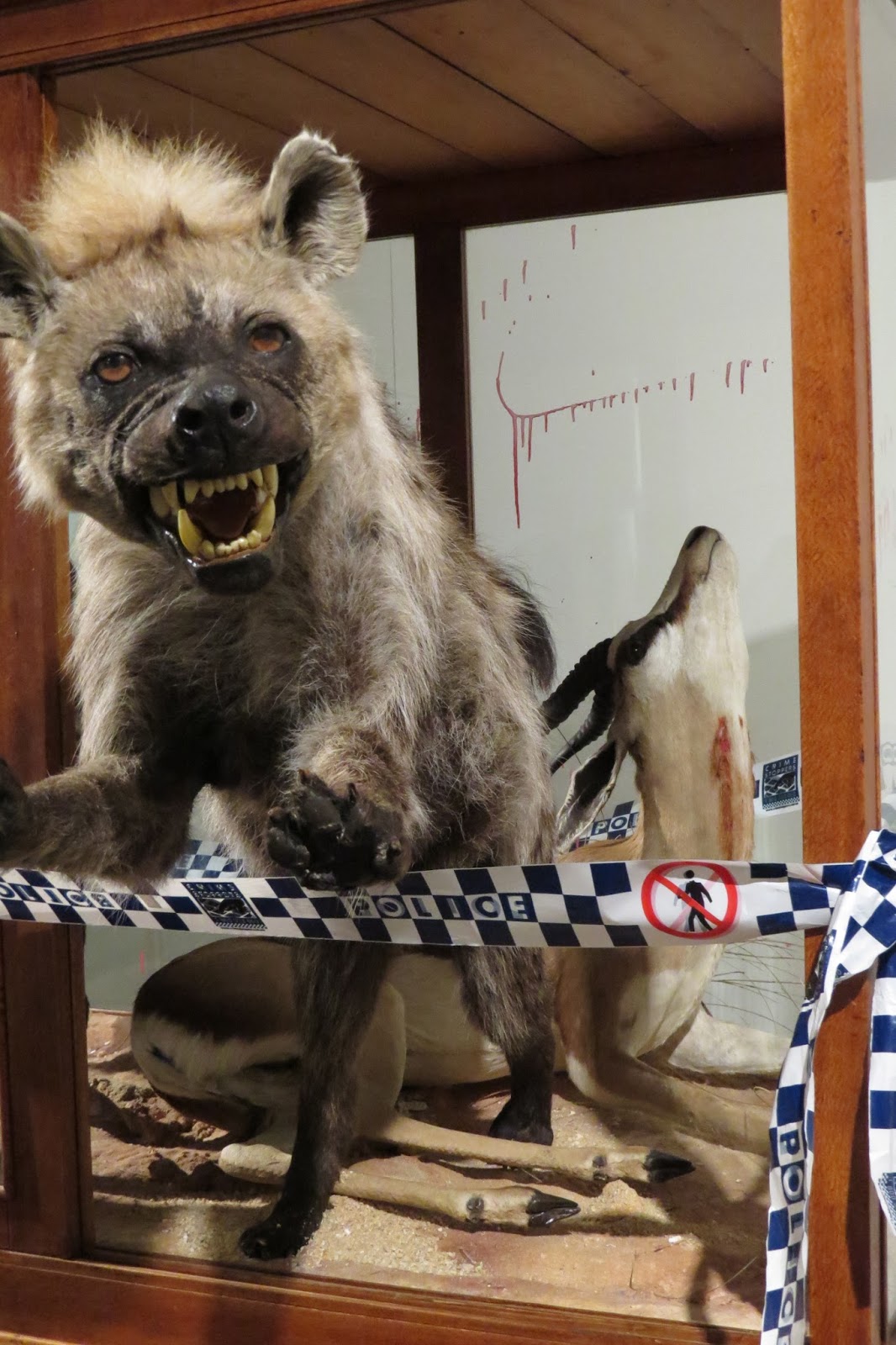
The Case of the Laughing Hyena 2012
A rather confronting display where a typical museum glass case is turned into a crime scene. A young boy visiting at the same time as me was greatly moved by this display. "This work asks us to think about how we represent nature often in sanitized, ordered worlds. The reality is often messy, violent and visceral. Animals do not live by human morals, standards or values." Which is pretty much why I have a hard time watching nature documentaries these days. 


War and Peace 2010
Magellanic penguins- native to the Falkland Islands, Chile and Argentina, nesting on toy soldiers. "Even in peace the actions of man weigh heavily on the survival of many species as a result of climate change, land clearing, over fishing and pollution. This work speaks of nature's ability to adapt against, and in spite of the tide of human activity that seeks to strangle it."


Are you my mother? 2010
An extremely moving 'family' group where the adults are only represented by trophy heads. 

Return to Sender 2012
Also very disturbing. Here twelve penguins are wrapped ready to send to the leading Natural History Museums of the world. This work is said to represent the plundering of Australia's native populations for museum use- dissection, classification and display. I'm a bit torn about this one, museums do perform an important role, particularly in recent times, historically it may have been more plundering than benefit.


Born Free 2013
Named for the iconic movie of course, Born Free explores wild animals and subjugation and domestication of certain species. The artist said that he studied the behaviour of his cat in posing the lion. He's contrasting the typical aggressive posing of lions with the playfulness of a domestic cat lolling about on a bed. It's a very striking work. 

Z is for Zebra
Z is for Zebra explores animals raised specifically to be hunted for pleasure in America. It references a number of biblical passages and organisations. This zebra was bought on ebay! It had never occurred to me that you could buy a zebra on ebay. Another modern tragedy.

Untitled (with toxic additives) 2012

I'm always a bit disappointed at Untitled as a title for a work of art. Particularly in this exhibition, as most of the titles of these works are important, apt and added to my understanding of the works. Here five penguins skeletons are filled with plastics to draw attention to the horrific Pacific Garbage Patch- estimated to be the size of France! The exhibition said there is a similar sized disaster in the Atlantic Ocean. Birds eating plastics is a very real problem.

Serengeti 2012
I think I found Serengeti the most disturbing overall. The antelope here are bodies discarded after their heads have been taken for trophies. It was haunting.

There are many other fascinating works- the dome series are particularly brilliant. Mere pictures can't express the feeling of what it was like being in the gallery space with these sculptures, with these animals. For the first part of my visit I was the only person there, I was glad for the solitude actually.

Go see it for yourself if you can, Wunderkammer is touring regional NSW and Queensland- I can't find a schedule online though. I'll certainly be going back, and taking Master Wicker although I'm not sure how he'll react (you can check out a video of the exhibition being installed here).

Orange Regional Gallery
Byng St, Orange
Until October 13
Tuesday-Saturday 10-5
Sundays/Public Holidays 12-4
Free entry

Wednesday, 11 September 2013

Wondrous Words Wednesday 11/9/13


Wondrous Words Wednesday is a fabulous weekly meme hosted by Bermuda Onion, where we share new (to us) words that we've encountered in our weekly reading.

This weeks words are from my recent reading of Lost Cat. 

1. Rumspringa (Noun)

Maybe Tibby had gine to Antarctica, or on rumspringa, or a kitty walkabout. 

A period of adolescence for some members of the Amish community during which a youth temporarily leaves the community to experience life in the outside world. Wiki


2. Redacted (Verb)

The names have been redacted because everyone is innocent until proven guilty. 


i) Edit (text) for publication. 
ii) Censor or obscure (part of a text) for legal or security purposes. Google. 


Picture source

Tuesday, 10 September 2013

Mem Fox at Mudgee Readers Festival

I've seen Mem Fox speak in person before. She's so funny, passionate, and such a dynamo, I was keen to see her speak again at the recent Mudgee Readers Festival.

Mem Fox is an impassioned advocate for children's literacy, she wrote a book called Reading Magic detailing why she wants us all to read aloud to children every day. She is a proud grandmother and a retired Associate Professor of Education at Flinders University in Adelaide. Mem is also an extraordinary author who wrote what is possibly one of Australia's most famous and most beloved picture books, Possum Magic- it was her first book, back in 1983! Possum Magic has just celebrated it's 30th Anniversary. You can hear a great interview with her celebrating the 30th anniversary on Radio National here.


I saw Mem Fox three times over the two days of the festival. The first time was her solo session, titled In Conversation with Mem Fox, but she gave a prepared speech, as she said she knew what she wanted to say and in what order. Her talks are always peppered with delightful readings of a selection of her books, new and old. It was a particularly captivating talk, delivered with trademark Mem Fox humour and candour. Mem told us about her passion for engaging children in reading and how that impacts on her writing process.

When Mem recently heard that if children know 6 nursery rhymes by heart by age 4 then they'll be in the top reading group at age 8 she wrote a book, Good Night Sleep Tight, which included 7 nursery rhymes,  the six required nursery rhymes and a bonus one- just to make sure.


Mem told us how children are deeply attracted to great writing- they want to read it over and over again, and are enchanted. Ordinary writing bores them, they roll their eyes to the ceiling- the kind of writing all too often in school readers, and the kind of writing that comes too easily off the pen.

Mem is greatly excited by every first draft she writes. She loves it. She then puts it aside in a draw for a few months to read it again with a fresh eye- and is all too often shocked and embarrassed.

"I couldn't have written this, I'm Mem Fox!"

First drafts reveal she is without genius! She will tell children "Kids, I'm not a writer, I'm a rewriter." Mem rather modestly credits nonwriting as the secret to her success, allowing the subconscious to get to work without the conscious mind getting in the way. Yet she consciously frets over word placement, reading aloud her work time and time again, perhaps replacing a two syllable word with a three syllable word because it sounds better.


Mem read us Koala Lou and the room (largely full of adults) was held spellbound. She told us the background story to this moving book. 577 words, all of which were agonised over. 49 drafts. 2 years of work. Koala Lou was written after Possum Magic hadn't won Picture Book of the Year in the 1984 CBCA Awards, although it was highly commended. It is fascinating to see this runner up status as the background to Koala Lou. Mem Fox is also the oldest of three girls.

Mind you Mem is quite emphatically against moralizing to children in books as it turns them off very quickly. "Leave it to the parents to bring up the kids, let writers entertain them." She feels strongly that writers shouldn't be writing to assuage adult guilt about what we've done to the world or to work out their own problems. Writers should be writing to allow children to love books and reading.

Mem has quite an extensive section on her website with tips and advice on writing picture books. She told us that the placement of pageturns are phenomenally important for picture books. In books for older children, if there's no problem, there's no story. The calamity is revealed on what she calls a blue page, and the blue page is essential. The level of intensity of the blue page will lead to how much the book is loved, and how well it is remembered. Early rhythmic books for the very young don't need a problem.

I hadn't heard of The Magic Hat before Mem read it to us.
A wonderful story of a magic hat that settles onto peoples heads
 and turns them into the animal they most look like!


In Mudgee Mem was very excited because one of her books, Ten Little Fingers and Ten Little Toes had just been selected to be part of the official Australian gift to the new heir to the English throne, Prince George of Cambridge.

Mem reading Ten Little Fingers and Ten Little Toes
to a packed Auditorium for the Sunday morning session
she read many books during the half hour session

Mem has an extraordinary stamina for book signing, she was at it for (literally) hours after every session!