Saturday, 6 August 2016

Eiffel Towers

I love the Eiffel Tower. Perhaps it's a cliched image, but for me it's like seeing the Harbour Bridge or the Opera House in Sydney, your heart skips a beat for a minute as you drink in the beauty. I will never tire of seeing her in the flesh. Day or night. I have visited the Eiffel Tower many times and have many, many happy memories there. I have had lunch at Le Jules Verne there three times (but only shown you two- one, two - but here's a hint: the third time was great too), and I have spent all afternoon on the Champs des Mars picnicking and waiting for the Bastille Day fireworks in 2013.

The Eiffel Tower is big business, not just visiting her, but she is used to sell everything in Paris and fills windows absolutely everywhere.


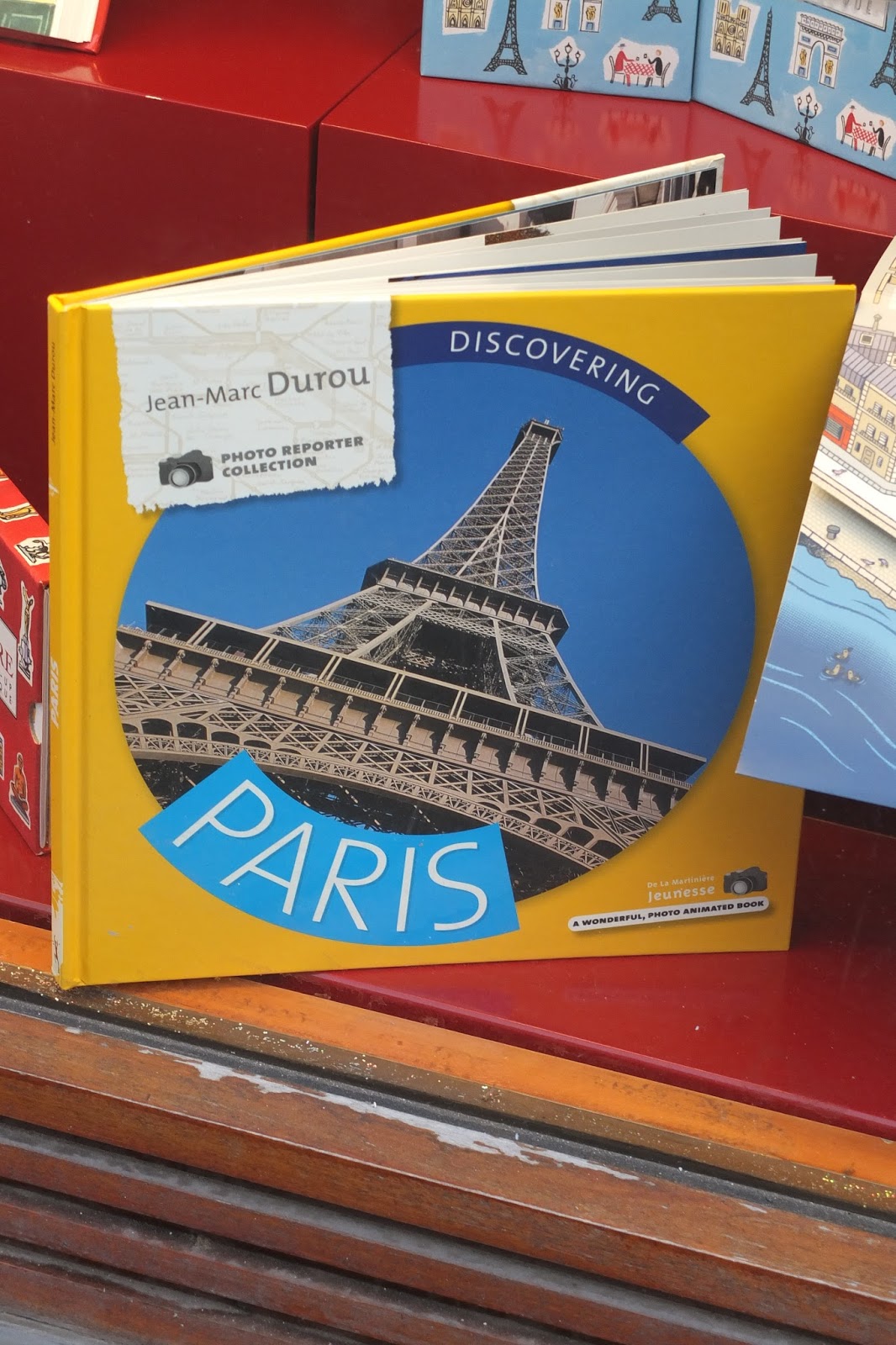
There are Tower books and games. 


Post cards of course.


Paintings and fridge magnets.


Rubbers


Of course a Tower iPhone case would be fab. If only one ever had an iPhone current enough that covers are still sold. 


Naturally you can drink the Eiffel Tower too. 


Or wear her.


Seemingly there is no end to the Tower trinkets and baubles. 


Just when you think you can't possibly do any more, you can eat the Tower. 


Or make dinner with her. 


I'm very pleased to have Le Tour Eiffel fill my 1000th post.

Saturday Snapshot is a wonderful weekly meme
 now hosted by 
WestMetroMommy

Friday, 5 August 2016

Circle and Flying for Your Life


Jeannie Baker is a big name in Australian picture books. She has made such a wonderful body of work over the years. The illustrations in her books are all photos of the amazing, intricate collages she makes, and her books often deal with environmental themes or urbanisation. I've read most, but not all of her books, and seen a previous exhibition of her artwork. 

I'd somehow never heard of Jeannie Baker's new book Circle until I walked into my favourite bookshop and snatched it off the shelf recently. I read it standing there, then I bought it. I was rather excited. You see it's about migratory birds, and bar tailed godwits in particular. I stalked godwits in New Zealand a few years ago and am thrilled to see their extraordinary lives highlighted in this book.

Circle tells the story of the godwits migration, leaving Australia for the Arctic, and later returning. Their departure is witnessed by a young boy, a rather enthusiastic birder, in a wheelchair who longs to fly like the birds.

As with any Jeannie Baker book there are a fabulous set of collages, 23 here. Jeannie Baker began making collages at art school, initially collecting textures, but becoming more representational as an illustrator. Children love pouring over illustrations with lots of detail and Jeannie Baker provides so much of it- there's always a new detail awaiting discovery.


My favourite Circle collage, a glorious double page
Picture Source

She has taken some artistic licence as the godwits appear to be in their breeding plumage all the way along their journey (sorry for the nerdy very amateur birder comment), the red providing a better contrast and more colour to the images.

I was a bit confused by the final image for a while. Why are people shown taking their dogs and horses where they are clearly prohibited?


And what is the boy doing with that dog? It helps to realise that it is not his dog that is chasing the birds into flight. The boy casts down his crutches and binoculars and is trying to stop the dog from charging at the birds. In one of the videos linked below Jeannie explains that she was using the boy to show that we can all individually make a difference in our local area. 


There is an Author's Note at the end giving more information about godwit migration, and a Godwit Migration Map.


There is an exhibition of Jeannie Baker's marvellous collages for Circle travelling Australia at the moment, and will be for the next two years. I can't wait to see it somewhere. The exhibition is then proposed to follow the path of the godwits internationally and be shown in Alaska, South Korea and China.


You can hear Jeannie Baker talk about Circle here. And an interesting SMH profile of the artist here.

Coincidentally I recently listened to an amazing 4 part radio documentary Flying for Your Life, an ABC and BBC coproduction. It complements Circle beautifully. If you can access these extraordinary episodes I'd highly recommend it. I learnt so much from each episode. Episode 1 is in Australia and explains our main threats to shore bird populations here - development, environmental degradation and dogs. It also describes how a migration actually starts.

Episodes 2 and 3 deal with the Yellow Sea, the most important staging and feeding areas for their migration north. The Yellow Sea is shallow and provides 20% of the world's fishery products. Sadly two thirds of the intertidal habitat of the Yellow Seas has been "reclaimed", i.e. destroyed in the past 50 years. It is funny to hear North Korea described as the "biggest organic farm in the world" and portrayed as possibly the saving grace for migratory birds. It had never occurred to me that people could eat shore birds before.

Episode 4 tells of the behaviours of the birds in their Northern summer breeding grounds in Alaska and Russia. Here global warming is the biggest threat to the birds, they are starting to hatch at times to miss out on the peak feeding times and are becoming smaller birds with smaller beaks. The birds completely change their foods for the southern and northern hemispheres, and change their body composition to prepare for their flights. The birds appear to monitor air pressure to time the start of their migration, and can fly at up to 80 km/hour! Bar-tailed godwits fly nonstop, up to 1500 km per day to travel the 11-12,000 km from Alaska to Australia and New Zealand in 8 or 9 days.


http://australianwomenwriters.com

Thursday, 4 August 2016

25 Books to Read Before You Die World Edition

A rather fascinating list of adult world Literature from Powells in America. I wonder why there are two from Italy and two from Japan. Rather disappointing to not see a title from Australia. Perhaps we're not off the beaten track enough?


Half of a Yellow Sun - Chimamanda Ngozi Adichie, Nigeria


Rashomon and Seventeen Other Stories - Ryunosuke Akutagawa, Japan

Voices From Chernobyl - Svetlana Alexievich, Belarus

Gabriela, Clove and Cinnamon - Jorge Amado, Brazil

The Master and Margarita - Mikhail Bulgakov, Russia

Invisible Cities - Italo Calvino, Italy

Love in a Fallen City - Eileen Chang, China

Life and Times of Michael K - J.M. Coetzee, South Africa

Hopscotch - Julio CortĂ¡zar, Argentina

My Brilliant Friend - Elena Ferrante, Italy


Mirrors: Stories of Almost Everyone - Eduardo Galeano, Uruguay

Too Loud a Solitude - Bohumil Hrabal, Czech Republic

The Bone People - Keri Hulme, New Zealand

The Summer Book - Tove Jansson, Finland (see my review)

Annie John - Jamaica Kincaid, Antigua

Independent People - HalldĂ³r Laxness, Iceland

Near to the Wild Heart - Clarice Lispector, Brazil

A Heart So White - Javier MarĂ­as, Spain

A Fine Balance - Rohinton Mistry, India

Cities of Salt - Abdelrahman Munif, Saudi Arabia

A Wild Sheep Chase - Haruki Murakami, Japan

Life: A User's Manual - Georges Perec, France


Blindness - José Saramago, Portugal

The Street of Crocodiles and Other Stories - Bruno Schulz, Poland

The Rings of Saturn - W.G Sebald, Germany

3/25

Well, that's better than I would have expected. I remember Blindness quite vividly even though it's been some years since I read it. I didn't really like The Summer Book and am rather surprised to see it in this list. 

I've been meaning to read the Georges Perec for some time, and even bought a copy last year. I have meant to read a few other books on this list and would especially like to try My Brilliant Friend one day to see what all the fuss is about.

Wednesday, 3 August 2016

Cleverman


Master Wicker and I have recently finished up watching the first series of Cleverman. It's not really my usual fare I guess, but I really enjoyed it. 


There have been a number of recent TV shows with great roles for Aboriginal actors, and encompassing Aboriginal stories. Cleverman takes that one step further and is firmly based in Aboriginal mythology. Set in a futuristic, but rather familiar Australia, Cleverman deals with prejudice, race and identity with some rather exciting supernatural and fantastic elements thrown in. Anyone even vaguely familiar with Australian history and politics will recognise themes of dispossession, race, asylum seekers and border protection. 


Cleverman was written by Ryan Griffen because he saw the need for more Aboriginal superheroes. Griffen grew up with comic book heroes and Teenage Mutant Ninja Turtles, and he was naturally introducing his own son to the same characters. It was while playing  dress-ups with his 3 year old Koen one afternoon that Griffen realised he wanted to share a culturally significant superhero with his son. It's no coincidence then that Cleverman's name is Koen, or that the real Koen can now play Cleverman in his room (although I guess he probably hasn't watched the whole series, there's a few too many adult concepts in there).


JJJ ran a series of the fantastic Dreaming short stories that inspired the script are read by the Cleverman actors. An impressive 80% of the cast and directors are indigenous Australians. Cleverman is an Australia/New Zealand coproduction, and involved the iconic Weta Workshop


I missed Redfern Now a few years ago, although have long been meaning to seek it out. But recently I've enjoyed Glitch and Ready for This, and I'm eagerly awaiting the movie adaptation of Jasper Jones later in the year. The second series of Cleverman will be released in 2017. I'll be watching. 


Compass had a fascinating Cleverman Special discussing the mythology and story behind Cleverman. 


Tuesday, 2 August 2016

Finding Winnie


It's amazing what you can learn from a kids book. Finding Winnie is a charming picture book that tells the back story of Winnie-the-Pooh. It turns out that Winnie was a real black bear before finding enduring fame as a fictional bear in the stories of A.A. Milne. 

Lindsay Mattick's great grandfather was a Canadian vet who was called up to fight during World War I. On the long train journey from his native Winnipeg Captain Harry Colebourn bought an orphaned bear cub at a brief stop at White River, Ontario in 1914. He was to name the bear cub Winnie after his home town of Winnipeg, and take her across the Atlantic to England.


Picture Source
In England Colebourn realised that it was rather improbable to take a black bear onto the battle fields of France, and so he took Winnie to London Zoo. Winnie found fame at the zoo because of her friendly hand-reared nature and children were allowed into her enclosure, one of them being Christopher Robin Milne. Christopher Robin so loved Winnie that he renamed his own stuffed bear Winnie, and of course the rest is literary history.


Did Christopher Robin give Winnie tooth decay?


In Finding Winnie this change is marked as a new story. 
"Sometimes," I said, "you have to let one story end so the next one can begin."
"How do you know when that will happen?"
"You don't," I said. "Which is why you should always carry on."
Lindsay Mattick grew up feeling related to Winnie-the-Pooh and went on to name her son Cole in honour of his great-great grandfather. Mattick dedicates Finding Winnie to Cole:
May this story always remind you of the impact one small loving gesture can have. 
Australian Illustrator Sophie Blackall has written a fascinating four part series of posts about how she researched and illustrated Finding Winnie on her blog. 1. 2. 3. 4Finding Winnie won the Caldecott Medal 2016. Sophie Blackall made a video full of excitement in appreciation of her win. I think it's fantastic that a Canadian and an Australian made the most "distinguished American picture book for children" last year. 


Monday, 1 August 2016

Letter to D. A Love Story


I like hanging out in used book sales. You never know what you're going to find. I'm always on the hunt for the obscure and out of print titles for my 1001 quest. And sometimes you find little gems like this one. I totally picked up this book and put it in my bag because of the little words, that you can't really see in the image above, in the bottom left corner of the cover. The Love Letter That Captivated Paris. Well, anything that captivates Paris will captivate me. Rummaging around the house recently I found it sitting on a pile of books, and picked it up for a Paris in July read.


I just love this photo of
André and Dorine

André Gorz was a very prominent French thinker and journalist. Born in Vienna as Gerhart Hirsch in 1923, his career took off after the second World War. He was friends with Sartre and de Beauvoir, and published his writings under several names. But he was to become best known for one of his final writings, the beautiful and moving Letter to D, a personal reflection looking back on his 58 year relationship with his wife Dorine.

You're 82 years old. You've shrunk six centimetres, you only weigh 45 kilos yet you're still beautiful, graceful and desirable. 

Gerhart Hirsch met the young Englishwoman Doreen Keir in 1947 at a poker game in Lausanne, Switzerland. He was immediately smitten.

You were striking, witty and clever, beautiful as a dream. 

Even though Doreen's friends warned her off Gerhart "He is an Austrian Jew. Totally devoid of interest", she accepted his offer to go dancing a month later, and they were quickly inseparable.

We were  both children of precariousness and conflict. We were made to protect each other from both. We needed to create together, by being together, the place in the world that we'd originally been denied. 
They lived a fascinating life. Gerhart was to find fame as AndrĂ© Gorz and Michel Bosquet, writing for Paris-Presse and L'Express. The couple moved to Paris in 1949 initially living in a room on the Rue des Saints-Pères (6th) leant to them by a friend for three years. They then moved to "two little attic rooms separated by the landing in an apartment block in the eleventh arrondissement." But they were not as happy there.

Up until then, we'd lived in poverty but never in ugliness. 

Doreen became sad because of their location.

You felt personally like you were in exile in that part of town. When you didn't come in to the paper, you were lonely, cut-off. You didn't see your friends nearly as often, now that they were a good half-hour away by metro. Whenever you left the house, wherever you went, there was nothing but deserted streets, dusty shops. You became sad. 

After a few unhappy years in the 11th they found a "small run down apartment" on rue du Bac (one of my favourite streets from my 2013 visit when we stayed nearby, Jacques Genin was one of the many highlights, although rue du Bac would have been very different in the 1950s). They felt they "lived at the centre of the universe".

André felt that he had left Dorine (Doreen had Frenchified her name- is there a better term than Frenchified? Anglicised seems a proper word, Frenchified not so much) out of his writings, it was "eating away" at him.

Why is there so little of you in what I've written when our union has been the most important thing in my life?
He felt that he had misrepresented her in The Traitor, "an image that disfigures you". Letter to D sets out to correct these perceived short fallings. It was written towards the end of their lives.

You gave all of yourself to help me become myself.

Dorine was unwell for decades having developed painful arachnoiditis following an intrathecal injection of Lipiodol to image her back in 1965.

You could no longer lie down, your head hurt so much. You'd spend the night standing on the balcony or sitting in an armchair. I'd wanted to believe that we were together in everything, but you were alone in your distress. 

Letter to D was published in France in 2006 when Dorine was terminally ill.

At night I sometimes see the figure of a man, on an empty road in a deserted landscape, walking behind a heard. I am that man. It's you the hearse is taking away. I don't want to be there for your cremation; I don't want to be given an urn with your ashes in it. 

AndrĂ©  never did receive that urn as he and Doreen died together of lethal injection at home in September 2007. They left a note on the door for the cleaner. "Warn the police station. Do not go upstairs." Dorine had agreed to the French publication of Lettre Ă  D on the condition that it not be published in English until after her death. In a note by translator Julie Rose she felt that translating Letter to D was harder than many other translations she has done of "difficult, elaborate books by France's leading intellectuals".

It is so simple on the surface, so tight, yet so emotionally complex, that the tiniest false note rings out like a gong. 
She's done a lovely job with it. It's a beautiful read.


Paris in July

French Bingo 2016
Dreaming of France is a wonderful Monday meme
from Paulita at An Accidental Blog