Sunday, 2 September 2012

What Reading Means to Me

What Reading Means to me was the beguiling title of a session that I attended at Melbourne Writers Festival this week. A great panel with Cassandra Golds, Andrew McGahan and John Boyne. This was another session in the schools program and the vast majority of the audience were school groups and their teachers, although some older ladies seemed to be there because the tickets were $7, still they enjoyed it too I think.


The moderator said that she had asked the panelists to think about three questions. What do writers read? Do the books they read when they were young still matter? And do you need to be a reader to be a writer?

Cassandra Golds spoke of her 6 year old self hearing a recording of Hans Christian Anderson's The Little Mermaid, and crying, the first time a work of art had made her cry. She knew from that young age that she wanted to be a children's author! At 9 she discovered Narnia, and discovered the possibility of another level of reality. At 11 or 12 years old she was most moved by The Stone Cage by Nicholas Stuart Gray, and described it as funny, magical and moving, a fantasy story with a fully developed psychology. I hadn't heard of this book before, but it does sound intriguing, being a retelling of Rapunzel from a cat's point of view.

Andrew McGahan described growing up as a rather bookish child on the family farm in Western Queensland. The house had a large library, and he had easy access to a rich storehouse of stories. He first loved horror and ghost stories like many boys, and then entered the world of fantasy via Tolkien and Stephen Donaldson.

However he came to realise that these were all European or North American settings, that none of the books he was reading were set in Australia, and none had any relevance to the flat farming land of the outback that he saw each day. He then read Patricia Wrightson's work, particularly The Ice is Coming and found it quite altering. Here were books set in Australia, drawing on Aboriginal mythology, with creatures that fitted the landscape that he knew.

Andrew McGahan has only recently become a children's author, his first work for a younger audience, The Coming of the Whirlpool, was only released recently. He made his name as an adult author and perhaps his most famous and lauded book, The White Earth, he described as having been written entirely in Patricia Wrightson mode.

John Boyne grew up in Dublin, and described his joy at the half school day on Wednesdays. Not just that it was a half day, but he would go to the library that day and carefully select the books that he would read that week. As a young boy he loved Bobby Brewster and Noddy books. He discovered the world of Narnia at 9 years old while recuperating from an appendicectomy. At 12 he was reading Dickens, preferring the works with child protagonists- David Copperfield, Oliver Twist and Nicholas Nickelby. Indeed he rereads David Copperfield to this day.

He cited A Monster Calls as one of the best books of the last few years. So many people do, I really must read it. He felt that there was very little rubbish published in the YA world, and I must agree.

They each talked about their writing selves too. Naturally, each of them felt that you needed to read to become a writer. Cassandra Golds felt that her reading had given her her voice. That each of her books was a response to all the books that she's loved, and a response to things that have happened to her. John Boyne described fellow Irish author Joseph O'Connor (Sinead's brother) as having written out Hemingway as a young writer to learn how to construct sentences and dialogue. John Boyne always carries a notebook to jot down ideas, while Andrew McGahan encouraged daydreaming. There'll be no time for daydreaming with the multiple books that have just been stacked on top of my already tottering TBR.

Saturday, 1 September 2012

Ashfield Park

I've known that there was a statue of Mary Poppins in Ashfield Park (in Sydney) for quite a while. I'd walked through the park several times in a half hearted effort to find it. A friend lives nearby so I was there reasonably often. Now my friend is moving, it's unlikely I'll visit all that often, so one day recently I went on a quest to finally find her.


Seems not only Paris has a pigeon problem

I'd walked most of the park (it's quite big), then realised where she had to be. Near the children's playground. And, there she was!


On duty for ever, watching over the children


I also found some of the local family of kookaburras. One of my favourite birds, they are always a delight to see, whether they're laughing or not. 

They typically perch up in trees on the lookout for  lunch


Laughing Kookaburra (Dacelo novaeguineae)

Saturday Snapshot, is a wonderful weekly meme from at home with books

Friday, 31 August 2012

Napoleon Exhibition NGV

The National Gallery of Victoria has a blockbuster Napoleon exhibition on until October 7 2012. An extraordinary collection of artworks and artifacts about Napoleon, his first wife Josephine, their lives and their enthusiasm for Australia!


The publicity for this exhibition has been huge. Ads in the weekend supplements each and every week. My Melbourne friends all seemed to have been, some multiple times. Resident Judge went. The Intrepid Reader went. Everyone loves it. So, I was expecting to like the Napoleon exhibition, and I was excited to find time today to go. Naturally, I wasn't disappointed. It's an astonishing exhibition. Well worth going, and the audio tour adds much to the experience for the patient and inclined.

Napoleon (the exhibition) gives us a chronological walk through the tumultuous times of late 18th and early 19th century France, and Australia. We start off in the court of Louis XVI, famously married to Austrian princess Marie Antoinette. We see a lock of Louis's hair, gorgeous paintings of the couple. Then terrible paintings of the revolution, the horrific prisons, the execution platforms. Particularly moving is Jacques-Louis David's Death of Marat, an extraordinary painting I hadn't seen before, and a simple revolutionary pike used to parade guillotined heads about the streets of Paris, next to a portrait of a friend of Marie Antoinette who met such a ghastly fate. Her head was paraded in front of Marie Antoinette to show her what had happened and as a prelude to her own gruesome death.

La Perouse is not a famous name to most Australians perhaps, although he is still marked by a suburb in Sydney, but it's absolutely fascinating to learn about his journey to Australia at the very founding of British settlement in 1788. La Perouse arrived the same week as the First Fleet in January 1788. He spent six weeks in Botany Bay, before sailing off to the Solomon Islands, where he and his crews all perished in a shipwreck. Louis XVI didn't know of his fate of course, and all the while when he was incarcerated after the French Revolution of July 1789, it is said that he asked each morning if there was any news of Monsieur de la Perouse. Even on the morning of his execution, having been visited by his family for the last time the night before he asked about Monsieur de la Perouse. I found that particularly moving.

We then come across a bright young military student from Corsica. Napoleon and Josephine were both not French by birth, and apparently spoke French that was quite heavily accented. Napoleon rose up through the ranks of the army, fighting famous battles in Egypt, and in Europe, crossing the Alps into Italy to fight the Austrian army, which gives us Jacques-Louis David's heroic portrait of Napoleon, used to promote the exhibition. Apparently Napoleon in reality crossed the Alps on a more sure-footed mule rather than the robust white stallion pawing the air, but it makes a much better picture doesn't it?


Extraordinary to see a dress worn at Napoleon's coronation on December 2 1804 at Notre Dame in Paris, normally held in a private collection. Jacques-Louis David's massive painting to mark the occasion is my favourite painting in the Louvre. It dominates a room in the Large French Paintings section. I love standing before it, dwarfed, in awe of the opulence and majesty of the scene. I have the fridge magnet version on my fridge door at home and gaze at it every day. How wonderful then to hear the astonishing music played at the coronation? Sadly not available on CD, I asked. Two massed choirs, it was sumptuous and gorgeous. Almost worth going back, just to hear it again. I wasn't aware that Napoleon was said to have crowned himself, upsetting the pontiff awaiting the task. Indeed there is a sketch by David of just such a scene, although it is not the version portrayed in the official portrait. And fascinating to learn of the use of bees, on Napoleon's robes and throughout the cathedral, symbolising immortality and resurrection. The whole coronation and beyond was of course more typical of the monarchy that had been abolished with so much bloodshed and violence in 1789.

And the Australian connection? Absolutely fascinating to see maps displayed with Southern Australia labelled as Terre Napoleon. We could have been French! Napoleon and Josephine were both quite fascinated with Australia. Josephine pursued specimens of Australian flora and fauna for her private residence at Malmaison (naturally a new destination has been added to the French wishlist). Kangaroos, emus and black swans graced these most French of gardens, amongst other exotic species. Black swans were said to be her favourite. Indeed Empress Josephine is reported to be the first person to breed black swans in captivity! Sadly she also aided the extinction of two species of emus.

Even after his death Napoleon may have contributed to Australia. Napoleon was initially buried in St Helena, buried in a field under willow trees. It is thought that visitors to his grave may have taken willow cuttings enroute to Australia and so perhaps the willows I see out of my kitchen window have their origins at Napoleon's burial place in St Helena? I hope so. I shall choose to believe that they do.

Wednesday, 29 August 2012

Wondrous Words Wednesday 29/8/12


Wondrous Words Wednesday is a fabulous weekly meme hosted by Bermuda Onion, where we share new (to us) words that we’ve encountered in our weekly reading.  

Recently I reread The Secret Garden (see my review), a 100 year old book set in Yorkshire. I knew that there would be some new words.

1. Broom (Noun)

"Nor it isn't fields nor mountains, it's just miles and miles and miles of wild land that nothing grows on but heather and gorse and broom, and nothing lives on but wild ponies and sheep."

A group of shrubs, most species have yellow flowers, but a few have white, orange, red, pink or purple flowers. Wiki

Image source
I would have thought it some sort of pea I suspect. 

2. Palanquins (Noun)

They were of different sizes, and some had their mahouts or palanquins on their backs. 

Palanquin is the French word for a litter, a wheelless carriage, usually carried by humans. Wikipaedia. Here it is clearly the elephantine variant. 

Image source

3. Daffydowndillys (Noun)

"Crocuses an' snowdrops an' daffydowndillys."

I know what daffodills are of course, but hadn't come across daffydowndillys before. I just love it!

4. Mignonette (Noun)

"Mignonette's th' sweetest smellin' thing as grows an' it'll grow wherever you cast it, same as poppies will."

A genus of fragrant herbaceous plants native to the Mediterranean and Southwest Asia. Grown for its sweet, ambrosial scent. Used in flower arrangements, perfume, pot pourri. Wiki. 

Image source


5. Wuthering

Mary told him her story about the midnight wuthering of the wind which had wakened her and about the faint, far-off sounds of the complaining voice which had led her down the dark corridors with her candle and ha ended with her opening of the door of the dimly lighted room with the carven four-poster bed in the corner. 

A wind blowing strongly with a roaring sound. Northern English dialect. Thefreeditctionary.com

A famous word of course, I was intrigued to see it here. 

6. Clemmin', clemming (Verb)

"But at last I seed a bit o' white by a rock on top  o' th' moor an' I climbed up an' found th' little 'un half dead wi' cold an' clemmin'."

To be hungry or cause to be hungry. Germanic origin. Collinsdictionary.com

7. Fakirs (Noun)

Magic is a great thing, and scarecly anyone know anything about it except a few people in old books- and Mary a little, because she was born in India, where there are fakirs. 

A Muslim Sufi ascetic in the Middle East and South Asia. Wandering dervishes teaching Islam and living on alms. Wikipaedia. 

I'm not sure that this definition fits all that well, but it will have to do. 

8. Pother (Noun)

They was quite in a pother yesterday. 

i) A commotion; a disturbance.
ii) A state of nervous activity; a fuss.
iii) A cloud of smoke or dust that chokes or smothers. 

9. Salver

The man held a salver with some letters on it and he waited quietly until Mr Craven took them. 

A flat try of silver or other metal used for carrying or serving glasses, cups and dishes at table or for the presenting of a letter or card by a servant. 

Image source

Tuesday, 28 August 2012

Jackie French!

I'm just loving the Melbourne Writers Festival. So many great sessions. Yesterday I went to a session titled Meet Jackie French as part of the schools program. The room was packed, mainly with kids, most of whom are enthusiastic readers, and many of whom want to be writers. Great to see kids at the festival. Participating. Engaged. Asking questions. Queueing to get their books signed after sessions. Authors as rock stars! Fantastic.

Jackie French has had many jobs of course, and her years in tv showed. She grabbed a microphone, stood up and just talked, and talked, so passionately. She really worked the room. The kids, and we brave grown ups, loved it.


Jackie French published her first book in 1992 (even though it had been accepted 5 years earlier!), and has published more than 130 books since then! I just tried to work out how many books she's published this year, and I can't. I think she writes faster than I read... Happily this day she mainly spoke about her recent book Nanberry. An extraordinary book that was one of my favourite reads of 2011. Check out my enthusiastic review here.

She spoke about the story, and she spoke about the process of writing the book. Nanberry wasn't the book she planned to write. Initially she planned to write a short, funny book "The Possum Who Kissed A Convict", it was a story she already knew and she thought it would be an easy book to write. But then she kept finding more stories accidentally. She met a descendent of Nanberry's at a conference. She found out more about Rachel Turner when documents from the Old Bailey came online.

Nanberry was a "very, very difficult book to write". It was four books that became one. Jackie French clearly knows her Aussie history, and is extremely passionate about it. When speaking of Waltzing Matilda she became even more enervated when she described it's origins as a song of defiance, and her despair that it has now devolved to be a folk song.

More generally she always writes the ending of a book first. Though of course, the ending may change during the writing process. When asked about her mastery of multiple genres, she said that she would hate to be limited to one genre, and she compared it to being forced to eat only one food all the time.

Big news- Jackie French's next book will be out on Dec 1 2012. The Girl from Snowy River. Yes Girl.  It's a sequel to A Waltz for Matilda. Another book I need to hurry up and read.


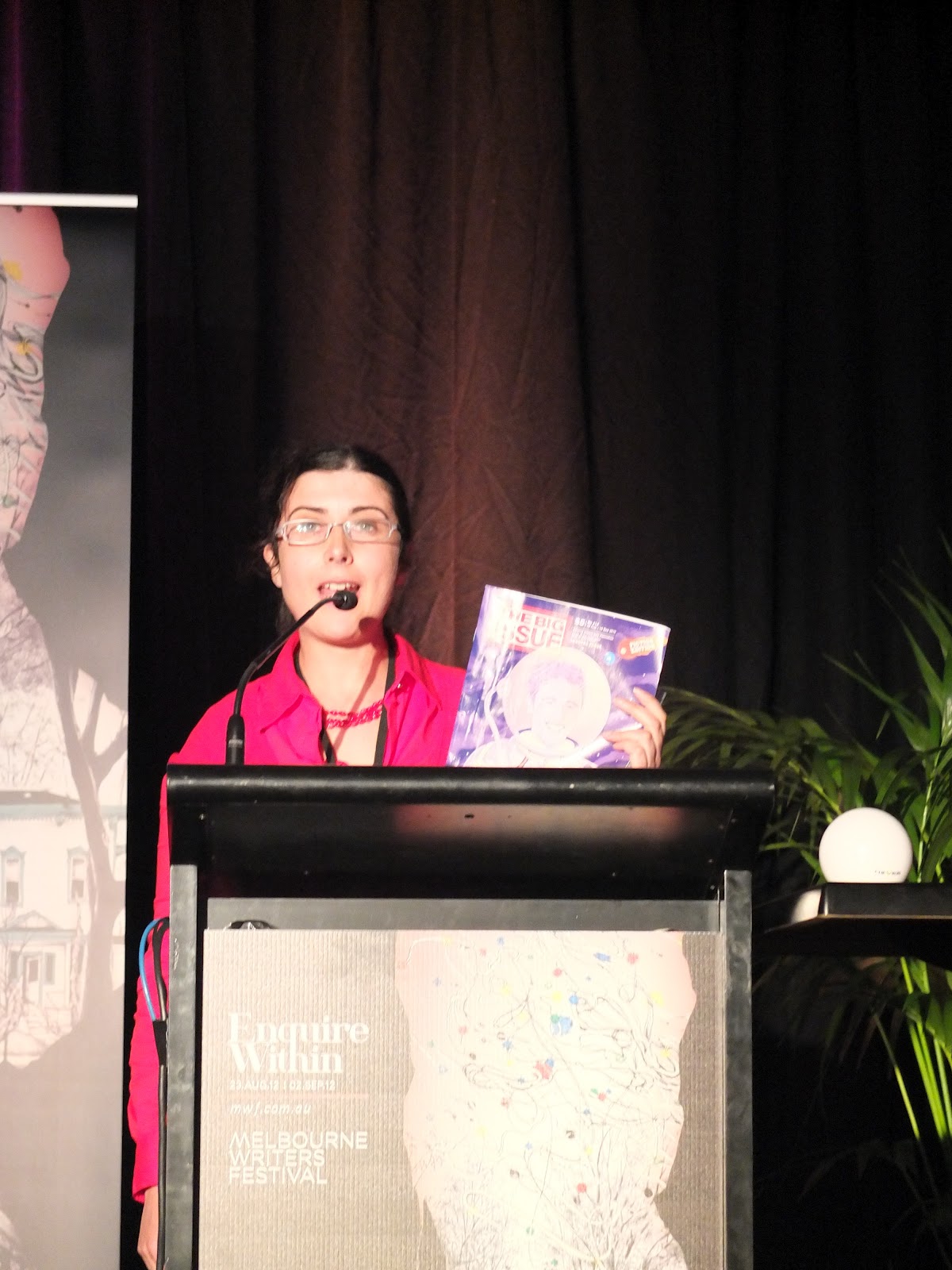
The Big Issue Fiction Edition 2012

As part of this year's Melbourne Writers Festival I was lucky to be able to attend the launch of the 2012 fiction edition of The Big Issue.

Melissa Cranenburgh, co-editor of The Big Issue


The Big Issue is such a fantastic concept. A fortnightly magazine, with great content, sold by vendors who often don't otherwise have any income- people with mental illness, drug or addiction problems or other tough circumstances. The vendor keeps half of the $5 cover price. Becoming a vendor helps not just with income, but socialisation, confidence and many other benefits too. The Big Issue started in Britain in the early 90s. The Australian edition was launched on the steps of Flinders Street Station in 1996. Since that time over 7 million copies have been sold, giving more than $15 million to the vendors.

There are no vendors where I live but I always buy a copy when I'm in Sydney or Melbourne.

Sir Andrew Motion launching the issue


2012 is the 8th year for the fiction edition, which has 12 short stories, 6 are commissioned by the editors and 6 are the result of a submission process- over 400 writers submitted their work. One contribution is getting a lot of media attention (including a lovely radio piece on Radio National today) this year because a Hollywood actor, James Franco (of course I had no real idea who he actually is) wrote it. The other commissioned authors are Margo Lanagan (I'll finally get to read some of her work! YAY), Tony Birch (new to me, but he sounds really interesting), Sophie Cunningham, Wayne Macauley and James Bradley.

The launch was a really interesting session. Sophie Cunningham and Tony Birch were there, as well as one of the writers selected through the sumbission process, 22 year old Rafael SW. They all spoke and read from their stories. Although at the end Chris Flynn asked about the other writers who had come through the submission process, and I think all of them were in the room! A big moment for them all.

The 2012 fiction edition is on sale until September 10. I hope you get the chance to buy one too. Now to just get time to finish reading it.


Monday, 27 August 2012

Graffiti Moon (with some random Melbourne graffiti)


I always really enjoy reading some fiction based around travel locations. So when I had the chance to travel to Melbourne for the Melbourne Writers Festival this year I was keen to read some local writing. Happily I chanced on this review of Graffiti Moon in the week or so before I left. Perfect timing.

Graffiti Moon was an Honour Book for the Older Readers in the Children's Book Council of Australia Awards in 2011. It also won the Young Adult prize for the Prime Minister's Literary Award in 2011 and the NSW Premier's Literary Award. So I'd seen it around and was thrilled to start.


Graffiti Moon is the story of one hot Melbourne night. Lucy is finishing high school and going for a night of fun adventure with her friends Jazz and Daisy. Daisy has a boyfriend, Dylan, but he's forgotten her birthday and is throwing eggs at her head in a show of boyhood excitement at finishing school.

Lucy is an artistic type, she has been learning glass blowing from an artist in a local studio and working on her Year 12 major piece. Both her parents are creative too, her mother is trying to finish a novel, her father a magician. Of course they have to hold down more pedestrian jobs to pay the bills. Things aren't running all that smoothly and her father is currently living in the shed in the backyard.


Lucy is besotted with a local graffiti artist Shadow. She sees his work on walls in the local area, and is moved by his work, his artistry. She knows that he isn't like the boys at her school. Lucy hasn't met him, but she plans to, although his identity is a closely guarded secret and he works stealthily at night with his partner Poet who provides the words to Shadow's vision.

I like that about art, that what you see is sometimes more about who you are than what's on the wall. 

But tonight she is out with her girlfriends and stuck with Dylan and his two friends, Ed and Leo. She plans to use this night to find Shadow and meet him.


There are many, many art and artist references, which I know I wouldn't have got when I was a younger reader. Jeffrey Smart. Rothko. Vermeer. Magritte. Some others that I have never heard of before. Cath Crowley does a good job of incorporating enough about these artists and their works that you get the meaning, without it seeming forced. Cleverly told in three alternating voices. Lucy. Ed and Poet. I was very quickly drawn into this wonderful, funny story.