Showing posts with label Newbery. Show all posts

Monday, 29 May 2017

The Family Under The Bridge


The Family Under the Bridge has been in my Paris TBR for some time. I came across author Natalie Savage Carlson a few years ago when I found an old copy of Pigeon of Paris at a used book sale (see my review). So I ordered a copy of The Family Under the Bridge, which appears to be her most famous book, and was a Newbery Honor Book in 1959. I think it was when I was moving books around selecting my stack for the recent Dewey's Readathon that I saw it on my shelves again and knew the time had come to read it.

I suspect that if I knew it was quite a Christmas story then I might have left it to later in the year, but I'm sure I would have forgotten about it again by then anyway. It's a quick little read too, only 123 pages. Armand is homeless, or "an old hobo" in 1950s parlance. It is a cold December day when he gathers his possessions and moves back to his usual winter home under a particular Paris bridge. 

Down the quay he pushed the buggy toward the bridge tunnel that ran along the shore. On the cobbled quay a man was washing his car with the free Seine water. A woman in a fur coat was airing her French poodle. A long barge, sleek as a black seal, slid through the river. It was like coming home after a long absence, thought Armand. And anything exciting could happen under a Paris bridge. 

But Armand finds three redheaded children living under his bridge. They too have become homeless after their father died, and their mother couldn't afford their rent on her wages from her job at a laundry. 

It is a rather simple and wholesome story, with some gypsy characters who are friends of Armand.
"To think we have fallen so low," wept the woman. "My children at home with gypsies."
"What is wrong with gypsies?" asked Armand. "Why do you think you are better? Are you kinder? Are you more generous?"
"I'm honest," murmured the woman through her scarf.
I can't imagine that this book would come anywhere near Newbery Honor status these days. It feels somewhat saccharine sweet. I suspect that I wouldn't have found it appealing at all if it hadn't been set in Paris. 

Naturally, I did enjoy glimpses and insights into 1950s Paris. I was confused at mention of "the Louvre store", but did some searching and realised that it was referring to Les Grands Magasins du Louvre a department store that operated until 1974, and is now Le Louvre des Antiquaires. Les Grands Magazines had impressive doors. 


 "In the good old days of Paris," he told the children, "they used to ring bells in the market places at the close of the day so the tramps would know they were welcome to gather up the leftovers. But no more."


Dreaming of France is a wonderful Monday meme
from Paulita at An Accidental Blog  

Sunday, 24 July 2016

Sounder


As soon as I began reading Sounder I realised that I was in similar territory to another 1970s Newbery winner- Roll of Thunder, Hear My Cry which I read a few months ago (see my review). Sounder is the slightly older of the two books, published in 1969, and is historical fiction telling the story of a black sharecropping family in the South of America at an unspecified time, although I can't remember a car ever being in the story even for the police so I suspect it is set quite some time before the Depression era tale of Roll of Thunder, Hear My Cry.

Sounder is quite an unusual book to read, as Sounder, a dog, is the only named character. Sounder lives with a family in their isolated, unpainted, uncurtained cabin. Actually Sounder lives under the cabin, sleeping on coffee sacks under the stairs. Sounder found the father when he "wasn't more'n a pup."

'Sounder and me must be about the same ag,' the boy said, tugging gently at one of the coon dog's ears, and then the other. He felt the importance of the years- a s child measures age- which separated I'm from the younger children. He was old enough to stand out in the cold and run his fingers over Sounder's head. 

The family are very poor, eeking out their rather marginal existence. The boy is keen to learn, and keen to go to school but the eight mile walk each way is too much in the winter cold. Sounder and his master, the boy's father, go out hunting each night, but they have been returning empty handed for some time. There were no racoon or possum hides to sell, and no meat for the family to eat. Winter also meant no crops, no work, and so no pay.

There are some interesting quotes about books, stemming from William H. Armstrong's work as a teacher I suspect.
The boy had heard once that some people had so many book they only read each one once.
It shouldn't have surprised me I suppose but it was a shock to have it pointed out that "no mailman passed and there was no mailbox" for the poor and illiterate. At one stage the boy retrieves a book from the rubbish. Rather intriguingly for someone who has taught himself to read by reading signs in stores he finds himself holding a book of Essays by Montaigne.

It was a book of stories about what people think. There were titles such as Cruelty, Excellent Men, Education, Cripples, Justice, and many others. The boy sat down, leaned back against the barrel, and began to read from the story called Cruelty.

But the words were "too new and strange". Sounder is a slim little volume, a mere 90 pages, but it sure packs an emotional punch. The boy's father is driven to do a desperate act by poverty and lack of food for his family. These are resilient, strong people living most difficult lives. There is indeed Cruelty and violence.

William H. Armstrong was a white teacher, and some people have criticized that he can't tell a black story. In an Author's Note at the beginning of the book he tells of a black man he knew in his childhood. This man told him the story of Sounder.

It is the black man's story, not mine.... It was history- his history. 

297/1001


Wednesday, 8 June 2016

Roll of Thunder, Hear My Cry


Roll of Thunder, Hear My Cry wasn't a well known book for me. I came across it in my 1001 quest, and have seen it in a few lists about the place since then. I'm so glad I got to read it, it's such an amazing book. I'm just sorry that it took me too long to read- 3 weeks for really quite a short book, but I just haven't had the time for reading these past few weeks. It's a mark of a great book that it can still shine even when the reader is forced to neglect reading as much I have been recently.

A story of a black family living in rural Mississippi in the early 1930s, which was a tough time of course. Our narrator is 9 year old Cassie the only daughter of the Logan family. Cassie lives with her three brothers,  her mother and grandmother in a small house on land bought by her grandfather after the abolition of slavery. The family grow cotton on their farm, Cassie's father is forced to leave the family home to work on the railway, while her mother teaches at the local school.

The writing is splendid, and there is a lot of tension and suspense, with a constant threat of nocturnal violence.


The lead car swung into the muddy driveway and a shadowy figure outlined by headlights of the car behind him stepped out. The man walked slowly up the drive. 
I stopped breathing. 

Roll of Thunder, Hear My Cry is an incredible account of the systemic racism of that era. Black children went to segregated schools. Their schools were only open from October to March as the children were needed to work in the fields by their poor sharecropping families during the growing season. While the white children started school in August. The white children are driven to school in a school bus, while the black children are left to walk 1 to 3 1/2 hours to school each way. All things designed to repress the black kids before they even got any sort of start at an education.

Author Mildred D. Taylor used the oral history told to her by her father to create a series of nine books about the Logan family. Roll of Thunder, Hear My Cry is a powerful exploration of ingrained, systemic racism, no mere casual racism here, but a deep hatred and sanctioned contempt at a time when violent criminal acts were condoned and ignored. Sadly these feelings have echoes today as we still need social campaigns such as BlackLivesMatter.


There are things you can't back down on, things you gotta take a stand on. But it's up to you to decide what them things are. 
288/1001

Wednesday, 6 January 2016

The Tale of Despereaux


It seems hard to believe that I've been waiting 12 years to read The Tale of Despereaux, but given that it was released in 2003 then I must have been (I read it late in 2015). I've read two of Kate DiCamillo's books before, Because of Winn-Dixie and The Miraculous Journey of Edward Tulane and enjoyed both quite a lot so I've been waiting to read more, and thankfully that day finally came. 

After all this waiting, I still didn't really know anything of this story save for the cover which has been taunting me all this time. Despereaux Tilling is a small mouse born in a large castle, he is a runt, but the only one of his litter born alive.
He was ridiculously small. His ears were obscenely large. He had been born with his eyes open. And he was sickly. He coughed and sneezed so often that he carried a handkerchief in one paw at all times. He ran temperatures. He fainted at loud noises. Most alarming of all, he showed no interest in the things a mouse should show interest in. 

Despereaux is different to the other mice- he loves music and story and dancing. He does not want to scurry about the castle hiding in the shadows. He admires the light through the stained glass windows, he can read the books in the library and does not want to eat them. He has love and purpose in his heart, although he is a bit of a fainter.

Told by an omniscient narrator The Tale of Despereaux is told in 4 books, each told from a different perspective.  It is a story of courage, love and soup. 
"And when times are terrible, soup is the answer." 
Times are indeed terrible as Despereaux must go on a perilous quest in the dangerous dungeons of the castle. It is beautifully written dispensing honesty and truth amongst the dungeons full of scary rats.
He saw that the floor of the dungeon was littered with tufts of fur, knots of red thread, and the skeletons of mice. Everywhere there were tiny white bones glowing in the darkness. And he saw, in the dungeon tunnels through which Botticelli led him, the bones of human beings too, grinning skulls and delicate finger bones, rising up out of the darkness and pointing toward some truth best left unspoken. 

We readers get some great advice along the way. 
"Might as well be happy, seeing as it doesn't make a difference to anyone but you if you are or not," said the soldier."
And perspectives on life.
There are those hearts, reader that never mend again once they are broken. Or if they do men, they heal themselves in a crooked and lopsided way, as if sewn together by a careless craftsman. 

We learn that we each take a different path. 
Reader, you must know that an interesting fate (sometimes involving rats, sometimes not) awaits almost everyone, mouse or man, who does not conform. 

It's a beautiful book, quick and easy to read. A deserving Newbery Medal winner. 

281/1001

Sunday, 27 December 2015

El Deafo


I came across El Deafo when it was an 2015 honour book for the Newberry Medal. I read the extraordinary Brown Girl Dreaming (see my review) at the start of the year, and bought El Deafo at the same time. This week I got to read it. I thought it would be the perfect book to read while sitting around on a train for a day, and it was. 

I don't read all that many graphic novels, it's a category that doesn't always appeal to me, but I've learnt to read and love verse novels, so anything is possible. 

El Deafo, is not just a graphc novel, it's a graphic memoir, and for some reason I have a bit more success with them than graphic novels alone. I'm particularly thinking of French Milk (see my review) I suppose. El Deafo tells us the story of Cece Bell's childhood, which changes for ever when she contracts meningitis aged 4 and is left profoundly deaf, a change which isn't immediately recognised by Cece, her parents or her doctors. A few weeks later the diagnosis is made. Not too many kids books have lumbar punctures.

Young Cece is anxious about her difference, self-conscious and worried that people are always staring at her because of her hearing aids- although no-one ever seems to. Cece, like every kid, wants a best friend. Kids (and adults) are always curious about any difference, but usually kids will just get on with things once their curiosity is answered.

Cece Bell is younger than me, and American, but I was surprised how many songs and TV shows we shared as kids. There are 70s references littered throughout El Deafo, very familiar to me of course, but not necessarily to modern kids. Monty Python. Elton John and Kiki Dee's Don't Go Breaking My Heart. The Monkees. The Partridge Family. I was most surprised to see reference a teacher singing "I've got a girl called Boney Maloney." I thought Bony Moronie was a Hush original. Sad to learn that it wasn't.


I was intrigued by the mention of Color by David Lasky. Because of my gross unfamiliarity with the graphic novel world I was not aware of the occupation of colorist (which rightly should be colourist of course). But it's a thing. Here's an interview with professional colorist Ian Hannin. I guess I find it odd that people can draw well enough to create a graphic novel and then need someone else to bring it to life in colour. 

Fascinating, but sad, to see that in this fabulous Guardian article that adult Cece still had those some childhood insecurities, but that they really led to the creation of El Deafo- first as a blog, then as a book. And she ran out of time to colour the book and so used a colourist! I am seeing references to Raina Telgemeier wherever I go today, so I think I know what my next graphic novel will be. 


Diversity on the Shelf 2015

Wednesday, 4 February 2015

Newbery Medal 2015

The 2015 Newbery Award was announced last night in America. One winner and two honour books. Three interesting books. Two verse novels and a graphic novel. No traditional prose fiction! The world is certainly changing. Perhaps verse novels are really becoming cool?

Kwame Alexander's Crossover was named the Newbery Award winner 2015 at the American Library Association Midwinter Meeting and Exhibition in Chicago. The full list of awards and winners are here.


Crossover is a verse novel about 12 year old basketball playing twins. Really.
May 2017 I've read it now (review coming soonish)

Honour books.


El Deafo is a graphic novel about a deaf girl written by a deaf author, Cece Bell. (see my review)


I still love this cover.
Beautiful. 

I loved Jacqueline Woodson's brown girl dreaming, an amazing verse memoir. See my review here. It also won the National Book Award

I'm moderately certain that the Newbery Committee didn't set out to make all three books to be diverse books, but they certainly achieved it with diversity in authorship and diversity in format. Awards like these are so important. I certainly wouldn't have heard of any of these books if they hadn't won significant awards like these. I look forward to reading them all.

http://weneeddiversebooks.org

Friday, 23 January 2015

Brown Girl Dreaming

Isn't that cover gorgeous?
It's gorgeous.
I hope the cover wins a prize.

Is it wrong to be somewhat thankful for a racist gaffe? I know it is. But it was lucky for me in a way that Daniel Handler made a racist remark to Jacqueline Woodson at the National Book Awards, otherwise without the ensuing controversy I may never have heard of this remarkable book, or ever read it. For Brown Girl Dreaming is an extraordinary read. You can read Jacqueline Woodson's powerful response to Daniel Handler in the New York Times here.

Brown Girl Dreaming is a remarkable memoir told in verse (yes, again with the verse novel for me) that blends slavery, race, history politics, geography and the familial/personal from the very first page.

I am born not long from the time
or far from the place
where
my great-great-grandparents
worked the deep rich land
unfree
dawn till dusk
unpaid
drank cool water from scooped-out gourds
looked up and followed
they sky's mirrored constellation
to freedom.

I am born as the South explodes,
too many people too many years
enslaved, then emancipated
but not free

I was surprised to read on page 3 that Jacqueline's parents race was recorded on her birth certificate. That is not something I've come across in Australia or New Zealand, either with relatively modern certificates or older ones that I have found in family history research. In some ways I can see that as just another piece of information like eye colour or height, but it's interesting that it's there in the first place. Race is still far from a perfect issue in Australia, but it is quite a different experience to that of America.

Brown Girl Dreaming weaves a family memoir set against the turbulent political times of the 60s and 70s, with Jacqueline's clear attraction to words, writing and story from a very young age. She is a slow reader even so.

I am not my sister.
Words from the books curl around each other
make little sense
until
I read them again
and again, the story
settling into memory

But even then she recognises the lack of children who look like her in books.

If someone had been fussing with me
to read like my sister, I might have missed
the picture book filled with brown people, more
brown people than I'd ever seen
in a book before.

Another thing that was surprising to my Australian self was her repeated use of the term brown people. It's in the title, it's repeated throughout the book. I'm not sure at all of why brown is used in preference to black, if that is significant, or if either term would have different racial overtones in the US.

Jacqueline Woodson is an accomplished author who has written many books for children and young people. I hadn't heard of her before she won the National Book Award for Young People's Literature 2014, but after Brown Girl Dreaming I'm definitely looking forward to reading more of her work. I'll be donating my copy of Brown Girl Dreaming to my local library in the hope that it will be more widely read here. It deserves to be.


http://diversebooks.org

Diversity on the Shelf 2015

Sunday, 21 September 2014

Holes


I'm so glad to have finally read this rather extraordinary book. Holes won the Newbery Medal in 1999  and if you even casually glance at pretty much any list of kids books Holes will be somewhere up near the top- lists like the 50 Best Books for Kids or SLJs Top 100 Children's Novel List, or even What Kiwi Kids Read. Of course it is one of my 1001 books too.

It's an extremely improbable story. Teenager Stanley Yelnats is overweight and unpopular at school, after he is convicted of stealing a pair of shoes he is sent to a work camp in Texas for reform.

Stanley was not a bad kid. He was innocent of the crime for which he was convicted. He'd just been in the wrong place at the wrong time. 

We know that Stanley is a good kid, and feel for him from the start.

It occurred to him that he couldn't remember the last time he felt happiness. It wasn't just being sent to Camp Green Lake that he made his life miserable. Before that he'd been unhappy at school, where he had no friends, and bullies like Derrick Dunne picked on him. No one liked him, and the truth was, he didn't especially like himself. 

An original, highly bizarre story, Holes is a very enjoyable read. I read it in just a few days. I like quirky books as a rule, but this is beyond quirky, it's downright odd. I would never have thought that onions, holes, yellow-spotted lizards, racial tensions past and present, smelly feet and a group of juvenile delinquents would make for a good story- but they certainly do. At least in Louis Sachar's hands. I hope to read more of his books.

246/1001

Tuesday, 22 July 2014

Inside Out & Back Again


I thought that Inside Out & Back Again was a book I'd never heard of when I plucked it off the shelf at my library. I was browsing the shelves and lured by something about the green spine and the font. I picked it up, noticed the Newbery Honor Book sticker, and wondered that I hadn't heard of it. I flipped through and realised that it was a verse novel. An then faint bells started ringing, and I thought of a different cover. 


And I knew that I had heard of it, a bit, but a while ago- it was a Newbery Honour Book back in 2012. Before this year the verse novel form would have put me off, but now that Steven Herrick is teaching me to read and enjoy verse novels I was less put off, and was even  intrigued enough to bring it home and read it.

Inside Out & Back Again is a rather autobiographical novel about a young girls journey from Saigon to Alabama after the fall of Saigon in 1975. It tells the story of ten year old HĂ , who has grown up in Saigon with her family- her mother and three brothers living a simple life. HĂ 's mother works two jobs to support the family since her husband disappeared nearly a decade earlier.

Father left home
on a navy mission
on this day
nine years ago
when I was almost one. 

He was captured
on Route 1
an hours south of the city
by moped.

They live a simple, traditional life in Saigon, until they are forced to flee Vietnam by political circumstance. The family then spend a harrowing three weeks at sea before arriving at Guam, and transferred to America. There are interesting perspectives on migrant experience- learning a new language, fitting in, the shock of a new culture.

 Thanhha Lai dedicates her book

To the millions of refugees in the world, may you each find a home. 

She writes an interesting Author Note at the end of the book.

Aside from remembering facts, I worked hard to capture HĂ 's emotional life. What was it like to live where bombs exploded every night yet where sweet snacks popped up at every corner? What was it  like to sit on a ship heading toward hope? What was it like to go from knowing you're smart to feeling dumb all the time?

Thanhha Lai achieves this emotional perspective quite well. I was moved, both saddened, and made to smile by her story. I'm not sure why this book needed a verse novel perspective, but then I am only a novice for this story form.

http://diversebooks.org

Tuesday, 3 June 2014

Hatchet


A funny thing happened on the way to reading this book. Last month I went to the Sydney Writer's Festival Secondary School Day with Master Wicker. We saw a great line up of four authors, the second of whom was Will Kostakis, author of The First Third (shortlisted for the CBCA Book of the Year for Older Readers this year). Will started talking about what got him into writing initially- and apparently it was the fact that he hated Hatchet so much when it was given to him by his Year 6 teacher. Will found it predictable. "I just guessed the entire course of the book in six seconds." Before my very eyes he did a hatchet job on Hatchet, a mere few days before I was to start reading….

I'd been wanting to read Hatchet for quite some time, and fully expecting to love it, so I was somewhat unsettled by young Will Kostakis' reaction. I've read a couple of Gary Paulsen's books before. My Life in Dog Years was totally amazing. Gripping, moving, fantastic. So amazing that you want every other book to be that good. Sadly every other book can't always be that good I guess, although Gary Paulsen has written more than 200 books which have sold more than 26 million copies, 3 of his books were Newbery Honour Books, so there's still plenty more for me to try.

Hatchet is one of those three Newbery Honour books, and one of Paulsen's most beloved books. It is frequently assigned reading for young people in American schools. Hatchet tells the story of 13 year old Brian Robeson, who becomes stranded in the Canadian wilderness after a plane accident. It is a classic survival story, a Robinsonade, in the way of  My Side of the Mountain, Island of the Blue Dolphins or Kensuke's Kingdom. Brian's parents have separated and he is travelling to see his father, an engineer, who is working in the remote oil fields of northern Canada. Brian carries a secret about his parents, their marriage, and their divorce. 


While I didn't love Hatchet as much as I hoped, I didn't dislike it as much as the young Will Kostakis did. I am glad to have finally read Hatchet, at the very least I would not know that porcupines smell really bad if I hadn't read this book! Many of the survival themes were quite similar to The Call of the Wild, which was the last book that I read.

Early in the new time he had learned the most important thing, the truly vital knowledge that drives all creatures in the forest- food is all. Food was simply everything. All things in the woods, from insects to fish to bears, were always, always looking for food- it was the great, single driving influence in nature. To eat. All must eat. 

Nothing in nature was lazy. 

Brian learns skills, and grows during his time in the wilderness.

He did not know how long it took, but later he looked back on this time of crying in the corner of the dark cave and thought of it as when he learned the most important rule of survival, which was that feeling sorry for yourself didn't work. It wasn't just that it was wrong to do, or that it was considered incorrect. It was more than that- it didn't work. When he sat alone in the darkness and creed and was done, was all done with it, nothing had changed. His leg still hurt, it was still dark, he was still alone and the self-pity accomplished nothing. 

 At one stage Brian finds a rifle, and he has an interesting reaction to it.

It was a strange feeling, holding the rifle. It somehow removed him from everything around him. Wihtout the rifle he had to fit in, to be part of it all, to understand it and use it- the woods, all of it. With the rifle, suddenly, he didn't have to know; did not have to be afraid or understand. He didn't have to get close to a fool bird to kill it- didn't have to know how it would stand if he didn't look at it and moved off to the side. 

This disconnection is particularly interesting to me, given the ongoing gun debate (with no discernible change) in the US. Gary Paulsen has lived a fascinating, often hard, life. Running away from his alcoholic parents quite early, he lived in the wilderness like Brian- something he still chooses to do. Paulsen's writing style is a bit Hemingwayesque- and now that he's a bearded  older chap he looks a bit like him too.


I love that he tells kids to

Read like a wolf eats. Read when they tell you not to read, and read what they tell you not to read. 


Sunday, 13 January 2013

The Giver


Wow. Just wow.

A much lauded novel, winner of the Newbery Medal in 1994, controversial and moving so it still frequently appears on banned book lists. It's still read and loved too though, coming in a #4 on School Library Journal's Top 100 Children's Novels 2012.

Anita Silvey in her Children's Book-A-Day Almanac describes it as the best children's novel of the 1990s, and one of the best science fiction works of all time. While I'm not sure that I think of it as science fiction, it's a dystopian vision of the future certainly, but I guess I need robots and aliens to make me comfortable with the science fiction tag (even though I know that the sci-fi folks don't necessarily see it that way). The Giver was said to be one of the first dystopian stories, paving the way for recent blockbusters such as The Hunger Games and Matched.

It's hard to know what to say about this book without spoiling it for those who may not have read it yet. Jonas is an 11 year old boy living in a future community when we meet him at the start of the book, living a comfortable life with his parents and younger sister. But it's coming up to December and he's becoming anxious about his upcoming Ceremony of Twelve when he will be assigned his future job.

The Giver is a deceptively simple, but beguilingly complex and powerful story. Lois Lowry shows us the importance of memory, history, love, wisdom and a bond with nature in an extraordinary and moving way.

In her acceptance speech for the Newbery Medal (best read after reading the book) Lois Lowry talks of how the roots of The Giver formed in experiences extending back to her own childhood and later experiences as an adult.


In beginning to write The giver I created – as I always do, in every book– a world that existed only in my imagination – the world of “only us, only now.” I tried to make Jonas’s world seem familiar, comfortable, and safe, and I tried to seduce the reader. I seduced myself along the way. It did feel good, that world. I got rid of all the things I fear and dislike; all the violence, prejudice, poverty, and injustice, and I even threw in good manners as a way of life because I liked the idea of it.

I think that perhaps The Giver will be up among my favourite books of the year. Which is great, but also a bit depressing to think that you might have peaked too early with the first book you've actually read for 2013. I know I will reread this book.

198/1001

Friday, 2 November 2012

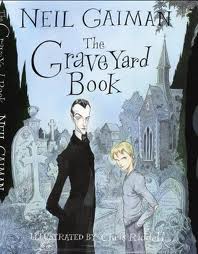
The Graveyard Book


Australians don't tend to celebrate Halloween, and old Scrooge me likes it that way. It isn't our holiday. We don't need it. Supermarkets are trying to flog more Halloween themed stuff each year. We've even had people knock on our front door occasionally over the past few years in an attempt at trick or treating. It can't be much fun to go trick or treating where noone wants you to come, or is prepared for you to come. Although last year I did enjoy a glimpse of pre-Halloween in Texas. Despite my grumblings Neil Gaiman's The Graveyard Book was a perfect read for the Halloween season.

I haven't read all that much Neil Gaiman as yet. Coraline. Wolves in the Walls. Both excellent and intriguing. But I'm becoming increasingly aware of him. His output is rather vast, and in a broad range of disciplines. The Graveyard Book is one of his more recent works, published in 2008, and sweeping awards the world over in 2009 and 2010, most famously winning both the Newbery and Carnegie Medals. 

The Graveyard Book has perhaps the most captivating, spine chilling opening of any book I've ever read. Big Call. I know. 


There was a hand in the darkness, and it held a knife. The knife had a handle of polished black bone, and a blade finer and sharper than any razor. If it sliced you, you might not even know you had been cut, not immediately.
 The knife had done almost everything it was brought to that house to do, and both the blade and the handle were wet. 
The street door was still open, just a little, where the knife and the man who held it had slipped in, and wisps of night-time mist slithered and twined into the house through the open door. 
The man Jack paused on the landing. With his left hand he pulled a large white handkerchief from the pocket of his black coat, and with it he wiped off the knife and his gloved right hand which had been holding it; then he put the handkerchief away. The hunt was almost over. He had left the woman in her bed, the man on the bedroom floor, the older child in her brightly coloured bedroom, surrounded by toys and half-finished models. That only left the little one, a baby barely a toddler, to take care of. One more and his task would be done.

Wow. I dare you to stop reading. You can't. You're immediately drawn into this world. Why would the man Jack want this family dead? What happens to the toddler? The toddler survives of course, to become that childrens book hero of old, the orphan. He is taken in and protected by the ghosts and spirits of the local graveyard, in a modern, macabre riff on the famous it takes a village to raise a child, here it takes a graveyard to raise a child. 


"I love what the first three pages of The Graveyard Book do to people's heads," said Gaiman. "I love reading the upset reviews from people who read those first few pages and say, 'Oh my God, it's like a slasher movie with all the murders and blood' and I think, 'No, you did that. I just had a man walking round with a knife and you killed all those people in your head. It says more about you than anything I wrote on the page.'"


Neil Gaiman has said that The Graveyard Book was the book that took him longest to write. 25 years ago he noticed how comfortable his young son was riding his bike around a local graveyard. Rather incredibly, he had the idea then, wrote a page, but realised that it was a much better book than he was a writer. He put his idea aside for 20 years, while he became that better writer, and then he wrote it (starting at Chapter 4). I'm very glad that he did. 

The Graveyard Book is a wonderful read, dark, funny and wise. Full of wonderful words like flibbertigibbet and ululation. I'm planning to use this as the next read aloud book with my son. So he gets to hear it, and I get to read it again. 


The French cover


Writing this post, brought to mind my tally of the Top 100 Children's Novels List. I've made some progress, but am still only at 34/100.

192/1001

Friday, 29 June 2012

Island of the Blue Dolphins


Wow, what a story! This was my second reading of this amazing action-packed, dramatic tale, and I loved it even more than the first time. The story of a 12 year old girl, Karana, who becomes stranded, alone on her native island off the Californian coast in the 19th century. She survives for nearly 20 years on her own. Inspired by the real life story of Juana Maria, Island of the Blue Dolphins won the Newbery Medal in 1961.

Karana has grown up on the island, is schooled in the pattern of the seasons and the ways and means of living from the land and the sea. It is of course this knowledge that allows her to survive. Although she has to go against the tribal customs that forbid women from making weapons, and overcome many other challenges. It's often quite beautifully written. There are particularly lovely passages about the fish, birds and other creatures who share her world.

The sai-sai is the colour of silver and not much bigger than a finger. On nights when the moon shines full, these little fish come swimming out of the sea in schools so thick that you can almost walk on them. They come with the waves and twist and turn on the sand as if they were dancing. 

Karana makes some unusual alliances in the many years of her solitude, and there are very powerful environmental messages woven into the story. We see the beauty of the changing seasons and the vitality, intelligence and caring instincts of her animal companions. We also see the brutality of the hunters who come from the Aleutian Islands to hunt the plentiful otter for fur. I'm still reading Robinson Crusoe for the first time (and finding it a bit slow going to tell the truth), but it's interesting to understand how influential Robinson Crusoe was, and indeed books such as Island of the Blue Dolphins, and Kensuke's Kingdom draw so heavily that they have their own genre called Robinsonade.

Scott O'Dell said that "Island of the Blue Dolphins began in anger, anger at the hunters who invade the mountains where I  live and who slaughter everything that creeps or walks or flies." That anger is apparent. At the end Karana changes her ways too (perhaps somewhat improbably).

After that summer, after being friends with Won-a-nee and her young, I never killed another otter. I had an otter cape for my shoulders, which I used until it wore out, but never again did I make a new one. Nor did I ever kill another cormorant for its beautiful feathers, though they have long, thin necks and make ugly sounds when they talk to each other. Nor did I kill seals for their sinews, using instead kelp to bind the things that needed it. Nor did I kill another wild dog, nor did I try to spear another sea elephant. 

I read this book as my first ever read on the Kindle function of my ipad. The major difficulty was wresting the ipad from my son who naturally is addicted to several ipad games. I'm planning a future post on the ipad reading experience specifically, but I can say that I found it enjoyable on the whole, and so, whilst I haven't embraced the ereading phenomenon with both hands yet, it is very acceptable when I can't get hold of the actual book any other way.

Monday, 27 February 2012

From the Mixed Up files of Mrs Basil E Frankweiler


I didn't know much about this book before I started reading it. Even the title seemed mystifying. I'm not sure that it was ever hugely popular in Australia. It certainly seems to have been in America- a Newbery winner, one of the 100 books that shaped the 20th century for  School Library Journal.

But I just fell in love with the premise of this book. Claudia Kincaid knew that she didn't want to run away, she wanted to run to something. The first paragraph is wonderful and pulled me in straight away.

Claudia knew that she could never pull off the old-fashioned kind of running away. That is, running away in the heat of anger with a knapsack on her back. She didn't like discomfort; even picnics were untidy and inconvenient: all those insects and the sun melting the icing on the cupcakes. Therefore, she decided that her leaving home would not just be running from somewhere but would be running to somewhere. To a large place, a comfortable place, an indoor place, and preferably a beautiful place. And that's why she decided upon the Metropolitan Museum of Art in New York City.

After spending a few days immersed in the museum, I felt like I too had lived there with Claudia and Jamie, and am very keen to visit. Until I get to New York again, I can visit it via the Mixed Up Files Issue of Museum Kids, which has a great article about E.L Konigsburg's inspirations for writing this story. It's extraordinary what the sight of one solitary piece of popcorn sitting on an antique chair in a museum can do. Claudia planned her escape all so meticulously, and was so sensible in her approach. Yet still childlike and naive at times. It was wonderful sharing her adventures in a pre-CCTV world. It's sad to think that a modern day Claudia wouldn't be able to repeat this wonderful escapade.

She's rebelling against the injustice of her terrible life. She has to empty the dishwasher and set the table on the same night, because she is the oldest girl, and yet her younger brothers get away with doing nothing again and again. She wants to teach her family a lesson in "Claudia appreciation". Claudia lived in quite an affluent world in 1967 Greenwich, even though she got the smallest pocket money of anyone in her class. And after all her parents only had a cleaning lady twice a week, and not the full time maid of her classmates.

I found it interesting that Claudia really gave no thought whatsoever to her family after she and Jamie left. There is occasional reference made to the newspaper articles about their disappearance, but Claudia didn't look for them, or see them when she was reading the New York Times to find out more about Angel, the mysterious statue possibly by Michelangelo that is causing a sensation at the time of her residence. Interesting too, that Claudia really pushed herself and Jamie to learn things during their adventure, they researched topics of interest and followed school groups to listen in to their tours. 

I had no idea what the title of the book meant, but I really liked our narrator, Mrs Basil E. Frankweiler. A very clever use of an omniscient narrator. To have a rather crotchety old lady wearing pearls and lab coats tucked away in her house far from the action central to the story. She even waxes a bit philosophical at times. 

Happiness is excitement that has found a settling down place, but there is always a little 
corner that keeps flapping around.

I ended up loving this book, for which I am very glad, as I really wanted to love it after I'd read the back cover. I read it in just a few days. Now I'm scanning my library's shelves for more books by Mrs Konigsburg. They all sound intriguing, but I think that The Second Mrs Gioconda sounds like it should be up next. 

Wednesday, 2 November 2011

Caddie Woodlawn


Should I admit that I wasn't looking forward to reading this book? Probably not. My lack of desire to read Caddie was mainly based on ignorance I guess. I had only heard of this book within the past few years. I only vaguely knew that it was a story of growing up in the harsh frontier life of America. And that was about it. Of course, Caddie won me over. I came to enjoy the book, and the things it taught me.

Caddie Woodlawn is the story of an 11 year old tomboy living in the wilds of Wisconsin in 1864. Abraham Lincoln is president of America. The American Civil War was in full swing. And the Woodlawn family were doing their best to get along on their frontier farm. The family had recently moved from Boston and now lived in a farm house near a small village. The town shared a teacher with a nearby settlement, so that the children went to school for 3 months at a time twice a year, leaving them time to do their chores on the farm. They made do, and wasted nothing. Clothes were handed down, clocks and watches were repaired and not merely thrown out or replaced, and nothing was wasted, especially unsold turkeys.

That much I had expected I guess. What I hadn't expected was such a controversial book. Caddie Woodlawn deals extensively with race relations between the white settlers and the Native American populations. Caddie Woodlawn was published in 1935, and won the Newberry Medal in 1936.

Carol Ryrie Brink based her character Caddie, on her grandmother, Caddie Woodhouse. Carol had a particularly tragic early childhood, her grandfather was murdered and she was  orphaned by the age of 8- after her father had died of consumption, and her mother committed suicide. She went to live with her grandmother Caddie and a maiden aunt. Little wonder that she loved hearing her grandmother's stories of her own happy childhood on the frontier with her many brothers and sisters.

The language is dated at times it's true- Caddie talks of half-breeds and redskins, and compares rough skin to that of an Indians. But Caddie and her father are friendly with the local Indian population, they openly trust them, especially Indian John. The book starts with Caddie and her two brothers, Tom and Warren crossing the river to visit the local Indians while they are making a birch-bark canoe. There have been many massacres in the area in the preceeding few years, and from the second page the question of whether the locals would ever participate in such an activity is raised. Every time, Caddie and her father speak strongly in defence of their local Native friends. Throughout the book, the troublemakers are white settlers.

There is a moving passage early on in Chapter 3. Caddie and the other children are expecting a visit from Uncle Edmond, who always "comes with the pigeons." There is a great description of flocks of migrating passenger pigeons (whom Uncle Edmond liked to hunt).

One night when they went to bed the sky was clear and the woods were still. But when they awoke in the crisp autumn morning the air was full of the noise of wings, and flocks of birds flew like clouds across the sun. The passenger pigeons were on their way south. They filled the trees in the woods. They came down in the fields and gardens, feeding on whatever seeds and grains they could find. The last birds kept flying over those which were feeding in front,  in order to come at new ground, so that the flock seemed to roll along like a great moving cloud. 

The boys go out hunting, but Caddie stays inside

She liked hunting as well as the boys. But this was too easy. This was not hunting-it was a kind of wholesale slaughter. She knew that the Indians and the white men, too, caught the birds in nets and sent them by thousands to the markets. She knew that wherever the beautiful gray birds went, they were harrassed and driven away or killed. Something of sadness filled her young heart, as if she knew that they were a doomed race. The pigeons, like the Indians, were fighting a losing battle with the white man.  

That's very moving, and rather far sighted. Although by the time Carol Ryrie Brink writes Caddie Woodlawn in 1935, passenger pigeons have been extinct for over 20 years. The last passenger pigeon, the sadly named Martha, died in captivity in 1914. Another environmental tragedy.

Martha