Sometimes you're just in the mood for an epistolary read, it's a form I really like but don't find them that often. The urge had been building for some time and I knew I had this book lying about the house, and happily I had enough free time in November to allow me to dig out Feeling Sorry for Celia. And I'm very glad I did. Feeling Sorry for Celia is an epistolary novel with multiple points of view. Both favourite styles for me. 16 year old Elizabeth Clarry lives in the suburbs of North West Sydney with her Mum, and the two communicate a lot with notes. At times this reminded me of Life on the Refrigerator Door which I read a few years ago. Elizabeth's parents have separated and Christina's Mum is busy with work and her Thursday night poetry club. There are also notes in italics from groups such as The Association of Teenagers, The Society of Talented and Interesting Correspondents and COLD HARD TRUTH ASSOCIATION. It took me a while to work these out, but they're fun and often rather funny. Elizabeth goes to Ashbury, her local private school and her English teacher assigns the class a task to write to a student in the neighbouring public school, Brookfield, which is only a block away.
I'm only writing it because of Mr Botherit. He's our new English teacher and he seems really upset that the Art of Letter Writing is lost to the Internet generation, so he's going to rekindle the joy of the ENVELOPE. Next he's going to bring in a club and a sabre tooth tiger and rekindle the joy of the STONE AGE.
If Mr Botherit was upset by the Internet generation of 2000 just imagine how upset he would be by them now! Elizabeth's pen pal is Christina Kratovac. Naturally the girls talk about their families, their school, the boys who sit at the back of the bus.
A VERY IMPORTANT THING for you to know is that I'm NOT a nice private school girl. And I know I'm not, cause most of the other girls here are like that. They take clarinet lessons and go to pony club. And they do this things whenever I'm talking to them where they blink their mascara'd lashes really quickly as if they need to take lots of little breaks from looking at me.
They also talk about Elizabeth's best friend Celia who is a troubled soul and often prone to going missing, and indeed Celia is missing for much of the book.
He also says there used to be a fairy princess girl, with long feathery blonde hair, who used to sit with you, only he hasn't seen her for ages. Is that Celia? He said he used to watch you two, and Celia always looked tiny and not-quite there, like she was just about to float through the bus window and fly away like a kite.
I really enjoyed Feeling Sorry for Celia and whizzed through it in just a few days- I think that's one of the reasons I really like epistolary novels- they are often super quick reads which is good for a slow, plodding reader like me. I had thought that Feeling Sorry for Celia was a stand alone book when I read it. It was at the time it was written I think, but it came to be the first of four Ashbury/Brookfield books- though the four books are loosely connected and don't have to be read in order! As if.
I’ve been wanting to read Catherine Jinks for quite some time. I saw her talk at my local library quite a few years ago now- it must be more than 5- and have been keen to read her work ever since. A friend is a fan and especially enthusiastic. Although I must admit that this title in particular wasn't really in my sights, and the cover doesn’t really do it for me. Twelfth century Jerusalem is really an odd choice of setting for a kids book isn’t it? It did put me off a bit, but then I really wouldn’t want to read adult books covering this era either. It’s also not a setting or time that I know an awful lot about, and I presume most kids wouldn’t either. Although my copy published in 2000 shows it was reprinted 7 times since 1993, i.e. roughly once a year, so it must have been quite popular.
So, our story starts with 16 year old Pagan Kidrouk joining up to become a squire with to Lord Roland Roucy de Bram, a Templar Knight. It’s clear that Pagan needs a job quickly and is in some sort of difficulty. Pagan describes himself as “godless mercenary garbage”. Pagan was raised in a monastery and has the rare skill of being literate and educated in a time when most people aren't and even Lord Roland himself cannot read.
'My lord, with all respect, you shouldn't take my learning too seriously. It might look impressive to be able to read, but that's because you can't read yourself. When you learn to read, all you can do is read.'
The story is told in three parts, each quite separate really, occurring over several months in 1187, with the mounting threat of invasion by Saladin- a real historical person and event, but who I'd never heard of before, and it felt a little Lord of the Rings to me (not that I've read that, only watched the movies).
It's a peculiar feeling- like a cold wind on your heart. The fact that it's actually happened. It's actually happened. You live with it all your life, like a cloud on the horizon, and suddenly the storm is overhead. They've come at last, after all this time. The Infidels. Practically on the doorstep. And it's not a surprise. That's what's so awful. Everyone born here- we all knew they would come. Everyone born here is born waiting.
Pagan's story is told in his first person rather modern voice, which I think I found a bit discordant to start with but by the middle of the book I was almost swept up in the story, and did find it quite humorous. I do really like Catherine Jinks’ descriptions. And this one of an alley is astonishing.
It’s like entering someone’s intestines. Narrow, slimy, smelling of dung. A cloud of flies settling like a cloak over your head and shoulders. Bones. Rats. Sludge from the nearby tannery.
I ended up enjoying Pagan's Crusade much more than I expected to, settling in enough to find the humour, especially in the middle pages, and found it a bit evocative of Monty Python's Holy Grail in places. Pagan has an oft repeated refrain "Christ in a cream cheese sauce" which I found really odd. Would they have had cream cheese sauces in medieval Jerusalem? I suspect not. Indeed why call your main character Pagan? Would people have been called Pagan then? Did it mean something else? Catherine Jinks is very clever, it must mean something, and I'm just not clever enough to work it out.
There came to be five books in the Pagan series, so these stories of medieval Jerusalem clearly had a broader appeal than I would have thought. I do think that if I read Pagan's Crusade again that I'd like it even more. I'm very glad to have dipped my toes in Catherine Jinks' work, and look forward to reading more of her in the future.
I knew listening to Rosie Batty's A Mother's Story would be tough, but I didn't expect to start crying during the dedication. Rosie Batty was catapulted to "fame" in early 2014 when her ex-partner killed their 11 year old son in the practice nets at Tyabb Cricket Club. Rosie starts her story as she became Australian of the Year in January 2015 in Canberra less than a year after Luke was killed.
It's an honour beyond my wildest imaginings. I am overwhelmed and truly humbled. And yet it's also bittersweet -12 months ago I was a single mum from Tyabb, a tiny dot on the map of the Mornington Peninsula, but in 18 days time it will be the one year anniversary of the death of my only son, killed by his father at cricket training. And then the sadness hits me, the only reason I'm in this position, the only reason I'm standing here holding this trophy and receiving this ovation is because I've endured the kind of tragedy that makes people recoil. I've become Australian of the Year because I'm the person noone wants to be, the mother who has suffered the insufferable.
Rosie and I actually had some similarities in our young lives including the bad frizzy perms popular at the time, and we both struck off at 20 for international adventures as a nanny- Rosie to Austria, me to Canada. Thankfully our paths were to diverge after these early experiences. A Mother's Story is just that- Rosie's life and the major turning points around which our worlds turn. For Rosie these are two major events- the private death of her own mother when she was a 6 year old girl, and then her son Luke's very public death decades later. Rosie had learnt not to cry in grief as a 6 year old girl when her mother died and she wan't told until after her mother's funeral. Luke's death did not happen out of the blue, Rosie had endured years and years of abuse at the hands of Luke's father. Rosie chronicles this abuse and her many and repeated attempts to get help and protection from those systems which are supposed to protect us- particularly the police and the courts. The multiple failings of Victorian police computer systems is beyond unbelievable, the convoluted processes, so far from being streamlined. I hope that these processes have improved now, even though Rosie's experiences are not that remote, just a few years ago. It also quite boggles the mind how an abused woman and mother trying to protect herself and her child from a violent, mentally ill man has no right to know when he incurs other charges- when he accesses child porn, or threatens to kill other people with a knife. How is his right to privacy more important than her right to safety? The final disc, disc 7, includes an impassioned plea for change in our society to help reduce family violence. There is an extensive list of resources for those affected by family violence in Australia and New Zealand. Rosie also talks of how she has found her purpose in Luke's death, how her tireless work in family violence, has given meaning to her life, and the strength to go on.
... I will not let my grief limit or define me. For reasons that are beyond me I am the one that people seem to want to hear from, and I know, people tell me, that I inspire them and give them courage. But what people don't know is that speaking out also empowers and inspires me. It's bittersweet knowing that this has happened because of Luke's death, but I feel I am making a difference, that gives me the impetus to keep going which is important, because my sense is that if I keep doing this and keep the public spotlight on the issue of Family Violence things will change because they have to change.
It is completely unacceptable that one woman is murdered each and every week in Australia by her current or former partner. One of my high school friends was shot and killed in the street by her expartner. It touches all of us. It does have to change.
I do wonder that Rosie Batty chose to champion family violence particularly rather than mental health services. In fact she doesn't really mention mental illness all that much in A Mother's Story even though Greg Anderson clearly had a major mental illness which may or may not have been adequately treated. Her story is obviously tragic, and moving and I'm glad that I've finished the audiobook in a way so that I won't have to drive to and from work largely in tears, but I do wonder about Greg's story too - his life had it's own tragedies too I believe, and I wonder if he too was failed by the systems- police, judicial and health, that should have been there to help him. Rosie says repeatedly how much he loved Luke, would Greg have wanted it to end this way? I can't imagine so. A Mother's Story is an important story for us all, no matter how hard it is to listen to.
Naturally the cover and title of Ransacking Paris was enough to make me snatch it off the bookshop shelf as soon as I saw it last year. I just needed to find the time to read it. Happily that time came recently as I prepared to see Patti Miller speak at the Newcastle Writers Festival. I'd started the book at least by the time I got to take my seat in the We Will Always Have Paris session on the Sunday morning. Ransacking Paris tells the tale of a year Patti spent living and writing in Paris with her husband/partner. It seems to have been a bit of a while ago, some 15 years ago now. Patti had taken a small apartment in Montmartre on Rue des Trois Frères to write a memoir about her friend Dina who died suddenly leaving her young son Theo. Patti Miller was to look after Theo for 7 years and that book was to become Whatever the Gods Do, published in 2003. Patti grew up in the Central West of NSW a mere 100 km from where I live now. So I was always very interested in her stories of growing up on a farm near Wellington. Thirteen year old Patti began French lessons in high school and it opened up a new world for her, giving her a "small distinction" amongst her eight siblings. Learning French, and learning that a dog is not just a dog but could also be un chien
hinted at the possibility of another kind of world, the faint beginning of awareness that there was a connection between language and perception. Other words for things created the idea that there was another way of seeing, of thinking, of knowing, that things didn't have to be what everyone agreed they were.
Young Patti started to dream of one day going to Paris, even though she didn't know anyone besides her French teacher who had ever been there.
It must mean something, a dream that can propel you to the other side of the world.
Six memoirists are her companions on her year long sojourn- Montaigne, de Sévigné, Rousseau, Stendhal, de Beauvoir and Annie Ernaux. I hadn't read any of the authors she featured, well I did read a bit of de Beauvoir back in the day, but much too long ago to remember anything more than I have actually read her. I have no sense of the books I read, or even which titles they might have been. Naturally I thrilled inwardly each time Patti went to somewhere I too had been - Musée Carnavalet, Tuileries, Angelinas on the Rue de Rivoli, the Luxembourg Gardens. All famous places, and not an uncommon shared experience. But I was even more excited to learn that Balzac grew up on Rue Vieille du Temple as I stayed just around the corner on my last visit in 2014. And I dined several times in Cafe des Philosophes where Patti "meets" Madame de Sévigné (a writerly device that didn't work for me- Patti told me that she had had mixed reactions to it), and while I didn't enter Les Éditeurs in the Carrefour de l'Odéon, I ate at two other establishments on the same corner, and know exactly where it is.
I enjoyed reading her experience of the city, learning the language and making friends. Walking, walking, walking everywhere. Going to concerts every Sunday- that's such a great idea- I've been to three concerts in Paris now, all extremely enjoyable experiences. If I ever get to live in Paris for a good while then maybe I'll go to a concert every Sunday too. Patti also joined a choir which is a brilliant thing to do if you can sing. I'm not sure that I'd be there long enough to brave Shakespeare in French as Patti did though! Just the thought! Patti proclaims the experience "more fun than I'd ever had watching Shakespeare." There are many layers to Ransacking Paris. The bees are much more than a cover motif, Patti Miller considers much in this memoir- philosophy, death, cafes and of course Paris. The narrative flips seamlessly back and forth over time.
That was in the future, but I like the way stories thread back and forth over time, connecting things that might otherwise have been lost or left flapping in the wind. It makes time past and time present seem to be, not a line, but arcs of a spiral.
Jeannie Baker is a big name in Australian picture books. She has made such a wonderful body of work over the years. The illustrations in her books are all photos of the amazing, intricate collages she makes, and her books often deal with environmental themes or urbanisation. I've read most, but not all of her books, and seen a previous exhibition of her artwork. I'd somehow never heard of Jeannie Baker's new book Circle until I walked into my favourite bookshop and snatched it off the shelf recently. I read it standing there, then I bought it. I was rather excited. You see it's about migratory birds, and bar tailed godwits in particular. I stalked godwits in New Zealand a few years ago and am thrilled to see their extraordinary lives highlighted in this book. Circle tells the story of the godwits migration, leaving Australia for the Arctic, and later returning. Their departure is witnessed by a young boy, a rather enthusiastic birder, in a wheelchair who longs to fly like the birds. As with any Jeannie Baker book there are a fabulous set of collages, 23 here. Jeannie Baker began making collages at art school, initially collecting textures, but becoming more representational as an illustrator. Children love pouring over illustrations with lots of detail and Jeannie Baker provides so much of it- there's always a new detail awaiting discovery.
My favourite Circle collage, a glorious double page Picture Source
She has taken some artistic licence as the godwits appear to be in their breeding plumage all the way along their journey (sorry for the nerdy very amateur birder comment), the red providing a better contrast and more colour to the images. I was a bit confused by the final image for a while. Why are people shown taking their dogs and horses where they are clearly prohibited?
And what is the boy doing with that dog? It helps to realise that it is not his dog that is chasing the birds into flight. The boy casts down his crutches and binoculars and is trying to stop the dog from charging at the birds. In one of the videos linked below Jeannie explains that she was using the boy to show that we can all individually make a difference in our local area.
There is an Author's Note at the end giving more information about godwit migration, and a Godwit Migration Map.
There is an exhibition of Jeannie Baker's marvellous collages for Circle travelling Australia at the moment, and will be for the next two years. I can't wait to see it somewhere. The exhibition is then proposed to follow the path of the godwits internationally and be shown in Alaska, South Korea and China.
You can hear Jeannie Baker talk about Circle here. And an interesting SMH profile of the artist here. Coincidentally I recently listened to an amazing 4 part radio documentary Flying for Your Life, an ABC and BBC coproduction. It complements Circle beautifully. If you can access these extraordinary episodes I'd highly recommend it. I learnt so much from each episode. Episode 1 is in Australia and explains our main threats to shore bird populations here - development, environmental degradation and dogs. It also describes how a migration actually starts. Episodes 2 and 3 deal with the Yellow Sea, the most important staging and feeding areas for their migration north. The Yellow Sea is shallow and provides 20% of the world's fishery products. Sadly two thirds of the intertidal habitat of the Yellow Seas has been "reclaimed", i.e. destroyed in the past 50 years. It is funny to hear North Korea described as the "biggest organic farm in the world" and portrayed as possibly the saving grace for migratory birds. It had never occurred to me that people could eat shore birds before. Episode 4 tells of the behaviours of the birds in their Northern summer breeding grounds in Alaska and Russia. Here global warming is the biggest threat to the birds, they are starting to hatch at times to miss out on the peak feeding times and are becoming smaller birds with smaller beaks. The birds completely change their foods for the southern and northern hemispheres, and change their body composition to prepare for their flights. The birds appear to monitor air pressure to time the start of their migration, and can fly at up to 80 km/hour! Bar-tailed godwits fly nonstop, up to 1500 km per day to travel the 11-12,000 km from Alaska to Australia and New Zealand in 8 or 9 days.
I'm not much of a cool girl and so I'd never heard of Rosie Waterland before I heard about this book. Happily though I saw her speak with Richard Glover at an event at Newcastle Writers Festial last month. I'm very glad I went to that session, and now very glad to have read my signed copy of Rosie's book. I don't watch all that much tv, and when I do I don't watch The Bachelor, so would hardly have had any need for satirical recaps of it, which is coincidentally apparently how Rosie shot to internet stardom on Mamamia in 2014. Stories like Rosie's don't get told all that often, not in memoirs at least. Movies maybe. But not in original, authentic first person voices. And it's a shame. Hers is an incredible story of survival against the odds, well told. Rosie grabs our attention from the get go- before she is even born.
Oh Rosie. Not even born yet, and already on the run. How exhausting. At a time when you should be concentrating on not growing an extra thumb, you're being tossed around in your mum's belly while she tries to jump-start an overheated hatchback by pushing it down a hill.
Of course that hill start is at 3am as her parents try to evade some "violent bikie drug dealers". Such is the chaos that Rosie is born into. Both her parents have mental illness and addictions to drugs and/or alcohol. Both of course have their own demons. Demons that often took up all of their energies, leaving next to nothing for their kids. Rosie and her sisters are often abandoned and left to fend for themselves. Despite this Rosie is writing plays and Oscar acceptance speeches from a very young age. She endures despite living in rehab and with abusive foster parents. Eventually circumstance rescues her from her life only to give her an even worse life at the hands of rich kids at a boarding school. Rosie never faced bullying until she attend a posh, expensive boarding school on Sydney's North Shore. Most chapters start with a killer hook to keep you reading. Both the chapter titles:
Your friends will find a dead body in the bush, and it will be your dad.
Your mum will be a sex worker, and you'll have no idea.
And then the first lines.
It's hard to keep up appearances when your mum hasn't been home in four days.
When a guy wearing nothing but a bedsheets as a toga pushes in front of you in the dinner line so he can get better dibs on the custard, you know you've hit rock bottom.
It is amazing how Rosie can make family dysfunction, drug addiction and unrelenting heartache funny, but she does. The Anti Cool Girl will not be for everyone. It is confronting at times (well on pretty much every page). It deals with addictions, mental illness, eating disorders and is particularly frank and sexually explicit. And there's quite a lot of poo. But it is an incredibly engaging journey to self acceptance, and if Rosie can accept, own and be proud of her story, then maybe we all can too. I'm on a roll with great Aussie memoirs this year. Although this is the first one that I've actually read as a book. The others I have listened to as audiobooks. First the spectacular Reckoning (see my review). And then the fabulous Flesh Wounds (review coming soon-ish).
Wow. Everything you've heard about how fabulous Magda Szubanski's Reckoning is, is true. I listened to the audio book read by Magda herself and from the very first words it is obvious that Reckoning is a treat. Within moments we are thinking of the Polish resistance in World War II, Hieronymus Bosch is referenced, with his famous 15th century painting, The Extraction of the Stone of Madness. Well, I hadn't seen it before, but it's still famous. And rather fascinating.
This is no simple comedic memoir. (Although perhaps none of them are?). Magda Szubanski is very well known in Australia for her work in television and comedy over many years. She rather famously came out on television a number of years ago, but is more famous for playing the rather simple Sharon Strzelecki on Kath and Kim. But Magda has really hit her stride with Reckoning. The audiobook read by Magda is sensational. The confidence from her years in performance and television gives us a masterful reading, as she slips effortlessly between the soft Polish and harder Scottish accents of her family.
The first disc tells of the recent death of her father, her own birth in Liverpool, and how her family moved to Australia when she was five because of nylon. She was a cheerful but anxious child, with many traits bordering on obsessive. Magda is intelligent, and bored at school but is fascinated with medicine, and plans to be a surgeon. She is a tomboy, with crushes on Marcia Brady, but is very distressed by shooting a rabbit on a hunting trip with her father.
Magda has a close relationship with both her parents. She describes the life and death of her father in particularly moving ways.
It is as much a struggle to die as it is to live, the letting go of life is no peaceful business and my father's body fought hard to stay.
As with every major life experience we usually can't fully understand or appreciate it until we experience it ourselves.
Billions have been down this path before but we bumbled through as though we were the first.
Her Polish father's childhood and wartime experiences are vividly recounted. Magda isn't sure if she really wants to know his story, if she can cope with the details, the truth of it, but "Someone has to bear witness. But am I the right person for the job? Do I have the stomach to gouge beneath the scabs and clean the wound?"
We were tugboats in the river of history my father and I, pulling in opposite directions. He needed to forget, I need to remember. For him only the present moment would set him free, for me the key lies buried in the past, the only way forward is back.
Of course Magda also tells her own story as well as those of her parents and her Polish and Scottish families. The love of humour she shares with her mother, "I'm not the funny one in the family. My mother is."
But when I was about seven something magic happened- I made my mother laugh.... I knew that I had learned that laugh. I knew that this was a rite of passage and that I had inched closer to being a human and humour was the lifeline. It had got her people through famines and clearances and clan wars. Humour the life force.
For Magda it was to become her life's journey and work as well. It was interesting to listen to her burgeoning career in Australian comedy, her work on classic shows such as The D Generation and Fast Forward, where she was writing with Doug MacLeod. The tales of the making of Babe are fascinating- the Babe of the film was actually 42 pigs!
Magda travels to Poland several times, and also to Scotland. There are fascinating tales of travelling in Eastern Europe in the 80s- East Berlin still existed, and Poland was besieged by queues for everything. I am now particularly interested in seeing her episode of Who Do You Think You Are after her descriptions of the show. Of writing Magda says that "what made you a writer was having the balls to call yourself one. That and a computer of ones own." Naturally she never takes herself too seriously with chapter titles such as Becoming a Fat Lesbian.
However, I do think that it was the section describing her coming out to her parents on a Sunday night in the mid 90s that was among the most extraordinary of this extraordinary book.
Coming out- it sounds like making your debut. But for gay people there was no party, no celebration, no welcoming into the bosom of our family and our community. We came out and then waited for the brickbats. We came out not knowing if, at the end of it, we would still have a family, a community. Some people were convinced it would kill their parents. Some of my friends have been with their partners for twenty years and more and their parents still don't know they are lovers.
That constriction, that inability to be open with the people we love more than anything in the world corrodes the soul. My generation of gay people are sometimes like the walking wounded, as teenagers closeted and terrified most of us never learned to weather the ups and downs of dating. I for one am a classic case of arrested sexual development, and the crucial difference between lesbian, gay, transgender, bisexual, intersex and questioning people and other minorities is this- in every other minority group the family shares the minority status. In fact it is often something that unites them, but gay people are a minority within the family. A minority of one.
It means, among many things that gay children cannot draw on the collective family wisdom about how to deal with their minority status. Noone else in the family has experienced what the gay child is going through. Worse still, all through our growing up, from the instant we realise that we are gay, we live with the gnawing fear that our parents love could turn to hatred in an instant.
Magda spent 8 years writing this book and it really shows, the writing is just fabulous, Magda can move you whether she is describing a piece of amber or her visit to Auschwitz. Magda visited on a gorgeous summer day, but this moving BBC drone vision was taken in winter.
I loved driving about with Magda talking to me in the car over several weeks. It was such an extraordinary experience that I listened to each disc twice through before progressing to the next, savouring it even though I was keen to keep going. I hope Magda delights us with many more books. My only gripe about Reckoning in the audiobook format is that I know I'm being jilted on the pictures that are in the print book (16 pages of photos). Why can't audiobook people make liner notes like CDs have so that we can see the pictures printed in the book?
Reckoning has already deservedly won many awards including The Australian Book Industry Awards Book of the Year 2016 and the Non-Fiction Book of the Year at the NSW Premier's Book Awards.
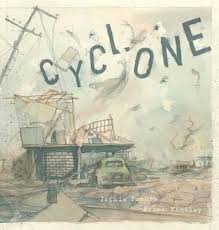
Jackie French can write and publish books faster than I can read them. There's always many, many new books from her waiting to be read (her website lists 9 books scheduled for release this year!), as well as her extraordinary back catalogue of course. So it's never a surprise to find a new book on the shelves at the local bookshop, which is where I came across Cyclone. Naturally I picked it up straight away. Cyclone is obviously a thematic continuation where the fabulous Flood and Fire left off. Cyclone tells the story of Cyclone Tracy which devastated Darwin on Christmas Eve 1974. I thought of Cyclone Tracy immediately on seeing the cover, but then wondered if she would write of another more modern cyclone- but Cyclone Tracy remains Australia's most devastating tropical cyclone. Eighty percent of Darwin's home were destroyed! 41,000 of the 44,000 population were rendered homeless. 30,000 people needed to be evacuated out of Darwin. Once again Jackie French has created a moving, yet hopeful, picture book poem out of this devastation.
Outside, a giant groans and growls, A wind that batters, shrieks and howls.
In December 1974 Jackie French was manning the phones in Canberra in her new job at the Depratment for Urban and Regional Development. She took phone calls from Cyclone Tracy survivors. Cyclone is dedicated to the man who told her of how his family shelter in their backyard barbecue. Decades later Jackie has told his story to us all.
The mood is inadequately captured here in my reproduction The dark broodingness of the storm The tiny dots of colour of 1970s Christmas lights The warmth of the tree and light through the window
And Cyclone has been masterfully illustrated by Bruce Whatley. Bruce used black and white photos taken at the time to research his illustrations and then chose a "toned-down palette" to give a documentary vision to the images. He's captured the building storm, the fury unleashed and the aftermath in an amazing way. The whole design really works. The font is like an old school typewriter evoking the precomputer 1970s. Teacher Notes for Cyclone.
I've been intrigued by this book ever since I saw the cover quite some time ago. It's quite distinctive. The story actually starts right there on the cover which is rather fun. Our narrator, 11 year old Henni is so keen to get going with the story that it starts on the cover. Stella Street is a typical street for an Australian childhood. The neighbourhood kids roam in a gang, everyone gets on, and life is pretty good. Kids always know their local neighbourhood best.
Stella Street is our native habitat. We know it off by heart! We know who will buy raffle tickets, who has loud parties and who will complain! We know where all the dogs live, including Barking Africa. He barks like CRAZY! Nobody gets past him. We know the walls for hitting a ball, all the good climbing trees, the short cuts and the long cuts. We know who makes good biscuits. We know where to ride our bikes to avoid the steep hills, and where the milk thistles grow for Claire’s canary. We know which drains block in heavy rain, where Mr Whippy stops, and the best places for roller blading. We know who gets drunk, which trees the cicadas will crawl up, and the best roof to watch the fireworks from.
But things always change, and Old Aunt Lillie at Number 45 dies. Her house is sold, and the Phonies move in. And suddenly there is trouble in the neighbourhood where there was none before, and it's up to the kids to sort it out. What are the Phonies up to? And where do they get all their money?
Henni has a wonderful, disorganised but observational style.
The library’s warm and quiet, except when this smelly old bloke sits near me sometimes. He has a whistle in his nose when his breathes, but he just reads the racing results and nicks off.
I think everyone knows that man. I certainly do. Elizabeth Honey was a new Australian author for me. I know I'll read more of her books. I wasn't all that surprised to read of her Blyton-esque inspiration for Stella Street - a gang of kids (and a dog) having an adventure in the Aussie suburbs. Originally published in 1995 Stella Street definitely still works today, although the kids would Google things instead of researching at the library. Elizabeth Honey was playing with the form of books before it became mainstream, playing with font, illustration and found objects.
Naturally I love a piece of Paris wherever it appears
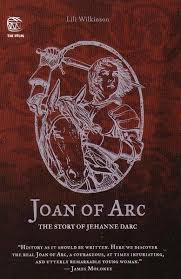
I'm really quite obsessed with Joan. It's an impossible story. Fantastic. Extraordinary. Almost surreal. But it seems to be real. So I was keen to read this book when I found out about it. Joan of Arc was Lili Wilkinson's first book. It was commissioned, and so far remains the only non-fiction book that she has written. I was very pleased to find that my library had a pack with the book and an audio version. I made the most of my recent trip to Newcastle and listened to the audiobook three times!
Fifteenth century France was quite a different one to the France of today. Much of Northern France was under English control. The Hundred Year war between England and France was three quarters of the way through when Jehanne Darc was born in 1412.
Legend says that when Jehanne Darc- Joan of Arc- was born at midnight on 6 January 1412, all the roosters in the village crowed, as if they were heralding a new sort of dawn.
The story starts and ends at a rather obvious place, Joan's very public death in the Old Market at Rouen.
People who watched Joan die claimed that they saw angels around her head; that a dove flew from the heart of the fire; that the words Jhesus-Maria were written in the flames; that a halo appeared above her head; that her heart remained full of blood, even when the rest of her was reduced to ashes.
Joan's" trial" was pure farce, as I suspect many medieval trials were.
The man chosen to break Joan was the Bishop of Beauvais, Pierre Cauchon. Cauchon was 60 years old, a Burgundian, and a very intelligent, cunning and cruel man. Cauchon had been promised by the English that if he could find Joan guilty, he would be made archbishop of Rouen.
Any wonder that Joan was found guilty then? She did make him work for it even though the odds were seriously stacked against her.
On the prosecution side, there sat a cardinal, six bishops, 32 doctors theology, 16 bachelors of theology, seven doctors of medicine, and 100 other clerics. On Joan's side, there was just Joan.
Once again Charles, the king that Joan put on the throne, comes under heavy criticism.
From the day Joan was captured, till the day she died Charles made no attempt to help her. The laws of chivalry stated that any noble or captain could be ransomed, but Charles never offered to ransom Joan.
Charles waited 21 years to save Joan. He then wrote a letter to the pope seeking to have an official trial of rehabilitation, which could officially annul the Trial of Condemnation where Joan was declared a heretic.
I've seen many images of Joan before, but not this one I think
The structure of the audiobook was a bit confusing at times, as there are historical notes and asides liberally peppered throughout the narrative- which is of course obvious in the book format but not so much in the audio. Covering interesting topics such as Women in Medieval France, Saints especially Saint Michael, Catherine and Margaret who spoke to Joan, these notes give an invaluable historical background to Joan's story. Lili Wilkinson also uses many primary first hand accounts of Joan's life, actions and her trial which while fascinating, did not always slip easily into the audio either. This book is the second I've read about Joan that strongly recommends Regine Pernoud's Joan of Arc by Herself and her Witnesses. I must have it. Lili Wilkinson did a great job of telling Joan's story, I look forward to reading some of her fiction too.