Friday, 17 July 2015

Tristan Banck's Top 10 Middle Grade Reads

Recently I read Tristan Banck's fabulous Two Wolves (see my review), and came across this list of his favourite 10 Middle Grade Reads. Whilst I do rail against his use of the rather American Middle Grade terminology  I do recognise that it is descriptive- and that this is a great list and certainly worth pondering.

1. Hatchet - Gary Paulsen (see my review)

2. Holes - Louis Sachar (see my review)

3. Okay for Now - Gary D. Schmidt


4. The Invention of Hugo Cabret - Brian Selznick (see my review)

5. My Side of the Mountain - Jean Craighead George (see my review)

6. Joey Pigza Loses Control - Jack Gantos

7. Don't Call Me Ishmael - Michael Gerard Bauer

8. Danny The Champion of the World - Roald Dahl


9. The Indian in the Cupboard - Lynne Reid Banks

10. Once - Morris Gleitzman

4/10

It is with considerable shame that I hang my head at never having read Danny The Champion of the World and Once. 

April 2017 5/10
I have now read (well, listened to Danny the Champion of the World)

June 2018 6/10 (and now I have listened to both Danny the Champion of the World and Once)

Thursday, 16 July 2015

Bathurst Writers Festival

I have a long term goal to get to all of Australia's Writers Festivals. So far I've been to Melbourne Writers Festival ( a few times), Sydney Writer's Festival (twice now), Newcastle Writers Festival, Mudgee Readers Festival (did you see what they did there? Love it). And just recently I accidentally went along to the Bathurst Writers Festival.

How can you go accidentally? Well you see I thought I was going to a Sydney Writers' Festival Regional Live Streaming event, which I think was a new concept for this year.


And I did. I got to see David Walliams' session- which naturally was great, and I should tell you about it sometime. But I also went along to a live event that day, and it turns out that this was part of the inaugural Bathurst Writer's Festival. 

The live event I went to was Writing for Children. It featured four local authors and illustrators. I've seen Freya Blackwood speak quite a few times before, but I admire her work greatly and am always interested in what she has to say. The other three authors were all completely new to me- it was great to learn that there are so many local authors working away. Greg Bastian. Louisa (L.J) ClarksonJeffery E Doherty

Each of the authors spoke about their work. Freya is of course the most well known. She is an illustrator who considers herself a story teller too, which is obvious when you think about it, particularly with those exceptional illustrators such as Freya who do more thoughtful and deliberate work. Freya enjoys the amount of extra story she can add through her illustrations.

Greg Bastion writes historical fiction for upper primary/lower secondary schools. He spoke of writing his latest book The Goldseekers, about two Korean children living on the Australian goldfields of the 1850s.

Louisa writes as LJ Clarkson and seems to write aimed at the American market, which I must admit disappointed me a bit. She writes magical YA, and mainly spoke of her novel, The Silver Strand, where a girl has a magical grey hair. Her books often have a bullying theme.

Jeff Doherty was the most exuberant of the authors this day- obvious before he even spoke as he was resplendent in a colourful vest. He is an author/illustrator who works in a school and writes junior fiction. Interestingly he said that he hated reading as a child and didn't read his first novel until he was in Year 11. He wants to write the book he would have liked to read as a kid.

At one stage the panel recommended their favourite books for young people. And they're a great selection of books.

Greg Bastion - The Book Thief - Markus Zusak
Freya Blackwood - Where the Wild Things Are - Maurice Sendak
LJ Clarkson - Artemis Fowl - Eoin Colfer (see my review)
Jeff Doherty - The Graveyard Book - Neil Gaiman (see my review) and Thirteen Reasons Why - Jay Asher (which sounds amazing, straight to the TBR).

I hope the Bathurst Writer's Festival continues to develop and evolve and look forward to seeing how it progresses.

Wednesday, 15 July 2015

Demon Dentist


I recently used a short break in Sydney to read the last of David Walliams' books that I hadn't read previously. This of course puts him (and me) in a rather enviable position- I've now read all of David Walliams' published books for children- well the novel length ones, I do have a few picture books to go still and there will be a new book again in September 2015, but this time I'm ready for it.

Demon Dentist was published in 2013, around the time that I started reading his work. It's certainly no wonder that he is phenomenally successful and wildly popular with kids- his books are fun, and a bit naughty and clever, and I think it is right that he is the most likely successor to Roald Dahl that we have writing today.

Poor 12 year old Alfie Griffith has terrible teeth.

Alfie hated going to the dentist. As a result the boy's teeth were almost all yellow. The ones that weren't yellow were brown. They bore the stains of all the goodies that children love, but dentists hate. Sweets, fizzy drinks, chocolate. The teeth that were neither yellow nor brown simply weren't there any more. They had fallen out. One had bitten into a toffee and stayed there. Assorted fruit-flavoured chews had claimed others. 

Alfie lives with his father who is very unwell as a result of his work as a coal miner.

A great big bear of a man, he had loved working down the pit and providing for his beloved son. However, all those years he spend down the mine took a terrible toll on his lungs.

Alfie's Dad is confined to a wheelchair, and can no longer work. Alfie acts as a carer for his father, and they get by on very little money. So when a do-gooder social worker turns up intent on getting Alfie to the dentist and on eating every chocolate biscuit in the house there was always going to be trouble.


Demon Dentist is probably the most scary of David Walliams' books. So scary it even comes with a warning.


It is also perhaps his most plot driven book- it gets pretty exciting towards the end. All of David Walliams books have a warm heart, but are never preachy. Here he shows us that you can find happiness after sadness, and seamlessly incorporates multiracial characters to represent a modern Britain/world.

Demon Dentist plays on the widespread fear of dentists- who doesn't hate going to the dentist? Kids growing up now do fare much better, but the concept of pain free dentistry certainly didn't exist when I was a kid, and I think for most adults a trip to the dentist is at least a drudge, if not downright terrifying. Children of course like to eat lollies and other sugary things that are not good for their teeth, and tooth decay is still a very modern problem. Of course it is all dealt with in traditional Walliams style with fart jokes and teachers underwear on display.

"But tooth fairies aren't real..." protested the boy.
The witch smiled. "Oh yes, they are. Annoying little do-gooders flapping all over the place."

Check out my David Walliams link to read my other reviews and ponderings. Billionaire Boy is still my favourite.

Tuesday, 14 July 2015

Waiting for Dinny

Sometimes you accidentally hear things on the car radio. Most often snatches of things that interest you a bit, but you don't always get a chance to listen to the complete program. Of course on this Bastille Day I heard snatches of a Paris story as I was driving around town and my interest was caught. I had to seek it out when I got home.

Waiting for Dinny is a wonderful exploration of grief, longing,  internet web cams and an black dog in Parisian courtyard. Jonathon Otis sat in Melbourne but looking outward to the world, and comes across a black labrador that looks very much like his own childhood black lab. Through the magic of the internet this is the rather ordinary looking courtyard that inspired Jonathon. And a picture of Antonio and Kika.

By the end Jonathon has fallen under Paris's spell too.

There is nowhere else I'd rather be. 

I feel lucky to be in this remarkable city which has always been here waiting for me to find my way to it. I resolve to make it a fixture in my life, to be here as often as I can. 

I feel exactly as Jonathon does.

Jonathon and his daughter visited the Stravinsky Fountain. Nestled between the Centre Pompidou and Paroisse Saint Merri in the 4th. It is the rather distinctive work of Niki de Saint Phalle and Jean Tinguely. We visited the Stravinsky Fountain on a perfect summer day in 2013.


I hope the audio is available worldwide, but I'm not sure if it is. There is also a transcript of the original article Waiting for Dinny, which forms the first part of the audio Waiting for Dinny.

Tonight I'm thinking back to my 2013 Bastille Day in Paris after partying at the Bal des Pompiers the night before.

Paris in July

Monday, 13 July 2015

Paris for Tourists- Take the Bus

Everyone knows that getting about Paris on the Metro is quick, and it is. But sometimes it's better to take the bus. Tourists don't always think about the bus, the Metro is so iconic, and tourist desitnations and shops will list nearest Metro stops on their webistes or info, there are t-shirts and a whole range of products with the Metro map on them. Books written on the Metro. Metro themed cushion covers. So it's no wonder that the Metro first comes to mind, but it's not the only way to get around Paris. To be truthful it took a few visits before I even really noticed the buses! Yes they're big and bus sized, and I didn't even notice them.
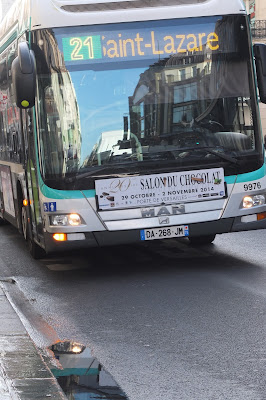

Check the route number
(all are colour coded)
and destination
The side of the bus highlights the major points along the route.


Taking the bus is a bit more complicated than using the Metro. You have to do a bit more homework to make it work, but then you can reap the rewards. The bus is vastly better than the Metro if you are travelling with someone older or less mobile, or indeed if you are someone older or less mobile. There can be many, many sets of stairs getting onto and out of your Metro platform, and changing platforms at the bigger stations can be a very long walk underground. Ride the bus and it's all above ground, no stairs, no unintentional walking for 15 minutes underneath Paris at Chatelet.

Riding the bus also gives you a much better sense of where you are, and helps integrate maps with actual vision. Whilst popping up from the Metro into a new quartier is always exciting, by taking the bus you see how you get there and see much magnificence on the way- monuments, museums, shops, amazing vistas when you cross the Seine.

I used the buses a few times in 2013 and when I was in Paris last we travelled on buses exclusively, and I only ventured into a Metro station to get our weekly passes topped up.

The bus stops are all named stops.


Each stop is packed with information. It will list the buses that stop there.


It will also show a Plan du Quartier, which shows local bus stops, where you can buy tickets and points of interest nearby.


And the bus stop will also show you a route map of the bus routes. These are very handy, they are everywhere. They show the names of the stops, and any differences in the route for either direction. I learnt more every time I looked at one of these. The bus route maps are also displayed inside the bus. 


Vous Ăªtes ici = You are here
 Inside the bus.


Bus stops have a digital sign that tells you when the next bus is due. These are pretty accurate.  There's always something fascinating to see though while you're waiting for the bus....

Bus stops have great views while you wait!

Beware sometimes the same bus stop may be used  by a bus travelling in either direction e.g. #69 at Solferino-Bellechasse. This is rare I think but we got caught out, and it was only as the Eiffel Tower kept looming larger and larger that I realised we were heading the wrong way.

Sometimes there are temporary stops for roadworks or special events.


Enter the bus via the front door. Do greet your driver with a cheery Bonjour Monsieur, or Bonjour Madame (as you should do when entering shops).

Swipe your Navigo at the purple reader

Parents with strollers will enter via the back door to park the pram in the designated area, or sometimes mailmen with trolleys.


Once on the bus, move towards the back- you need to leave by the back doors anyhow. It can get Very Crowded in peak hour, or at random other times, or if the bus has been delayed. The Metro can get just as crowded too though.


More modern buses will indicate the next stop and you can follow progress on the route map.

Next stop:

Navigating by bus takes a little bit of preparation, more so than the Metro. But there are plenty of websites and an app to help you. 

RATP have a fantastic interactive Guide to the bus routes of Paris. Once again there is a wealth of information presented in the guide. It takes a number of uses to get used to it, and to realise how much information is there.


Click on a destination or interchange and it will show you all the buses that travel through there. 


Click on an individual route and it will be highlighted. If you then click on Plan de ligne  symbol (those linked red dots next to 24 in this example) you will get the familiar route map.


RATP also have a website to help plan your trip (by rail, bus or tramway). You can select many options.


I'm not sure why it says"most amount walking" when I was using it
last year it said "least amount walking"

It then will offer a suggested route. This one taking 14 minutes, with 1 minute of walking. There are often many different options so if you repeat the same search you'll often get a different result.


For a while I was only using the website at home, but it wasn't handy when out and about if you did some different things during the day and needed to change your plans, or ended up somewhere unexpected. And so I looked for an app. There's an app! And it's very, very handy (you do need to have your international roaming sorted out though so you don't get huge phone bills). I used it constantly.


Making connections is the hardest part, and can be a little tricky at times. There can be many bus stops at some locations such as Hotel de Ville for example. But checking the maps on the app, and also the Plan du Quartier at the bus stop.

You can buy tickets in many ways.

Directly from the bus driver with cash, which is not preferred as it takes longer and holds up the bus, and is the most expensive way to travel. Still cheap enough though at 2 euros per trip.

With a prepurched ticket- from some Tabacs, newspaper kiosks, or any Metro station (the same ticket works on any Metro, bus or tram- you can change modes or lines for any 90 minute journey). You can buy single tickets, or books (carnets) of 10 tickets which are a little cheaper. You can select English to when using a machine to buy your tickets, but it's pretty easy to get through in French too. Patientez.


The little blue sign indicates they sell tickets

Or get a pass. We used a Navigo Decouverte pass this last trip. It was fantastic! Cheap, easy and quick. I bought mine at a Metro station- you need a bit of preparation for this with passport sized photos- although of course there are photo booths at train stations a la Amelie.  Some websites suggest that non-French credit cards may be rejected by the ticket machines- I had no trouble at all with my Australian Visa card with a chip. The Navigo Decouverte is valid for 5 years, so I still have it in my handbag just in case I need to swipe onto a Paris bus sometime soon.

Check out my Paris for Tourists- What's On In Paris

Paris in July

Dreaming of France is a wonderful Monday meme
from Paulita at An Accidental Blog 


Saturday, 11 July 2015

Day trip to Billecart-Salmon

Champagne was recently awarded World Heritage status by the United Nations- as seems befitting of this most fabulous  and refined of tipples. Which brought back wonderful memories of a day trip we took to Champagne in October last year to take a tour of the marvellous Billecart-Salmon.

So off we went early one morning to Gare de l'Est to take the train.

Which was delayed by an hour for a reason I still don't 
understand. There were announcements which were mildly
perplexing, and many people got off no doubt to find a quicker
transfer. We sat and waited.
The joys of travel.


After we got going though we were soon whisked away
to the lovely countryside of the 
Champagne region. 

Epernay - where everything celebrates Champagne

 Of course we had local Epernay
Champagne with lunch
Thankfully we didn't use the
advice of my phone

A quick taxi ride and there we are


Naturally the gardens are beautifully
manicured
Billecart-Salmon was founded in 1818 by Nicholas François Billecart and Elisabeth Salmon on the current site. It is still family run, by the 6th generation to make their famous product. We were shown around by the stylish and knowledgeable Jerome.

I was surprised to find that the vineyard and production facilities are really right in the town of Maureuil-sur-AĂ¿, behind the original house. The town was occupied during the war, but thankfully not bombed- I guess the Nazis liked champagne too and wanted to preserve it.

The famous Clos St Hilaire vineyard


Bacchus watching our progress
Billecart-Salmon have 3.5 km of cellars under the roads and buildings!


The cellars are somewhat spooky, but fascinating


Thousands of these bottles explode per year!


Jerome showing us the lees.


Riddling racks

Riddling is done to collect the sediment in the neck of the bottle, this is then frozen and removed leaving a beautiful, clear champagne. Riddling is now largely performed by machine. Understandble as machine riddling takes a mere 4 days, whilst riddling by hand takes 4-6 weeks. Hand riddling is still done for large bottles or special vintages. Jerome told us about the production of champagne in great detail- it's a fascinating process to make those delightful bubbles- a superb blend of chemistry and art. 

Billecart-Salmon age their wines in barrels that have been used to make burgundy blanc for at least 5 years. 


How better to end our tour than with a tasting? I don't mind if I do. 


Fabulous. 

The Brut Rose is Billecart-Salmon's most famous and popular variety. Jerome told us it was always fresh, blended with pinot noir and is lovely with any pink food- salmon, tuna, red fruits, desserts like strawberry soup (strawberry soup is a thing in France- it's very delicious). The rose is in an older style of bottle, a foundation shape. It was amazing to learn that all their bottles are made in the village- less than 5 km away. 

I'd love to spend more time in Champagne. Until I can get back though I'll just have to be content to do my best and drink some as often as I can. 

Saturday Snapshot is a wonderful weekly meme
 now hosted by 
WestMetroMommy