Sunday, 11 December 2016

The Great Aussie Bloke Slim Down


I'm not usually one to follow the careers of retired sportsmen. But I've been watching Peter FitzSimons from afar for some time. He has certainly reinvented himself in his post rugby life. Author, Chair of the Australian Republican Movement, Great Aussie Bloke, seemingly Mr Everywhere. He seems to be a powerhouse, releasing at least one new book each year. I've seen him speak a couple of times at book related events, and know that he is a great raconteur, although until now I don't believe that I've read any of his books. I've bought a lot of them, my Dad likes them and they make great presents, but I haven't got to reading any as yet. It's not easy to slip in a quick read of a doorstopper of a book on battles of the First or Second World Wars. But The Great Aussie Bloke Slim Down caught my eye in the shops last week, and I brought it home with me.

Peter FitzSimons was always a large lad, but then he played rugby for Australia so he had to be. His weight varied between 107-126 kilos when he was playing, and then it spiralled somewhat out of control until he hit 152 kg in December 2011. He was the second heaviest man to finish the Kokoda Track in 2002, a record he holds to this day. In January 2012 he started reading David Gillespie's Sweet Poison (see my review) and dropped sugar from his own diet. Later that year he was part of a Sunday Night program also entitled Sweet Poison that charts his progress. 


The program says he maxed out at 144, the book 152
Consistency, people!

Peter went on to quit drinking, and lose more than 40 kilos. He's obviously happy with the changes and wanting to spread his experience with Australian men. 

Clearly, this book is not written for me. I am not a Great Aussie Bloke, or even an average Aussie Bloke, and there is certainly a lot of Aussie Bloke Banter. 
Mate, I can't put it any simpler, you have to stop drinking that shit, and the same goes for fruit juices. It is sheer madness. You will recall how you and I used to love smoking, but are now disgusted by it. You need to get to the same point with soft drink and fruit juice. I have. 

No it's not touchy-feely, or sugar coated (I've amused myself there), it's blunt, forthright and funny. It's a bit like Peter FitzSimons has taken the time to sit down and chat to you. 
The elephant in the room ...... is YOU
Oi! You. Fatty Boomka. Yes, you. 
Although I have always used Fatty Boombah here. Never heard of Fatty Boomka before. And Pete seems to be rather obsessed with party pies, while I can't remember the last time I saw one. I don't think that women get fat on party pies...

There is the requisite chapter on sugar science, one on the history of various diets- which included some fascinating insights into how Malcolm Turnbull lost quite a bit of weight a few years ago (mainly by not eating at all, and drinking Chinese herbs). I was surprised to see a whole chapter on abstinence vs moderation, a concept I was introduced to by Gretchen Rubin, and one that I'd struggled to identify myself in. I want to be a moderator, but feel I probably should be an abstainer- which sounds much less fun. 

Not surprisingly for someone who represented their country in sport Peter FitzSimons is still competitive and still loves being active and is particularly passionate about team sports. There were more sport stories than I would normally encounter in my reading, but not so many that I couldn't enjoy it, and I understood all but one of them. And even I enjoyed the Warnie joke. 

Pete's basic messages are quite simple. 
Stop the sugar = Stop the hunger
Don't eat sweet
Give up the grog
Get moving

The Great Aussie Bloke Slim-Down shouldn't be Secret Men's Business - Great Aussie Sheilas will enjoy it greatly, and likely learn something too. I've been interested in the sugar debate for several years and have read a few books now (Sweet Poison, I Quit Sugar, I Quit Sugar for Life).  Every time I read something about sugar I think that I shouldn't eat it, I think maybe they're right, that as terrible as it sounds, maybe they're right. 

This post is linked to Weekend Cooking
a fabulous weekly meme at BethFishReads

Saturday, 10 December 2016

An Afternoon in Glenorchy

Recently I spent a lovely few days in Queenstown, New Zealand. Even though I've been to NZ quite a few times I'd never been to Queenstown, but knew that it was a beautiful area. And it most certainly is. One afternoon we had a few spare hours and took a drive to Glenorchy, a town that I'd not really heard of, but a lot of people know of it as a Lord of the Rings location, and the series Top of the Lake (which I know would like to seek out) was also filmed there.

Looking back to Queenstown

Looking ahead to Glenorchy

Everywhere you look is like a postcard,
a Very Windy postcard this particular day

Foxglove


The Wharf Shed


Jet boats are everywhere, they look fun....
Maybe next time?


We walked part of the Glenorchy Walkway
beside the Dart River

It was like walking into that postcard

The war memorial in Glenorchy


Saturday Snapshot is a wonderful weekly meme
 now hosted by 
WestMetroMommy

Sunday, 4 December 2016

Pagan's Crusade


I’ve been wanting to read Catherine Jinks for quite some time. I saw her talk at my local library quite a few years ago now- it must be more than 5- and have been keen to read her work ever since. A friend is a fan and especially enthusiastic. Although I must admit that this title in particular wasn't really in my sights, and the cover doesn’t really do it for me. 

Twelfth century Jerusalem is really an odd choice of setting for a kids book isn’t it? It did put me off a bit, but then I really wouldn’t want to read adult books covering this era either. It’s also not a setting or time that I know an awful lot about, and I presume most kids wouldn’t either. Although my copy published in 2000 shows it was reprinted 7 times since 1993, i.e. roughly once a year, so it must have been quite popular. 

So, our story starts with 16 year old Pagan Kidrouk joining up to become a squire with to Lord Roland Roucy de Bram, a Templar Knight. It’s clear that Pagan needs a job quickly and is in some sort of difficulty. Pagan describes himself as “godless mercenary garbage”. Pagan was raised in a monastery and has the rare skill of being literate and educated in a time when most people aren't and even Lord Roland himself cannot read. 


'My lord, with all respect, you shouldn't take my learning too seriously. It might look impressive to be able to read, but that's because you can't read yourself. When you learn to read, all you can do is read.'


The story is told in three parts, each quite separate really, occurring over several months in 1187, with the mounting threat of invasion by Saladin- a real historical person and event, but who I'd never heard of before, and it felt a little Lord of the Rings to me (not that I've read that, only watched the movies).


It's a peculiar feeling- like a cold wind on your heart. The fact that it's actually happened. It's actually happened. You live with it all your life, like a cloud on the horizon, and suddenly the storm is overhead. They've come at last, after all this time. The Infidels. Practically on the doorstep. And it's not a surprise. That's what's so awful. Everyone born here- we all knew they would come. Everyone born here is born waiting. 

Pagan's story is told in his first person rather modern voice, which I think I found a bit discordant to start with but by the middle of the book I was almost swept up in the story, and did find it quite humorous. 
I do really like Catherine Jinks’ descriptions. And this one of an alley is astonishing.


It’s like entering someone’s intestines. Narrow, slimy, smelling of dung. A cloud of flies settling like a cloak over your head and shoulders. Bones. Rats. Sludge from the nearby tannery. 

I ended up enjoying Pagan's Crusade much more than I expected to, settling in enough to find the humour, especially in the middle pages, and found it a bit evocative of Monty Python's Holy Grail in places. Pagan has an oft repeated refrain "Christ in a cream cheese sauce" which I found really odd. Would they have had cream cheese sauces in medieval Jerusalem? I suspect not. Indeed why call your main character Pagan? Would people have been called Pagan then? Did it mean something else? Catherine Jinks is very clever, it must mean something, and I'm just not clever enough to work it out. 

There came to be five books in the Pagan series, so these stories of medieval Jerusalem clearly had a broader appeal than I would have thought. I do think that if I read Pagan's Crusade again that I'd like it even more. I'm very glad to have dipped my toes in Catherine Jinks' work, and look forward to reading more of her in the future. 

302/1001


http://australianwomenwriters.com

Thursday, 17 November 2016

Twelve Books to Read About Paris

A wonderful Parisian list created for Good Reading September 2015 by Patti Miller, a longtime Paris devote, who wrote Ransacking Paris (see my review).

Patti describes this list as an 'amuse-bouche', and warns us that once you have begun "There is never any ending to Paris." It's far too late for me to read those words, I've been well and truly drawn in by Paris, and indeed there is never any end to Paris for me. 

It does seem that I have lots of reading left to do...


Paris: The Secret History - Andrew Hussey


The Hunchback of Notre-Dame - Victor Hugo

Perfume: The Story of a Murderer - Patrick Suskind

Old Goriot - Honoré de Balzac

Missing Person - Patrick Modiano

Memoirs of a Dutiful Daughter or The Mandarins - Simone de Beauvoir

A Moveable Feast - Ernest Hemingway

The Elegance of the Hedgehog - Muriel Barbery

True Pleasures: A Memoir of Women in Paris - Lucinda Holdforth

This is Paris - Miroslav Sasek

Un Peu de Paris - Sempé


Writers in Paris - David Burke

2/12

A particularly dismal effort. I did take both Notre Dame de Paris and The Elegance of the Hedgehog to Paris on different trips but always spend too much time holidaying to get to reading much at all and so they remain unread.

Wednesday, 9 November 2016

The Borrowers


I just finished a re-read of The Borrowers, and enjoyed it just as much as I remembered it. Mary Norton's classic story came out in 1952. I first read it as an adult, only about 5-10 years ago I think. I remembered that the Borrowers were a family of tiny folk that lived hidden away in a grand house and “borrowed” the things that they’d needed from the house, but I wasn’t able to really remember any of the specifics. I remembered that I’d liked it, and was happy to find that I really liked it again on this rereading.

The basic setup feels quite a lot like The Secret Garden (see my review), where a lonely child who grew up in India is rattling round a big old country house. But this is where the similarities end, and here one day the boy finds a family of small people who live under the floor boards, the Clocks. But the child is not the hero here, it is the Borrower daughter, Arrietty, a lonely girl who is the only child of the solitary family of Borrowers left in the house. 


'Oh, I know papa is a wonderful Borrower. I know we've managed to stay when all the others have gone. But what has it done for us, in the end? I don't think it's so great to live on alone, for ever and ever, in a great, big, half-empty house; under the floor, with no one to talk to, no one to play with, nothing to see but dust and passages, no light but candlelight and firelight and what comes through the cracks.'

Arrietty's father, Pod, is the Borrower for the family, and he generally has the run of the place because there are only three humans inhabiting the house- Great Aunt Sophy a bedridden invalid who likes to partake of a decanter of Madeira each night, Mrs Driver the cook and Crampfurl (a most splendid name) the gardener. That is until the boy comes to stay, and Arrietty’s father Pod is "seen".

The Borrowers is such a wonderful, make believe world, vividly told, it makes me wish that there were little people living under my floor borrowing from my possessions to survive. 

There have been a number of film versions of The Borrowers over the years. All seem to need to update and modify the original story in some way. A 1997 movie has John Goodman as a developer looking to knock down a Borrower house. A 2011 BBC telemovie starring Stephen Fry and Christopher Eccleston is a Christmas themed adaptation. Happily I found it lurking unwatched on my hard drive recorder the other day. I've watched it now, and even better I find it is available on youtube complet en francais! 


Saturday, 5 November 2016

A History of the World in 100 Objects


On our recent trip to the South Coast Master Wicker and I had a quick stopover in Canberra where we caught a couple of fascinating exhibitions. I showed you Bigger on the Inside last week. We also went to the National Museum of Australia to see the amazing A History of the World in 100 Objects from the British Museum

It was really worth work a look. We spent about two hours there, although I think Master Wicker was done in about an hour. I don't think I've ever seen an Egyptian mummy before, and I'd certainly never seen the chronometer from the HMS Beagle, or realised how very small the worlds first coins were. I will share some of the objects I enjoyed most, or found particularly fascinating, and were easy to photograph. 

A great deal of information can be discovered through the close study of a single object. Individual things, when approached in the right way, can unlock an understanding of how people lived- from how they worshipped to what they ate. 

It was fascinating to see the remnants of the earliest writing. Incredible to see these 5, 000 year old objects so remarkably preserved, and the origins of reading and writing that I hold so dear. 


Early writing tablet
3100-3000 BCE
Southern Iraq
Clay

A cuneiform tablet showing part of the Epic of Gilgamesh, "the first great epic poem in world literature". A man is warned by God of an impending flood, and told to build a boat to save his family. It predates the Old Testament story of Noah and his Ark. 


Flood tablet
700-600 BCE
Kouyunjik (Nineveh), Iraq
Clay
Axes were the principal tool of early humans for about a million years! This beautiful one is near perfect and thought not to have been used. 


Jade Axe
5000-3600 BCE
Biebrech, Germany
Statue of Ramses II
About 1280 BCE
Temple of Khnum, Elephantine, Egypt


Bust of Sophocles
About 150 CE
Lazio, Italy
Marble


Head of Augustus
27-25 BCE
Meroë, Sudan
Bronze, glass, calcite

I learnt that Buddha's long earlobes is a sign of his rejection of wealth - because he was born into wealth he had worn the customary heavy earrings which stretched his lobes, and we see this still after he has renounced the world to seek enlightenment. 


Seated Buddha from Gandhara
100-300 CE
Gandhara, Pakistan
Stone

Master Wicker's favourite object. 


Arabian Bronze Hand
100-300 CE
Yemen

 I think this statue was my favourite object, even though it is quite grisly.


Statue of Mithras
100-200 CE
Rome, Italy

The museum folks have done a great job with the installation of the exhibition- it's a stunning mix of old and new, the objects from antiquity displayed with modern accents, there's a great feel to the space, it's lovely just to be there, despite the admiring hordes. 


Naturally I had an audio tour as I'm an audio tour kind of gal but there was really very good introductions to each area, as well as printed descriptions of each object. Some objects also had short videos displayed nearby introducing the objects by staff of the British Museum. All very informative.


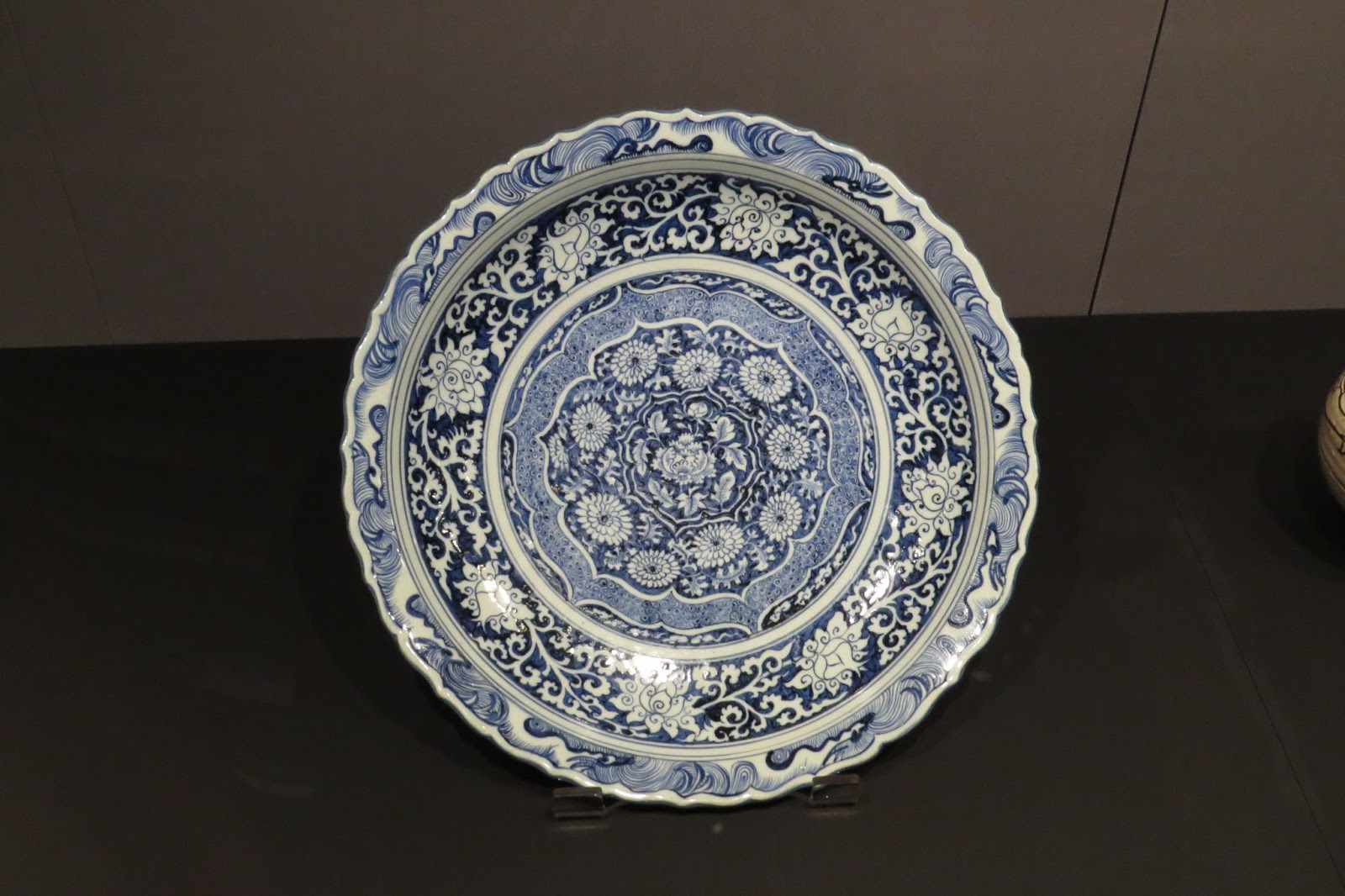
I tend to think of blue and white porcelain as Delftware, but this is a Chinese plate, and the cobalt blue used was imported from the Middle East, possibly Iran, so apparently the Chinese call it Muslim Blue. Which makes sense when you think of all the old mosques decorated so beautifully with blue and white tiles. 


Chinese blue and white dish
1330-1350 CE
Jingdezhen, Jiangxi provence, China
I really liked DĂ¼rer's Rhinoceros too- beautifully done, and all the more amazing because naturally he'd never seen a Rhinoceros in 16th century Germany. There was a very cool hologram Rhinoceros nearby. 


Albrecht DĂ¼rer's Rhinoceros
1515 CE
Nuremberg, Germany

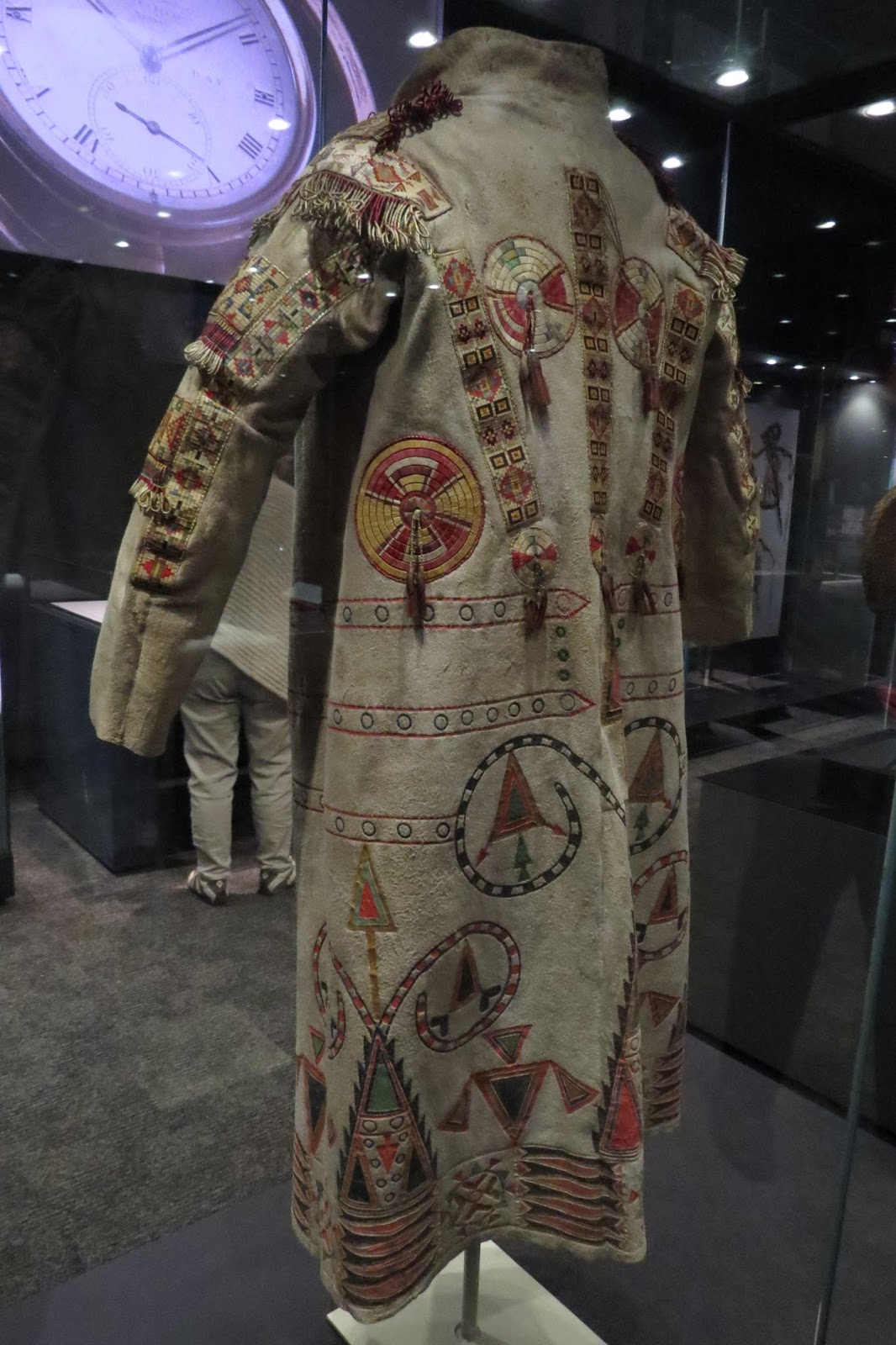
North American Frock Coat
1800-1900 CE
Canada
Painted moose skin, porcupine quills and otter hair


War Shields
1990-2000 CE
Wahgi Valley, Papua New Guinea
Painted wood, metal, rubber, fibre

Outside the exhibition is a wonderful tactile table where you can touch replicas of some objects. There were also Braille descriptions of the objects next to the English. 


We nearly missed this, make sure to search it out. 


National Museum of Australia
Canberra
$20 adults/ $15 concession / $8 child / $45 family / $60 season pass
September 9 2016 until January 29 2017

Saturday Snapshot is a wonderful weekly meme
 now hosted by 
WestMetroMommy


Thursday, 3 November 2016

Top Ten Books To Read If Your Book Club Likes MG

This week I came across this most excellent list and thought it worthy of a Listmania post. It's a Top Ten Tuesday post from YAYeahYeah.

Five Children on the Western Front - Kate Saunders

Jane, the Fox & Me - Fanny Britt, Isabelle Arsenault (illustrator)


Murder Most Unladylike series - Robin Stevens

The Lie Tree - Frances Hardinge, Chris Riddell (illustrator)

The Riverman - Aaron Starmer

The Scandalous Sisterhood of Prickwillow Place - Julie Berry

The Summer of Telling Tales - Laura Summers

The Wickford Doom - Chris Priestley, Vladimir Stankovic (illustrator)

The Wolf Wilder - Katharine Rundell, Gelrev Ongbico (illustrator)

Twerp - Mark Goldblatt


No, I haven't read any of these books, although have had my eye on some of them for a while - The Lie Tree, The Wolf Wilder (although I really want to read her Rooftoppers more) and Jane, the Fox & Me in particular. I'm particularly taken with the idea of Twerp which I've never heard of before. My library doesn't have any of these books, well apart from Five Children on the Western Front, which I already own. Hello, Fishpond...