Wednesday, 12 October 2011

All Sorts of Stupidity 4

As I was researching a bit to write my post on The Slap, I came across a news article that just left me astonished.

Radio National is a branch of our Australian national public broadcaster The ABC. I moved on from JJJ to Radio National quite a few years ago. JJJ is the youth broadcaster, and I listened to it longer than most I think. But it comes a time when you want more thought, more content and less indie rock. So you start listening to Radio National. And it's great!

So many fabulous programs. Radio National can make stuff that you're not really interested in, interesting. You can download most of it from their very good websites, and listen to it whenever it's convenient.  One of my great favourites is of course The Bookshow. Ramona Koval is fabulous. They explore a wide range of books and literature, big sellers and little known. You always learn something. Recently I listened to a story on the literary life of Jacqueline Kennedy Onassis while I was cooking one Saturday afternoon. I'd had no idea that she'd worked as a book editor. I'd had no idea that she'd worked actually. It was unexpectedly fascinating.

And now I find out that The Bookshow is under threat! RN are apparently planning to turn The Bookshow into an hour long books and arts show (up from the current 45 minutes), and claiming that this will increase the coverage of books! The Age has taken up the story. And The Australian. I haven't come across anything in The Herald as yet, which I presume is why I didn't know about this.

Thankfully Christos Tsiolkas has come out swinging. And I will too. Earlier this year I became old enough to write my first letter to the ABC. My second letter, well alright email, is under construction.  I hope yours is too. As the news reports have said of The Bookshow- everyone loves it just the way it is, and if it ain't broke- don't fix it!

Random photo of tulips in Launceston last month

Sunday, 9 October 2011

The Slap


It's been quite a while since I read an adult book, and it's been a refreshing change. Even though this is quite an adult book. This was THE book of 2009. As perhaps the last person in Australia to read it, I finally succumbed to the pressure in the week leading up to the airing of the miniseries on TV. I naturally, wanted to watch it, but had to read the book first. Of course I'd left it so long that I was then forced to buy the TV tie-in copy instead of the proper cover. I hate that. I want to imagine the characters as I see them, not the actors playing it out on screen. And then I didn't finish in time to watch the first episode before I'd finished reading. Another quandry. In the end I decided to plow on and finish the book before I started with the mini-series. Interestingly this edition has three pages of "Praise for The Slap" at the front, and an extra two pages at the back. I don't know that it needs that for readership, but there it is.


This book literally was everywhere in 2009. It won the Commonwealth Writers Prize, and the Vance Palmer Prize for Fiction in the Victorian Premier's Literary Awards. It was shortlisted for the Miles Franklin (beaten by Tim Winton's Breath), and longlisted for the IMPAC Dublin Literary Award. They talked about it on the First Tuesday Book Club. On the Bookshow on Radio National (where the reviewer wonders if Tsiolkas has mellowed as The Slap isn't nearly as raw and confrontational as his previous works! WOW. They must be something. This is a great 5 minute audio review actually). And it was lauded and discussed in just about every paper, magazine and on every scrap of paper. 

Still, even though it's been so talked about I wasn't quite sure what to expect. Yes, everyone knows by now I'm sure that it involves a child who is slapped by a man, not his father, at a backyard barbeque in suburban Melbourne during the later years of John Howard's Australia. It is however, much more than that. The actual slap is quite near the beginning of the book, and the book is more about the year following the slap. The events the slap unleashes and the strains it puts on the rather complex relationships between the characters. Cleverly told in 8 sections, each narrated by a different character who was present at the barbeque and involved in the narrative in various ways. 

There are of course many more than 8 characters, and initially I found the first chapter a bit confusing. Who was related to who, where everyone fitted in. Much like when the hordes descend at a real barbie I guess. This soon sorted itself out. Perhaps the most shocking thing is the insight into each character's head. As many have said, the vast majority of the characters are flawed, and well, particularly obnoxious and rather awful. I felt very uncomfortable being inside their thoughts. They are vulgar and profane on many levels. Is this really what it's like in other people's heads? I hope not, because it's very, very awful. 

Tsiolkas does broach many subjects as well as the debate about whether anyone has the right to slap an obnoxious, awful child. He takes on private vs public schooling, Australian drinking culture, marriage, fidelity, the mores of the modern world, the role of the media. He even taught me a slang racial epithet that I didn't know that was used to depict Australians! (Skip). There is tenderness. I found Manolis' section particularly moving. And humour too.

Connie looked alarmed at that option. "I don't know anything about hats."


"It's the sad decline of civilisation. What can I say? It's okay. I don't wear them either now that I'm a hippie."
One passage that really stood out for me was when the court case is held. She here is Rosie, the mother of the child who is slapped.


When they finally entered the courtroom she  had to stifle her disappointment at how unimpressive it was. A lone Australian coat of arms sat above the judge's seat and already a stain of weak, lemon coloured damp was rising in a corner of the room. They took seats near the front and waited for the case to be heard. 


The pettiness of people's lives, the mundane sadness of what people did, mostly for money, sometimes for love or out of boredom, but mostly for the desperate need for money, is what Rosie took away from that day. Young men- just boys really, but already with long, tedious prior convictions read out by equally young, bored coppers in hesitant monotonous tones- faced the dock for stealing toys, stealing radios, stealing iPods, stealing televisions, stealing handbags, stealing work tools, stealing food, stealing liquor. There were young mothers ripping off the dole, young girls shoplifting trinkets and mascara and DVDs and CDs and Barbie dolls for their kids. 

I'm glad that I finally read got around to reading The Slap. It's very uncomfortable reading for much of it, but does have a lot to say about how we live now (which I have just realised is Helen Garner's blurb on the front cover). I hadn't read any of Tsiolkas's work before, and perhaps this was a good place to start. . I'll be interested to read more of it. And  now I have television series to look forward to. If I could get near a screen this weekend, what with Dr Who finales then a Series 6 marathon, car racing and endless games of World Cup Rugby, then I could watch the first episode. 

Saturday, 8 October 2011

Houston Topiary

I was very lucky and had a recent trip to Texas. A garden centre in Houston has a fabulous array of topiary creatures in the centre of the road outside the centre. I just loved them. 


Saturday Snapshot, is a wonderful weekly meme from at home with books.

Tuesday, 4 October 2011

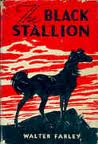
The Black Stallion


First let me say how much I hate the cover of my copy. It's too much like an airbrushed velvet painting for my tastes. Sadly it was illustration free too. I wish I was able to read an earlier edition that presumably had the illustrations. Even if it is a tad dated, it has olde shoppe charm. And now I find a reprint of the 1941 edition is still available. Damnation. 


A famous book, and deservedly so. Walter Farley began writing The Black Stallion when he himself was still in high school. It was published when he was a 26 year old college student, and he had an instant hit on his hands. It has remained popular, and is still in print 70 years later! Farley went on to write 34 books in total, including 21 Black Stallion titles.

The Black Stallion begins in India. An American school boy, Alec Ramsay, has just spent the summer in India with his missionary uncle. He travelled out with friends of his father, but is making his journey home alone. It's never specified just how old Alec is, but I think it's remarkable that the school boy is allowed to travel alone by ship for the better part of a month. Can you imagine parents letting their children do that these days? Not likely. We hover over them too much, worrying over the least detail of their lives. No helicopter parenting for young Alec. 

Every chapter is fairly short, 10-12 pages, and punchy. Something big happens in every chapter, just to keep the pages turning. The cover proclaims "Shipwrecked with a wild stallion!", but the shipwreck action is all over in the first 4 chapters! The major part of the story is the friendship, love and bond between Alec and the Black. (This is probably really stupid as an objection but I really didn't like it that the horse was simply referred to as "the Black". I found it weird that Alec never really named him.)

Still it's a rollicking tale, and quite the page turner. I really enjoyed it, even though my horsey phase is long over. It feels wholesome just reading it. 


Kid Konnection is a weekly childrens book feature at Booking Mama

Saturday, 1 October 2011

Birds in the Botanic Gardens

Last week you saw the lovely flowers that caught my eye on a recent walk in my local Botanic Gardens-and which were much easier to photograph than these birds. Bird photography is HARD! Still it's fun to try and exciting when I accidentally get something in focus.

Eastern Spinebill- Acanthorhynchus tenuirostris


Yellow-faced Honeyeater- Lichenostomus chrysops


Eastern Rosella- Platycercus eximius


Juvenile Crimson Rosella- Platycercus elegans elegans


Eastern Rosella- Platycercus eximius


Eastern Rosella- Platycercus eximius
I kept a careful eye out for the Magpies, thankfully none were swooping this day

Australian Magpie- Gymnorhina tibicen

Red-browed Finch- Neochmia temporalis

Sometimes you just need to keep an eye out for the quieter types

Pacific Black Duck- Anas superciliosa


This pair were busy renovating a nest in this sawn off branch
Galah- Cacatua roseicapilla

Another pair busy preening

Galah- Cacatua roseicapilla


Saturday Snapshot, is a wonderful weekly meme from at home with books.

Thursday, 29 September 2011

Rain May and Captain Daniel


I wish I'd found this book another way. I'd never heard of Rain May and Captain Daniel until last week when I was blogging and thinking about The Slightly True Story of Cedar B. Hartley. A book that I loved.  I came to realise that Cedar B. Hartley was only shortlisted for the 2003 Younger Readers Book of the Year Children's Book Council of Australia Awards. Shortlisted. It didn't win. That meant that the judges thought another book was better than the delightful Cedar! Rain May and Captain Daniel was that book. Winner of the Younger Readers Book of the Year 2003. But I'd never heard of it. Or the author. Why not? I don't know.

Rain May and Captain Daniel is a fine book. An excellent book even. But the whole time I read it, I was wondering, why, why did this beat Cedar? That's an unfair way to approach a book I suspect. Still if I'd been a judge of the CBCA Awards in 2003 would I have voted for Rain May or Cedar to win? I don't know. Thankfully, noone has ever asked me to be a judge.

Catherine Bateson is a rather prolific and lauded Australian author. Turns out she has won the Book of the Year Younger Reader, not once, but twice in the past 9 years, and made the short list many other times! That's pretty good going. It seems she rose to prominence in the poetry world and has written several verse novels. This in part explains my lack of knowledge- I really am a complete nincompoop as regards poetry.

Rain May is the story of a girl called Rain. Her parents have recently separated and she is forced to move with her mother from their inner city Melbourne life to a small town in the country. They move into her grandmothers old house, which has been rented out since Rain's grandmother died 4 years earlier. Twelve year old Rain is less than thrilled by the move, and by her parents separation. She meets and befriends Captain Daniel, the boy who lives next door to Granny's, who is just a tad obsessed with Star Trek.

The book is told in the alternate voices of Rain May and Captain Daniel. I've always enjoyed multiple narrators, and this book does it really well. Rain writes in a simple narrative style. Captain Daniel writes The Captains Log. Stardate included. It's very funny. I suspect Catherine Bateson, or her kids, has watched a bit of Star Trek.

Her name's Rain, not after the astronomer in Future's End, Star Trek, Voyager, Season 3, but after a poem. She's heavily into poetry. She writes fridge poetry. I don't know anyone who writes poetry. They tried to make us do it at school but the Klingons wrote obscene limericks instead. 
Captain Daniel is a bit of a dweeb. He's very bright, and into chess and Star Trek. Not terribly popular pursuits in small town rural Australia. Daniel is a lonely kid, and picked on at school. Rain likes him though, and they go exploring the local area, trying to find platypus in the river.

Rain is indeed named after an e e cummings poem, and she and her mother do write fridge poetry to each other with one of those packs of fridge magnets with words. She makes the pithy and oh so true comments common of the serious book for younger readers.

It beats me why kids who are liked by adults are always the ones not liked at school. 

I think Rain May and Captain Daniel, is perhaps a more earnest book than Cedar B. Hartley. Maybe that's why it won. They're both very good, and both deal with big topics. Both girls have absent fathers- Cedar's has died, Rain's has left and is living with his new girlfriend.  Cedar possiby has a lighter touch, although both are full of memorable characters and they have introduced me to two amazing new Aussie authors. Now I want to read more of Catherine Bateson, and yes my TBR just got even bigger....

Wednesday, 28 September 2011

Wondrous Words Wednesday 28/9/11


Wondrous Words Wednesday is a fabulous weekly meme hosted by Bermuda Onion, where we share new (to us) words that we’ve encountered in our weekly reading.  


My first word today comes from an article in the SMH on an author I wasn't familiar with, Helen Hodgman.

Anomie (noun)

The story of Blue Skies, about a young mother in a state of anomie, has echoes of Hodgman's own experience.

1. Social instability caused by erosion of standards and values.
2. Alienation and purposelessness experienced by a person or a class as a result of a lack of standards, values or ideals. The Free Dictionary.


This next one is from a blog post on Charlotte's Library, a review of Come Back, Lucy.

Spillikins (noun)

Lucy has lived a very quiet childhood brought up by her extremely old-fashioned aunt--playing spillikins and croquet, educated at home, and generally out-of-step with modern (1970s) children.

The game of jackstraws. The Free Dictionary.


Well that doesn't help, I haven't heard of jackstraws either. 


The thesaurus part of the Free Dictionary helps. A game in which players try to pick each jackstraw (or spillikin) off a pile without moving any of the others.

Ah, what I would have called Pick Up Sticks. I think spillikins is a better name.

My final words today comes from Walter Farley's 1941 classic The Black Stallion.

Huckster (Noun)

Alec helped to harness old Napoleon to the little huckster's wagon.

The Free Dictionary has three definitions
1.One who sells wares or provisions in the street; a peddler or hawker.
2.One who uses aggressive, showy, and sometimes devious methods to promote or sell a product.
3.Informal. One who writes advertising copy, especially for radio or television.

Clearly Walter Farley was using the first meaning.

Tony's wagon might have looked like this
Hobbyhorse (Noun)

Made the track record look like it was made by a hobbyhorse.

Again 3 definitions from The Free Dictionary
1. A child's riding toy that consists of a long stick with an imitation horse's head on one end.
2. A figure of a horse worn attached to the waist of a mummer, as in a morris dance.
3. A topic that one frequently brings up or dwells on; a fixation.


Ah, if I'd ever known that these were called hobbyhorses then I'd forgotten that! Of course these days I'm much more familiar with the "getting on one's hobbyhorse" usage.