Monday, 2 December 2013

Hector and the Search for Happiness


Hector and the Search for Happiness is an English translation of a French book, Le Voyage d'Hector ou la recherché du bonheur. Hector was originally published in France in 2002, and it took 8 years for the English translation to become available. Which is a great shame.

I had seen Hector  around the bookblogs a bit a while back, but I didn't know anything much more about it rather than the title, the covers were cute, and I hadn't heard of the author before. At some stage I learnt that it was French. And then I started seeing Sim get excited about the upcoming movie version over at Chapter1-Take1. I knew I would have to read it someday. And then one day my library had a copy, and I was about to go to a conference in Adelaide, and so had lots of time to fill in- sitting on planes, and in hotel rooms. Not that this slim volume (even in the large print format from my library) takes all that long to read.

I fell in love with Hector very early on. How could I not? Hector is a psychiatrist living and working in what I assume is Paris:

Hector's practice was in a city full of wide avenues lined with attractive old buildings.

Hector is a good psychiatrist, but he  is becoming increasingly dissatisfied with his work, as he can't make his patients happy. He can make the sick ones well, or at least manage their illnesses if he can't cure them, but he can't cure those with first world problems.
Basically , all of these well-dressed people said that they didn't like their lives, they questioned their choice of profession, they wondered whether they were married or nearly married to the right person, they had the impression that they were missing out on something important in life, that time was passing and they couldn't be everything that they wanted to be. 

The unhappy people are taking their toll on Hector. They're unhappy for no apparent reason. Hector gets more and more tired and unhappy himself.

He began to wonder whether he was in the right profession, whether he was happy with his life, whether he wasn't missing out on something. 

So he does what we all do when we need a break, and goes on holiday. Hector heads off on a bit of an around the world adventure to visit some far flung friends, but it's a busman's holiday- he's aiming to understand what makes people happy or unhappy. I love it that he decides to go to China mainly because of a character in Tin Tin's The Blue Lotus (see my review). The French are obsessed with Tin Tin, and have many, many windows devoted to him, I'll have to show you some sometime. Anyway, that tickled me.

Somewhat annoyingly every other destination is vague. In China, it seems that he goes to Hong Kong. Later he goes to a former French colony in Africa, where the people are poor, but the beer is good. Later he goes to the country of More, rather obviously America.

They were both going to the big country where there were more psychiatrists than anywhere else in the world. Notice that we say 'more psychiatrists than anywhere else in the world' but we could just as well say more swimming pools, more Nobel prizewinners, more strategic bombers, more apple pies, more computers, more natural parks, more libraries, more cheerleaders, more newspapers, more racoons, more of many more things, because it was the country of More, and had been for a long time.

I suspect Lelord's lack of specificity is to make it universal and global, but why not name names and give us actual settings when you actually mean them? Some are rather clear anyway, and I'm sure if I knew more about which former French colonies in Africa had had embargoes and yet still made good beer, then I'd be able to guess that one too. But why make me guess?

Hector makes some astute and oh so funny observations about our modern world, like when he gets upgraded to business class on a flight:

That part of the plane is called business class, just to make it seem as if the people sitting there are travelling on business and not for the pleasure of having a nice comfortable seat, champagne and their own private TV screen. 

My love affair with Hector stalled a bit when he got to the country of More. I'm not sure why. He still made insights and jokes. The style is odd from the get go- overly simplified. And I know lots of readers haven't warmed to that. Or the self-help novel vibe, a Sophie's World for the new millennium? I'm not sure if that's unfair or not.

It's fascinating to learn that Francois Lelord is himself a French psychiatrist, although he has been working in Vietnam and Thailand for some time. In this interview he somewhat mockingly says that a philosophical story written in a naive style is a French tradition- now that makes me feel better. Perhaps it is true? I haven't read Voltaire or Montesquieu, I haven't even heard of Montesquieu, but I have read Saint-Exupery's The Little Prince (another French obsession, possibly bigger than Tin Tin?), and it could well be.

Still I liked it all well enough that I will search out the second and third Hector books now available in English, Hector and the Secrets of Love and Hector and the Search for Lost Time- lets hope that one is about Proust, I'm not sure that it is, but that would make me happy. And I'll have to get to reading The Blue Lotus. Read 1 book, then need to read 3 more. It's the story of my life. And there's a movie to see- although paying more attention now, and they've made Hector English, which is rather dispiriting.


Books on France, a great 2013 challenge
 from Emma at 
Words and Peace

Dreaming of France is a wonderful Monday meme
from Paulita at An Accidental Blog

Saturday, 30 November 2013

The Corner Shop

We hired a great apartment for our Parisian holiday in June. It was on rue de Sevres in the 6th, and very handy to so many wonderful places. The rather magnificent food hall, La Grande Epicerie was our local corner shop! While any trip to a Parisian supermarche is wonderful, La Grande Epicerie is like a supermarche on steroids.

And we took full advantage of it. We sampled many delights. They were in the midst of a major renovation in June/July and so the shop would often look quite different every time we went. Whole departments would move on the weekend. So it was the thrill of the new every Monday.

But there were always walls of chocolate
sadly we were generally too busy eating pastries to eat chocolate

Gorgeous produce, much of it reasonably priced
But beware the exotic.
Pay attention when the lady weighs the dragon fruit that Master Wicker must have.
Otherwise you get it home and realise it was over 8 euros.
Then you nearly die of shock. 
Best. Tomatoes. Ever.
Eaten on a picnic by the Seine, in the gorgeous summer Paris evening light.

Tim Tams!
But no we didn't buy any.
No time for Tim Tams in Paris. 

We did buy many baguettes de tradition though.

We didn't have time to try their macarons

They  do have an amazing patisserie section
We had a celebration tart one night, it was most delicious. 

We often stocked up for dinner

Our foraged dinners often came out of here

There were three foie gras fridges! Three.

A whole walk in room of dairy

We never did get to trying the horse milk

But we certainly did try the butter. It was glorious. 

Walls of delicious French yoghurt. 
There is a fabulous wine store downstairs. Quite reasonably priced. Actually great value. 


So many bubbles!

So much deliciousness.

Saturday Snapshot is a wonderful weekly meme now hosted by WestMetroMommy


This post is linked to Weekend Cooking, 
a fabulous weekly meme at Beth Fish Reads

Dreaming of France is a wonderful Monday meme
from Paulita at An Accidental Blog

Thursday, 28 November 2013

The Crowstarver


I've read the occasional Dick King-Smith title in the past, but had never heard of this one before it came up on my 1001 reading schedule. Dick King-Smith despite not successfully publishing a book until he was in his 50s, managed to publish over 100 books after that. He is most famous of course for his story of a pig who thinks it's really a dog, best known as Babe- from the movie title, although the book has the somewhat more clunky name of The Sheep-Pig. I find a lot of his book titles a bit clunky actually, The Crowstarver among them I guess. Perhaps it's because you think it should be scarecrow, but it isn't.

The Crowstarver is a sweet, endearing book as it turns out, despite the title. A rather odd story really. A newborn baby is left as a foundling on a remote Wiltshire farm in 1926. The baby boy is taken in by the amiable, poor shepherd and his wife, Tom and Kathie Sparrow, who are sadly childless. They soon realise that their new son has delayed milestones. He is slow to talk, and slow to walk. Indeed he adopts his own style of locomotion so peculiar that he known as Spider Sparrow from then on. (The book is published in America as Spider Sparrow).

Spider has his own skills though. He can mimic animal noises perfectly, and has a great rapport with both farm and wild animals. Spider grows up in a loving home, but it is a quiet existence. His parents try to enrol him at school when he's old enough, but in what was probably quite typical for the time, he was refused school enrolment as the headmaster didn't know how to deal with his particular circumstances.

The first half of the book is really quite slow, not unpleasant at all, but it's hard to say that anything much actually happens. Soon enough though World War II makes it's presence felt even in rural Wiltshire- the young men go off to war, and Spider is given work to do on the farm. This is when he becomes a crowstarver.

Crowstarving's about all he'll be fit for by the look of him, walking up and down banging a sheet of tin with a stick to keep the birds off new-sown corn.

The action picks up after the war starts, and there are some rather moving events, with the cycle of life and death on the farm, and the war. After a German plane is shot down on the farm, several of the farm men race to the scene of the crash, out for revenge and blood.

Percy Pound stared into those blue eyes, and all of a sudden as he did so, he experienced a dramatic change of mood. He found himself forgetting his anger and his hatred for any member of the race that had killed his son, and instead he felt a stab of pity and an enormous sorrow for the madness of mankind.
He lowered the pitchfork.
Oh dear God, he thought, he looks so much like our Henry. 

I have a few more King-Smiths to read before I'm grown up, and many more that I could read of course, I'll be looking forward to them.

222/1001

Wednesday, 27 November 2013

Australian Children's Laureate 2014-2015 Jackie French


I'm so excited. One of my very favourite authors, Jackie French has been named the Australian Children's Laureate for 2014-2015! That is such fantastic news. Jackie French is a deadset legend. She has written everything- nonfiction, fiction, books for toddlers,young kids, teenagers and adults.

Jackie with her Magpie award
Picture source
Jackie will take over from the inaugural laureates Boori Monty Pryor and Alison Lester in January 2014. The theme for Jackie's Laureateship will be Share a Story. You can listen to an interview with Jackie here. 


"I'd like every child in Australia to have a book to go to bed with, and a bed to read that book in."

"I would like every child in Australia to learn to read."

"Every child can learn to read."

"They are more important than submarines, winning medals at the Olympics, expensive ice-cream. If we have got money for that, we have money for every child in Australia to read."

Jackie also wants children to have access to teacher librarians and children's librarians to guide them to the books they need.

"Reading is more important than almost anything else in our society."

"When you read a story you can taste the ice-cream, when you watch a DVD you can only see the ice-cream."

"Never ever ever underestimate the power of a story."

She's so passionate, so well suited to take up this position.

It's an honour that's so well deserved.

I saw Jackie speak at the Melbourne Writers Festival last year. She was fantastic.

I've read a few of her books, you can see reviews of two of my favourites- Nanberry, and Flood.

Last year when I saw Jackie in Melbourne she was the author of 130+ books, this year they are saying 140+ books. I feel more than justified in my musings that she may well write faster than I can read. I shall have to read more and more of her books over the next two years. I can't wait to see what she achieves with this position.

Monday, 25 November 2013

The Little Paris Kitchen


Picture source

Australia has been a bit slow to jump on the Rachel Khoo bandwagon. Rachel is English of Malaysian/Austrian background, she moved to Paris a few years ago, and has turned a three month patisserie course at Le Cordon Blue into a media food career. Initially Rachel ran a two seat restaurant in her tiny Belleville flat, with two gas burners and a minuscule oven. She published two books in French, and then hit the big time with a BBC series, The Little Paris Kitchen, and a book to accompany the series.

The TV series ran here in June and July this year, so I was able to watch a few episodes before heading to Paris myself. Recently I watched the rest of the series. It's readily consumable fare for a Paris tragic like me. Lots of gratuitous shots of Paris in all her beauty to make you swoon.

We do learn lots of valuable things too. Paris has 1100 patisseries. No wonder I feel that I will never get through them all! Population density in Paris is four times that of London- so no wonder it can feel crowded at times.

Rachel has a buxom 50s housewife vibe, often wearing knotted cardigans and big full skirts. I do love the way she wears red lipstick, and am totally envious of one so young having such skills. I must learn to wear red lipstick. Like many chefs and cooks before her Rachel aims to take the fear out of French cooking, showing us her take on French classics.

Rachel of course celebrates the delicious, amazing ingredients and produce available in Paris. She always uses the full fat versions. During her eggs en cocotte Rachel advises us that we could do a low fat version, but she then looks disdainfully at us, and reminds us that this would be on our own conscience. None of it is rarefied French cooking though. Rachel has a passion for French food, cooked simply, like Parisians do at home. I love the occasional slip of camera angle that lets us see she is cooking in her socks, that she uses frozen peas like all home cooks, and has Heinz ketchup in her fridge!


A number of the recipes looked really good, and easy enough for those of us who tragically don't live in Paris to make. Her Ile flotant looks particularly amazing. I've longed for ile flotant for a long time. I had it once in Paris, but at a cheapish restaurant and it wasn't all that great. It wasn't terrible mind you, but not the transcendent experience that I'd hoped for. I'd love to give Rachel's recipe a go one day.

Dreaming of France is a wonderful Monday meme
from Paulita at An Accidental Blog

Saturday, 23 November 2013

Anne Frank Huis

It's hard to call a visit to Anne Frank Huis a highlight, but it certainly was one of the very memorable stops on our trip to Amsterdam in June this year.

There's always a long line. It's a bit slow moving.
But it's totally worth it.
You can buy tickets on line but we weren't sure that we would be able to squeeze  in a visit,
also it's really hard to access  a printer while you're travelling,
although you can also use a smartphone or tablet.
It's  astonishing to walk through the secret door that kept Anne hidden for all that time during the war. To climb the same narrow stairs that she did, and stand in the small rooms that held her life, where she did her lessons, read her books, listened to the radio, ate her meals, and where she wrote her diary (see my thoughts about her diary). If you can't make it to Amsterdam sometime soon you can take a pretty cool online tour. 


There is a moving exhibit at the end of the rooms. Sadly no photos were allowed inside. 

Anne Frank Huis has kept up with the times,
with an iPhone app.

 I haven't and don't really know what to do with these things,
or how they could add to my experience.
I must learn. 

Perhaps the 50th anniversary of Dr Who is weighing heavily on my mind (it's this weekend and the Wicker boys are Very Excited about it), but doesn't the little logo in the corner look ever so slightly like a tardis? If only The Doctor had been able to visit Anne. 

A statue of Anne nearby. 
Saturday Snapshot is a wonderful weekly meme now hosted by WestMetroMommy

Friday, 22 November 2013

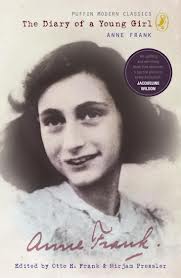
The Diary of a Young Girl


I'd been meaning to read Anne Frank's diary for many years. It was clearly a rather large omission to have not read it before this. But there was nothing like an upcoming trip to Amsterdam for the first time to get me there finally.

I started off reading this book out loud to Master Wicker as our night time reading. He didn't enjoy it from the outset (not nearly enough dystopian fantasy world for him, and no aliens, all major drawbacks), and it was hard going as a read aloud book. Which in turn made the reading drag. I did enjoy it much more after I gave up on the read aloud aspect (we switched to The Hunger Games which had a much more favourable reception) and just read it for myself.

Anne Frank and her diary are justifiably very famous. Anne and her family spent two years in hiding, living in cramped, crowded conditions in a factory annexe in Amsterdam during World War II. Of course Anne famously didn't survive the war, so the end is no mystery, but it's such an important story to tell.

I feel dreadful that I didn't love this rather beloved book. Even more because I didn't really like Anne's voice. I didn't like Anne all that much actually, which makes it difficult to read her first person narrative. I was interested in her plight of course, in everything she had to say, her descriptions of her experience of the war, and her living conditions and her moods. I feel my lack of enjoyment was more a failing on my part than hers.

It was shocking to read the limitations of freedom begin.

After May 1940 the good times were few and far between: first there was the war, then the capitulation and then the arrival of the Germans, which is when the troubled started for the Jews. Our freedom was severely restricted by a series of anti-Jewish decrees: Jews were required to wear a yellow star; Jews were required to turn in their bicycles; Jews were forbidden to sue trams; Jews were forbidden to ride in cars, even their own: Jews were required to do their shopping between 3.00 and 5.00 pm; Jews were required to frequent only Jewish-owned barbershops and beauty salons; Jews were forbidden to be out on the streets between 8.00pm and 6.00am; Jews were forbidden to go to theatres, cinemas or any other forms of entertainment; Jews were forbidden to use swimming pools, tennis courts, hockey fields or any other athletic fields; Jews were forbidden to go rowing; Jews were forbidden to take part in any athletic activity in public; Jews were forbidden to sit in their gardens or those of their friends after 8.00pm; Jews were forbidden to visit Christians in their homes; Jews were required to attend Jewish schools, etc. You couldn't do this and you couldn't do that, but life went on. 

I was really surprised to read Anne writing quite knowledgeably about what would later be called the Holocaust in August 1942.

If it's that bad in Holland, what must it be like in those faraway and uncivilised places where the Germans are sending them? We assume that most of them are being murdered. The English radio says they're being gassed. Perhaps that's the quickest way to die. 

I hadn't known that these things were actually known during the war. I'd thought that it was only after the war that people found out what had been happening. It was terrible reading Anne's descriptions of the privations of the family's time in hiding. The radio was constantly on as the families listen desperately for news and updates. The boredom, the fears of disease, of discovery, of destruction from falling bombs, and the terrible, rotting food.

It was heartbreaking to see Anne's moods over time, as she was robbed of her liberty, and her youth, and eventually of course her life.

I wander from room to room, climb up and down the stairs and feel like a songbird whose wings have been ripped off and who keeps hurling herself against the bars of its dark cage. 

And yet somehow Anne remains optimistic til the end.

It's utterly impossible for me to build my life on a foundation of chaos, suffering and death. I see the world being slowly transformed into a wilderness, I hear the approaching thunder that, one day, will destroy us too, I feel the suffering of millions. And yet, when I look up at the sky, I somehow feel that everything will change for the better, that this cruelty too will end, that peace and tranquility will return once more.

Anne wanted to be a writer and journalist and she's done that.

I don't want to have lived in vain like most people. I want to be useful or bring enjoyment to all people, even those I've never met. I want to go on living even after my death!

Anne is still living after her death. Her thoughts and words are still alive in the 21st century. And still worth reading.

See some photos from my visit to Anne Frank Huis.